
Have you ever dreamed about a lion, snake, dog, bird, or another animal and wondered whether God was trying to tell you something? Dreams about animals can feel powerful, especially when they involve fear, peace, danger, or a sense of wonder.
The Bible contains many dreams and visions involving animals. Some reveal important truths, while others use animals as symbols in stories, prophecies, and teachings. However, Scripture does not provide a fixed meaning for every animal that appears in a dream.
For Christians, the best approach is to examine biblical teaching, consider the dream carefully, and seek God’s wisdom without jumping to conclusions.
This guide explores the biblical meaning of dreams about animals, common animal symbols, important Bible passages, and practical ways to respond with faith and discernment.
What Do Dreams About Animals Mean Biblically?

Dreams about animals may reflect emotions, personal experiences, spiritual questions, or themes found in biblical imagery. In Scripture, God sometimes communicates through dreams, but the Bible does not teach that every dream carries a divine message. Christians should test their interpretations against Scripture, pray for wisdom, and avoid treating symbols as certain predictions.
An animal in a dream may remind you of a quality such as courage, gentleness, danger, freedom, or dependence on God. Its meaning can also depend on what happened in the dream and how you felt.
For example, a lion might remind one Christian of courage and Christ’s victory, while another might associate it with danger because the Bible also describes a roaring lion as a threat.
The animal alone does not settle the meaning.
Key Takeaways
- The Bible records dreams and visions involving animals.
- Animal symbols can have different meanings in different biblical passages.
- Not every dream is a message from God.
- Personal feelings and experiences may influence dreams.
- Prayer, Scripture, wisdom, and sound judgment are better guides than fear or superstition.
- Christians should not make major life decisions based only on a dream.
Does God Speak Through Dreams About Animals?
The Bible shows that God has sometimes used dreams to communicate with people. Yet it does not promise that every dream is supernatural or that every animal symbol carries a hidden message.
In the Old Testament, God says in Numbers 12:6 that He may make Himself known to a prophet through a vision or speak to that person in a dream. This establishes that dreams can be part of biblical revelation.
Job 33:14–18 also describes God speaking in ways people may not recognize, including dreams and visions during sleep. The passage connects this with warning people and turning them away from harmful paths.
However, these passages do not give Christians permission to label every unusual dream as a prophecy.
Consider three possibilities:
- An ordinary dream: Your mind may draw on recent events, memories, worries, or familiar images.
- A dream with personal significance: The experience may prompt reflection on your fears, relationships, choices, or spiritual life.
- A dream you believe may have spiritual significance: You can pray about it, examine it in light of Scripture, and seek wise Christian counsel without assuming its origin is certain.
The important question is not simply, “What does this animal mean?” It is also, “What can I learn from this experience without going beyond what Scripture teaches?”
What Does the Bible Say About Animals in Dreams?
Animals appear throughout the Bible in creation accounts, laws, poetry, parables, dreams, and prophetic visions. Their significance depends on the passage.
For example, Genesis 41 describes Pharaoh’s dreams of healthy and thin cows, followed by full and thin heads of grain. Joseph explains that these images point to seven years of abundance followed by seven years of famine.
This is a clear example of a dream receiving an interpretation within a specific biblical story.
In Daniel 7, Daniel sees four great beasts emerging from the sea. The vision is explained in the chapter as a series of kingdoms. These beasts are part of a prophetic vision, not a universal guide to interpreting animals in everyday dreams.
In Acts 10:9–16, Peter sees a vision involving a large sheet containing different kinds of animals. The vision plays an important role in the story of the gospel reaching Gentiles. Its meaning becomes clearer through the events that follow, especially Peter’s encounter with Cornelius in Acts 10.
These accounts teach an important lesson: biblical animal imagery must be interpreted in context.
A cow in Pharaoh’s dream, a beast in Daniel’s vision, and an animal in a modern dream should not automatically receive the same interpretation.
Important Bible Passages About Dreams and Animals
| Bible passage | What happens | Main lesson |
|---|---|---|
| Genesis 1:24–25 | God creates land animals | Animals are part of God’s creation |
| Genesis 40:9–19 | Joseph interprets the cupbearer’s and baker’s dreams | Interpretations belong to their specific context |
| Genesis 41:1–32 | Pharaoh dreams of cows and grain | God gives Joseph the interpretation of this particular dream |
| Numbers 12:6 | God describes dreams as one way He may communicate | Dreams appear in biblical revelation |
| Job 33:14–18 | Elihu discusses dreams and warnings | The passage presents dreams as one possible means of warning |
| Daniel 7:1–8, 17 | Daniel sees beasts representing kingdoms | Prophetic animal imagery requires contextual interpretation |
| Acts 10:9–16, 28 | Peter sees a vision involving animals | The vision’s meaning unfolds through its biblical context |
| Matthew 10:16 | Jesus compares His followers to sheep and serpents | Animal imagery can teach wisdom and innocence |
These passages provide a biblical foundation for studying animal dreams, but they do not establish a universal dictionary in which every animal always means the same thing.
Biblical Meaning of Common Animals in Dreams
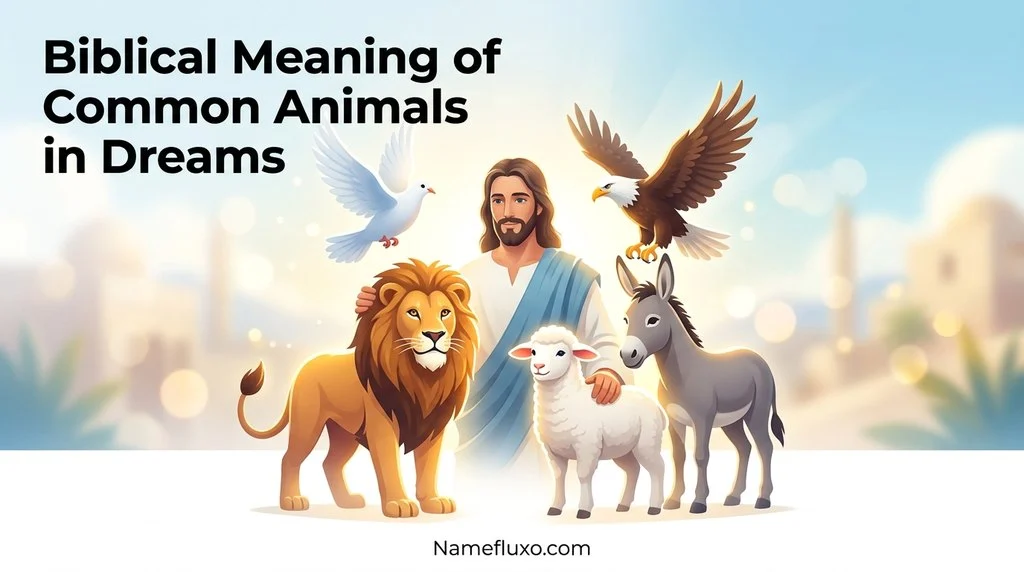
The following interpretations draw on animal imagery found in Scripture. They are possible points for Christian reflection, not guaranteed meanings or predictions.
A lion in a dream may bring thoughts of strength, courage, authority, danger, or protection. The Bible uses lion imagery in both positive and negative ways.
Revelation 5:5 calls Jesus the Lion of the tribe of Judah, connecting the image with His victory and messianic authority. By contrast, 1 Peter 5:8 compares the devil to a roaring lion seeking someone to devour.
These different uses matter.
- A calm lion may prompt reflection on courage or strength.
- A threatening lion may bring to mind fear, danger, or spiritual vigilance.
- A lion protecting others may suggest a theme of responsibility or protection.
None of these interpretations is automatic. Think about what the lion did, how you responded, and whether the dream connects with something happening in your life.
Christian reflection: Ask God to help you face challenges with courage, humility, and wisdom rather than fear.
2. Dreams About Snakes
Snakes have a strong biblical association with deception because of the serpent in Genesis 3. In that account, the serpent deceives Eve and challenges God’s command.
Revelation 12:9 also connects the ancient serpent with the devil. However, Matthew 10:16 uses a different aspect of snake imagery when Jesus tells His disciples to be wise as serpents and innocent as doves.
A snake dream may therefore prompt reflection on trust, temptation, caution, wisdom, or fear.
- A snake attacking you might reflect a feeling of vulnerability or conflict.
- A snake appearing quietly might make you think about a situation that needs careful judgment.
- A snake you are afraid to approach might reflect an unresolved worry.
These are possibilities for reflection, not proof that someone is deceiving you or that spiritual danger is present.
Christian reflection: Pray for wisdom and honesty. Do not accuse another person or make a serious decision simply because you dreamed about a snake.
3. Dreams About Dogs
The Bible mentions dogs in several contexts, and the imagery is not always the same.
In Matthew 15:21–28, Jesus uses the image of dogs in a conversation with a Canaanite woman, which must be understood within the cultural and narrative setting of that passage. In Philippians 3:2, Paul uses the word as a warning against harmful teachers.
Modern readers may also associate dogs with loyalty, companionship, protection, or fear. Those associations can come from personal experience rather than biblical symbolism.
A friendly dog in a dream may remind you of companionship or trust. A frightening dog may reflect anxiety, a difficult memory, or a sense of being threatened.
Christian reflection: Consider whether the dream brings up questions about trust, relationships, or the way you treat others. Do not assume it reveals the character or intentions of a particular person.
4. Dreams About Birds
Birds appear throughout Scripture as part of God’s creation and as images in Jesus’ teaching.
In Matthew 6:26, Jesus points to the birds of the air to teach His followers about God’s care and to challenge anxious concern about daily needs.
In Matthew 3:16, the Holy Spirit descends like a dove at Jesus’ baptism. The image of the dove also appears in Genesis 8:8–12, when Noah sends a dove from the ark.
A bird dream may invite reflection on freedom, provision, peace, hope, or a desire for relief from worry. These associations depend on the dream and the dreamer’s circumstances.
- A bird flying freely may remind you of freedom or hope.
- A bird searching for food may bring Matthew 6:26 to mind.
- A wounded bird may prompt reflection on vulnerability or compassion.
Christian reflection: If the dream leaves you anxious about your needs, read Matthew 6:25–34 and consider how you can trust God while still taking responsible action.
5. Dreams About Sheep
Sheep are important in biblical teaching because they often represent God’s people and their need for guidance.
Psalm 23 describes the Lord as a shepherd who provides care and direction. In John 10:11, Jesus calls Himself the good shepherd who lays down His life for the sheep.
A sheep dream may therefore remind a Christian of belonging, dependence on God, spiritual guidance, or the need for community.
- A peaceful flock may bring to mind care and belonging.
- A lost sheep may prompt reflection on feeling disconnected or needing direction.
- A shepherd protecting sheep may remind you of God’s care as taught in Scripture.
These images can encourage reflection, but a dream about a lost sheep does not prove that you have lost God’s favor.
Christian reflection: Consider whether you need to reconnect with your church community, seek wise guidance, or spend time reading Scripture.
6. Dreams About Wolves
The Bible sometimes uses wolves as images of danger to a flock.
In Matthew 7:15, Jesus warns about false prophets who come in sheep’s clothing but are inwardly ravenous wolves. Acts 20:29 also uses wolves to describe people who threaten a Christian community.
A wolf dream may bring to mind fear, mistrust, vulnerability, or concern about harmful influences. However, it does not prove that a particular person is dangerous.
Christian reflection: Examine people’s actions with fairness and wisdom. Follow the biblical instruction to recognize behavior by its fruit (Matthew 7:16–20), rather than judging someone because of a dream.
7. Dreams About Horses
Horses appear in biblical accounts of warfare, travel, strength, and royal power.
Psalm 20:7 contrasts trust in chariots and horses with trust in the name of the Lord. Proverbs 21:31 acknowledges that a horse may be prepared for battle, while victory ultimately belongs to the Lord.
A horse dream may prompt reflection on power, ambition, preparation, control, or the desire to move forward.
- A running horse may remind you of energy or momentum.
- A horse that is difficult to control may reflect a feeling that circumstances are moving too quickly.
- A calm horse may bring to mind discipline or confidence.
These are personal associations, not established biblical definitions.
Christian reflection: Ask whether you are relying too heavily on your own strength or whether you need to combine careful preparation with trust in God.
8. Dreams About Fish
Fish appear in several important New Testament accounts.
In Matthew 4:19, Jesus calls fishermen to follow Him and become fishers of people. In John 21:1–14, the disciples catch a large number of fish after Jesus directs them where to cast their net.
Fish can also appear in ordinary dreams for reasons unrelated to religious symbolism.
A fish dream may lead a Christian to reflect on discipleship, provision, service, or a new opportunity. Yet Scripture does not say that dreaming about fish guarantees financial gain, success, or a coming blessing.
Christian reflection: Consider whether you feel called to serve others, deepen your faith, or respond to an opportunity with prayer and sound judgment.
9. Dreams About Bears
Bears appear in some biblical accounts as powerful and potentially dangerous animals. In 1 Samuel 17:34–37, David recalls protecting his father’s sheep from a lion and a bear.
This story highlights David’s experience, courage, and confidence in God’s help. It does not establish that bears in modern dreams always symbolize enemies or spiritual attacks.
A bear dream might prompt reflection on strength, danger, protection, anger, or a challenge that feels difficult to manage.
Christian reflection: If the dream reminds you of a difficult situation, consider what practical steps you can take and whom you can trust for wise support.
10. Dreams About Elephants
Elephants are not given a standard symbolic meaning in the Bible’s dream accounts. Their appearance in a modern dream should not be assigned a biblical meaning that Scripture does not provide.
People may associate elephants with memory, strength, family bonds, or a large responsibility. These associations are cultural and personal rather than established Christian doctrine.
Christian reflection: Ask what the elephant means to you personally. Does it remind you of a responsibility, a relationship, or something that feels too large to handle? Use that question as a starting point for reflection, not as a divine prediction.
11. Dreams About Cats
The Bible does not provide a clear, established symbolic meaning for cats in dreams.
A cat may remind someone of independence, affection, caution, or a personal experience with a pet. Another person may associate cats with fear or uncertainty.
There is no biblical basis for concluding that dreaming about a black cat automatically means bad luck, witchcraft, or an approaching spiritual attack.
Christian reflection: Consider your own associations and emotions. Avoid allowing cultural superstitions to replace biblical teaching.
12. Dreams About Insects
The Bible mentions insects such as locusts, ants, and flies in several settings.
Proverbs 6:6–8 presents the ant as an example of diligence and preparation. The locust plagues in Exodus 10:1–20 demonstrate judgment in a specific historical event.
These passages do not mean that ants in dreams always symbolize hard work or that locusts always predict disaster.
An insect dream may bring up themes of persistence, irritation, disorder, or a concern that seems small but keeps returning.
Christian reflection: Consider whether there is a practical issue you have been neglecting or a habit you would like to change.
Does the Animal’s Behavior Change the Meaning of the Dream?
Yes, the animal’s behavior can change how you reflect on the dream. However, its behavior does not create a fixed biblical interpretation.
For example, a lion chasing you and a lion resting peacefully may bring up very different feelings. One may remind you of danger, while the other may suggest strength or calm.
The following table offers reflection questions rather than guaranteed spiritual meanings.
| Dream experience | Possible theme for reflection | Biblical connection |
|---|---|---|
| An animal chases you | Fear, pressure, or conflict | Psalm 56:3–4 |
| An animal protects you | Safety, trust, or responsibility | Psalm 23 |
| You feed an animal | Care, stewardship, or kindness | Proverbs 12:10 |
| An animal is injured | Compassion, grief, or vulnerability | Luke 10:33–35 |
| An animal is lost | Uncertainty or a desire for direction | Luke 15:3–7 |
| You rescue an animal | Responsibility and mercy | Proverbs 12:10 |
| An animal attacks another animal | Conflict or concern about harm | Romans 12:18 |
| You see many animals together | Community, creation, or a crowded situation | Genesis 1:24–25 |
The biblical connections provide themes for reflection. They do not prove that the dream has a supernatural source.
What If You Feel Afraid During an Animal Dream?
Fear can make a dream feel urgent or spiritually important. Yet a frightening dream does not automatically mean that something bad will happen.
Psalm 56:3 says, “What time I am afraid, I will trust in thee” (KJV). The verse offers a response to fear: trust in God.
If an animal dream frightens you, consider these steps:
- Take a moment to calm yourself after waking.
- Pray honestly about what you felt.
- Consider whether recent stress or experiences might have influenced the dream.
- Read a relevant passage of Scripture.
- Avoid making predictions or accusations based on the dream alone.
You can take your feelings seriously without treating them as proof of danger.
Positive and Negative Animal Symbolism in the Bible

Animals in the Bible do not always represent the same idea. A symbol can be positive in one passage and negative in another, depending on the message and context.
| Animal or image | Positive biblical association | Negative biblical association |
|---|---|---|
| Lion | Christ’s victory and authority — Revelation 5:5 | Danger — 1 Peter 5:8 |
| Serpent | Wisdom — Matthew 10:16 | Deception — Genesis 3 |
| Dove | The Spirit’s descent at Jesus’ baptism — Matthew 3:16 | No universal negative meaning established for dove dreams |
| Sheep | God’s care and Christ’s people — John 10:11 | Vulnerability without a shepherd — Matthew 9:36 |
| Horse | Strength and preparation — Proverbs 21:31 | Misplaced confidence in military power — Psalm 20:7 |
| Ant | Diligence — Proverbs 6:6–8 | No universal negative dream meaning established |
| Wolf | No standard positive meaning in the cited warning passages | False teaching and danger to the flock — Matthew 7:15 |
This comparison shows why it is unwise to interpret a dream by looking up an animal’s name alone.
The biblical passage, its purpose, and the surrounding events matter more than a symbol’s popular meaning.
Dreams About Animals in the Old and New Testaments
The Old and New Testaments contain different kinds of animal imagery. Comparing them helps readers avoid treating every dream or vision as if it followed one pattern.
Animal Imagery in the Old Testament
The Old Testament includes dreams, prophetic visions, poetry, historical events, and laws that mention animals.
In Genesis 41, Pharaoh dreams about cows, and Joseph explains their significance within the story of Egypt’s coming abundance and famine.
In Daniel 7, beasts represent kingdoms in a prophetic vision. The chapter itself provides interpretive clues, including an explanation of the beasts’ significance.
In Psalm 23, sheep and shepherd imagery describes the Lord’s care and guidance.
These examples serve different purposes. A prophetic vision, a historical dream, and a poetic metaphor should not be interpreted in exactly the same way.
Animal Imagery in the New Testament
The New Testament also uses animals to teach spiritual lessons.
Jesus describes Himself as the good shepherd in John 10. He compares His followers to sheep among wolves in Matthew 10:16 and tells them to be wise as serpents and innocent as doves.
In Acts 10, Peter’s vision involving animals becomes part of a larger account about welcoming Gentiles into the Christian community.
These passages show that animal imagery can communicate important ideas. They do not teach that Christians should decode every modern dream as a message about the future.
How Should Christians Interpret Dreams About Animals?
A balanced Christian approach combines prayer, biblical understanding, honest reflection, and practical wisdom.
Rather than immediately searching for a hidden message, take time to consider what the dream involved and how you can respond faithfully.
Step 1: Write Down the Dream
Record what you remember soon after waking. Include the animal, its behavior, the setting, your emotions, and any events that stood out.
For example, you might write, “I dreamed about a bird trapped in a room. I felt worried and tried to open a window.”
Recording the details helps you remember the experience without adding an interpretation too quickly.
Step 2: Identify Your Emotions
Ask yourself how you felt during and after the dream.
Were you afraid, peaceful, confused, sad, or relieved? Did you feel threatened, protected, or responsible for something?
Emotions can help you understand your personal response to a dream. They do not establish whether God caused it.
Step 3: Consider Your Recent Experiences
Think about what has happened in your life recently.
Have you been worried about a relationship, a work decision, a family member, or your future? Have you watched a program or read something involving the same animal?
Ordinary experiences can influence dreams. Considering these possibilities can prevent you from assigning spiritual meaning too quickly.
Step 4: Look for Relevant Biblical Passages
If the animal appears in Scripture, read the entire passage rather than relying on a list of symbols.
For example:
- For a lion, compare Revelation 5:5 with 1 Peter 5:8.
- For a snake, read Genesis 3 and Matthew 10:16.
- For sheep, study Psalm 23 and John 10.
- For birds, read Matthew 6:25–34.
- For a dream involving prophetic animals, study Genesis 41 or Daniel 7 in context.
Notice the differences between a biblical story, a prophetic vision, a metaphor, and a modern personal dream.
Step 5: Pray for Wisdom
James 1:5 encourages those who lack wisdom to ask God, who gives generously.
You do not need to know exactly what a dream means before praying. You can ask God for peace, wisdom, patience, and help with any concern the dream has brought to mind.
A simple prayer might be:
“Lord, please give me wisdom as I reflect on this dream. Help me understand my feelings, remember Your Word, and avoid fear or false conclusions. Guide my choices according to Your truth. Amen.”
Step 6: Seek Wise Christian Counsel When Needed
If the dream raises a serious spiritual or personal concern, consider discussing it with a trusted pastor or mature Christian.
Choose someone who respects Scripture, avoids sensational claims, and encourages sound judgment.
You do not need to seek repeated interpretations from people who make you feel afraid or tell you that a dream guarantees disaster.
Step 7: Make Decisions Based on Truth and Wisdom
Do not make major decisions about marriage, money, employment, health, or relationships solely because of an animal dream.
Consider the facts, your responsibilities, relevant biblical principles, and advice from qualified people when appropriate.
A dream may prompt you to examine an issue, but it should not replace careful thought or reliable evidence.
What the Bible Does Not Say About Animal Dreams
One of the most important parts of Christian dream interpretation is knowing where Scripture stops speaking directly.
The Bible includes specific dreams and visions, but it does not give a complete dictionary of modern dream symbols.
It does not establish that:
- Every animal in a dream represents a spirit or supernatural force.
- A black animal always represents evil.
- A white animal always guarantees blessing or purity.
- A snake dream proves that someone is plotting against you.
- A dream about money-related symbols guarantees wealth.
- Every frightening dream predicts a future event.
- Repeated dreams always mean God is giving a warning.
- A person must discover the hidden meaning of every dream to remain spiritually safe.
These claims go beyond what Scripture clearly teaches.
Christians may hold different views about whether God gives personal guidance through dreams today. Some believe such dreams can occur, while others place greater emphasis on caution because of the difficulty of discerning their source. Christians across these views can agree that dreams must not contradict Scripture or replace the gospel’s central teachings.
The goal is not to dismiss every dream. It is to respond with faith without confusing speculation with biblical truth.
Why Do You Keep Dreaming About the Same Animal?
Repeated dreams about the same animal can feel especially meaningful. You may wonder whether God is trying to get your attention or whether the repetition signals a warning.
The Bible contains examples of repeated dreams. In Genesis 41:32, Joseph explains that Pharaoh’s dream was repeated because the matter had been established by God and would soon take place. However, this explanation belongs to Pharaoh’s particular dream and its interpretation.
It does not mean that every repeated animal dream predicts a future event.
Recurring dreams may also relate to ongoing stress, repeated experiences, strong emotions, or concerns that have not been resolved.
If the same animal keeps appearing in your dreams, consider these questions:
- What is happening in the dream each time?
- Do you feel the same emotion whenever it appears?
- Has anything in your life changed since the dreams began?
- Does a relevant biblical passage offer a helpful lesson?
- Is the dream affecting your sleep, peace, or daily life?
You can pray about recurring dreams while remaining open to ordinary explanations. If they cause severe distress or regularly disrupt your sleep, speaking with a qualified health professional may also help.
Are Dreams About Animals a Warning From God?
Sometimes the Bible presents a dream as a warning. For example, Matthew 2:12 describes the wise men being warned in a dream not to return to Herod.
But this passage does not establish that every warning-like dream comes from God.
If an animal dream makes you feel that something is wrong, avoid immediately assuming that a particular person is dangerous or that a disaster is coming.
Instead, ask whether there is a real concern that deserves attention. If you have concrete reasons to question a situation, examine those facts independently of the dream.
First John 4:1 tells believers to test the spirits rather than believe every spirit. Although the verse addresses spiritual claims in its own context, it reflects the broader biblical importance of discernment.
A wise Christian response involves prayer, truth, patience, and careful judgment—not panic.
Can Animal Dreams Have Spiritual Meaning Without Being Prophetic?
Yes. A dream can prompt useful spiritual reflection without predicting the future or providing new revelation.
For instance, dreaming about sheep may remind you of Psalm 23 and encourage you to reflect on God’s care. Dreaming about a frightened animal may lead you to consider whether you have been neglecting your own need for rest or support.
In these cases, the value comes from how the experience leads you to reflect on biblical truth and your life.
There is an important difference between these statements:
- Reasonable reflection: “This dream reminded me to trust God when I feel afraid.”
- Unsupported certainty: “This dream proves God has revealed that something terrible will happen tomorrow.”
The first recognizes a personal response to an experience. The second claims certainty that the dream itself does not establish.
Christians can learn from an experience without treating it as a direct message from heaven.
A Simple Christian Guide to Responding to Animal Dreams
Use this checklist when an animal dream stays on your mind.
Your reflection checklist
0 of 7Write down the dream without adding assumptions.Identify the feelings you experienced.Consider recent events that may have influenced it.Read relevant Bible passages in their full context.Pray for wisdom, peace, and discernment.Discuss serious concerns with a trusted, balanced Christian.Make decisions using Scripture, facts, and sound judgment.
Reset checklist
This approach keeps your focus on spiritual growth and practical wisdom instead of fear or superstition.
A Prayer for Understanding Dreams About Animals

You do not have to understand every detail of a dream to bring your concerns to God.
If an animal dream has left you confused, worried, or curious, you can use this prayer as a starting point.
Heavenly Father,
Thank You for Your care and for the wisdom found in Your Word. I bring You the dream that has been on my mind. Please help me understand my feelings and respond with wisdom.
If there is something in my life that needs attention, help me face it with courage and honesty. If the dream comes from ordinary thoughts or experiences, give me peace and help me let it go.
Protect me from fear, superstition, and conclusions that are not grounded in truth. Teach me to trust You, love others, and make wise decisions.
Help me remember that Your character is faithful and that I can seek Your guidance without needing to understand every dream.
In Jesus’ name, Amen.
Bible Verses to Read After an Animal Dream
| Scripture | Why it may help |
|---|---|
| Psalm 23:1–4 | Reflect on God’s care and guidance |
| Psalm 56:3–4 | Respond to fear with trust |
| Proverbs 3:5–6 | Seek God’s direction while walking in wisdom |
| James 1:5 | Ask God for wisdom |
| Matthew 6:25–34 | Consider worry, daily needs, and trust |
| Philippians 4:6–8 | Bring concerns to God and focus on what is true |
| 1 John 4:1 | Remember the importance of discernment |
Read each passage in context. These verses offer guidance for Christian living; they are not formulas for decoding dreams.
FAQs:
1. What is the biblical meaning of dreaming about animals?
Dreaming about animals may prompt reflection on themes such as courage, fear, wisdom, protection, or God’s care. The Bible includes animal imagery in dreams and visions, but it does not give a fixed meaning for every animal. Interpret each biblical passage in context and avoid assuming that every dream is a message from God.
2. Does God send animals in dreams?
The Bible records dreams and visions in which God communicates through specific images, including animals. Genesis 41 and Acts 10 provide examples. However, Scripture does not say that every animal appearing in a modern dream has been sent by God. Christians can pray for wisdom while remaining open to ordinary explanations.
3. What does it mean to dream about a snake spiritually?
A snake may remind Christians of deception in Genesis 3 or of the wisdom mentioned in Matthew 10:16. Its significance depends on the biblical context and the dreamer’s personal associations. A snake dream does not prove that someone is deceiving you or that a spiritual attack is taking place.
4. Is dreaming about a lion a good or bad sign?
The Bible uses lion imagery in different ways. Revelation 5:5 associates a lion with Christ’s victory, while 1 Peter 5:8 uses a roaring lion to describe danger. Therefore, a lion dream is not automatically good or bad. Consider the dream’s details and emotions without treating it as a prediction.
5. What does it mean when animals attack you in a dream?
An attacking animal may reflect fear, pressure, conflict, or a difficult experience. These are possible explanations, not certain biblical interpretations. The dream alone does not establish that an enemy is pursuing you or that something harmful will happen. Consider your circumstances, pray for peace, and address any real concerns using reliable evidence.
6. What does dreaming about a dead animal mean in the Bible?
The Bible does not provide a universal interpretation for dreaming about a dead animal. The dream might bring up feelings of grief, change, fear, or loss, but these associations depend on your experiences. It does not automatically mean that someone will die or that a spiritual curse is present.
7. Why do I keep dreaming about the same animal?
Repeated dreams can relate to ongoing worries, memories, experiences, or strong emotions. Genesis 41 describes a specific repeated dream with a divine interpretation, but that account does not mean every recurring dream predicts the future. Record the details, consider possible causes, and seek help if the dreams seriously affect your sleep or well-being.
8. Should Christians interpret every dream spiritually?
No. The Bible does not command Christians to find a spiritual meaning in every dream. Some dreams may reflect ordinary experiences or emotions. You can pray about a dream that concerns you, but you do not need to assign a hidden message to every image. Scripture, wisdom, and sound judgment should guide your response.
9. Can animal dreams predict the future?
The Bible contains specific prophetic dreams, but it does not establish that modern animal dreams reliably predict future events. A dream should not be used as the sole basis for financial, medical, relationship, or other major decisions. Christians can remain prayerful while acknowledging that they may not know why a particular dream occurred.
10. What should I pray after dreaming about an animal?
Ask God for wisdom, peace, and discernment. You can pray about any fear or concern the dream brought to mind and read a relevant passage of Scripture. Avoid prayers based on unsupported assumptions about curses or guaranteed predictions. A simple prayer asking for guidance and a heart grounded in truth is a helpful place to begin.
Conclusion:
Dreams about animals can leave you curious, peaceful, or frightened. The Bible offers many examples of animals used in dreams, visions, stories, and teachings. These examples can help Christians reflect on themes such as courage, wisdom, protection, temptation, and trust in God.
But the most important lesson is to interpret Scripture carefully and avoid treating every dream as a supernatural message.
A lion does not always represent strength, a snake does not always mean deception, and a bird does not automatically promise freedom. Biblical meaning depends on context, and personal dreams do not come with guaranteed interpretations.
If an animal dream stays with you, write it down, pray for wisdom, study relevant passages, and consider your circumstances. Seek trusted Christian counsel when needed, and make important decisions based on truth, evidence, and sound judgment.
Above all, remember that you do not need to decode every dream to walk faithfully with God. You can bring your questions to Him, trust His wisdom, and continue living with faith, peace, and discernment.

I’m Chris Robert, a writer at Namefluxo. I decode the hidden spiritual meanings behind biblical names, dreams, and sacred symbols, turning deep scriptural insights into engaging guides that deepen your faith and inspire your journey.