

The biblical meaning of age depends on the context. In Scripture, age can refer to a person’s years, a stage of life, a generation, or a period of history. It can also point to spiritual maturity and the temporary nature of human life.
The Bible does not teach that reaching a certain age automatically gives someone greater spiritual value. Instead, Scripture shows that every stage of life has purpose. Children, young adults, parents, older adults, and the elderly all have a place in God’s plan.
Age in the Bible is therefore both a measure of time and an opportunity for growth, wisdom, service, and faithfulness.
Quick Answer

Biblically, age represents more than the number of years a person has lived. Scripture connects age with life stages, wisdom, maturity, generations, and God’s appointed seasons.
The Bible honors both youth and old age while teaching that spiritual maturity comes through knowing God, obeying His Word, and growing in faith.
Key Takeaways
- Age in the Bible can mean years, life stages, maturity, generations, or eras.
- Physical age and spiritual maturity are not the same.
- Scripture honors both younger and older people.
- Age does not determine a person’s value before God.
- Older believers can continue bearing fruit and serving others.
- Young believers can demonstrate genuine wisdom and faith.
- Biblical numbers should be interpreted in context.
- The Bible does not give every birthday a secret spiritual meaning.
- Human life is temporary, so Scripture encourages wise use of time.
- God’s purposes are not limited by a person’s age.
A Christian Reflection on Age
Your age is part of your story, but it does not define your worth.
You may look at the years behind you and feel grateful. You may also look back with regret. Perhaps you wonder whether you started too late, wasted too much time, or missed something God wanted you to do.
Scripture gives a better place to stand.
God cares about faithfulness in the season you are living now.
The question is not only how many years you have lived. The deeper question is what you are doing with the days God has given you.
Prayer for Wisdom in Every Season of Life
Father, thank You for every season of my life. Help me accept where I am without fear or comparison. Give me wisdom to use my time well, courage to follow Your Word, and humility to learn from others.
Help me grow in spiritual maturity and remain faithful at every age. Let my life point others toward You and help me leave a legacy o
What Does Age Mean in the Bible?

The word “age” appears in several different senses throughout biblical language.
Sometimes it means a person’s physical years. At other times, it describes an era or period of time. In still other passages, age relates to maturity or the condition of growing older.
This matters because there is no single biblical definition of age.
| Meaning of ageBiblical idea | |
|---|---|
| Physical age | The number of years someone has lived |
| Life stage | Childhood, youth, adulthood, or old age |
| Maturity | Growth in wisdom and understanding |
| Generation | People living during a particular period |
| Era | A period or “age” in God’s larger plan |
| Human limitation | The shortness of earthly life |
The context of a passage determines which meaning is intended.
What Does the Bible Say About Human Age?
Scripture recognizes that human life has different stages.
Psalm 90:10 says that the normal span of human life is often understood in terms of seventy or eighty years, while also emphasizing the difficulty and brevity that can accompany life.
This passage should not be treated as a guaranteed expiration date for every person. It is a reflection on human mortality and the limited nature of earthly life.
James 4:14 makes a similar point by comparing human life to a mist that appears briefly and then disappears.
The lesson is not to fear growing older. The lesson is to recognize that our time is valuable.
Why Does the Bible Emphasize the Shortness of Life?
The Bible repeatedly reminds people that life passes quickly because this should shape how they live.
Knowing that life is temporary can encourage:
- Wise use of time
- Faithfulness to God
- Love for family
- Service to others
- Repentance from sin
- Gratitude for each day
- Eternal rather than temporary priorities
Psalm 90:12 captures this idea in the prayer, “Teach us to number our days.”
The point is not simply to count birthdays. It is to live each day with wisdom.
Does Age Have a Spiritual Meaning in the Bible?
Age can have spiritual significance, but Scripture does not assign a mystical meaning to every number of years.
For example, someone turning 30, 40, 50, or 70 does not automatically enter a specific spiritual category established by the Bible.
Instead, Scripture places greater emphasis on character and spiritual maturity.
A person may be physically old but spiritually immature. Another person may be young yet demonstrate remarkable faith and wisdom.
The Bible therefore separates physical age from spiritual maturity.
What Does the Bible Say About Spiritual Maturity?
Spiritual maturity is one of the most important ideas connected with growing in faith.
Paul writes in Ephesians 4:13 about believers growing toward “mature manhood” and the fullness of Christ.
This shows that Christian maturity is not measured simply by how long someone has been alive.
A person can spend many years attending church without growing deeply in faith. Conversely, someone relatively young can develop strong biblical understanding, courage, humility, and obedience.
What Are Signs of Spiritual Maturity?
Biblical maturity can be seen through qualities such as:
- Growing knowledge of God’s Word
- Obedience to Scripture
- Love for other people
- Self-control
- Humility
- Wisdom
- Patience
- Perseverance
- Ability to handle trials faithfully
- Willingness to serve
Hebrews 5:12–14 also connects maturity with the ability to distinguish good from evil and handle deeper spiritual teaching.
In other words, spiritual age and physical age are not the same thing.
What Does the Bible Say About Growing Older?
The Bible does not present old age as something worthless.
Instead, Scripture frequently treats older people as valuable members of the community.
Proverbs 16:31 says, “Gray hair is a crown of glory” when it is found in a life of righteousness.
This is an important biblical perspective. Aging can bring experience, perspective, memories, lessons, and opportunities to guide others.
Psalm 92:14 says that those who are planted in God’s house can still bear fruit in old age.
That means usefulness does not end when physical strength decreases.
Can Older People Still Have a Purpose?
Yes.
The Bible gives numerous examples of people who served important purposes later in life.
Abraham was an elderly man when God called him into a major covenant relationship. Sarah was also advanced in age when she became the mother of Isaac.
Moses was eighty when he stood before Pharaoh and began the central mission associated with the Exodus.
Caleb was also an older man when he continued to pursue the inheritance God had promised.
These accounts do not mean that every older person will receive the same calling. They demonstrate a broader principle: God’s purposes are not limited by a person’s age.
What Does the Bible Say About Youth?
The Bible also gives young people an important place.
Paul told Timothy not to allow others to despise his youth but to become an example to believers in speech, conduct, love, faith, and purity (1 Timothy 4:12).
This is significant because biblical respect is not based solely on age.
Young people can demonstrate genuine faith and can serve God meaningfully.
At the same time, Scripture encourages young people to seek wisdom and learn from those who have walked before them.
Is Youth Considered a Weakness in Scripture?
Not necessarily.
Youth can involve energy, courage, creativity, and a willingness to serve. But youth can also involve limited experience.
The biblical pattern is not to glorify youth or dismiss it. Instead, young people are encouraged to grow in wisdom and character.
Older believers, meanwhile, are encouraged to continue living faithfully and sharing wisdom with younger generations.
What Is the Biblical Meaning of Different Life Stages?
The Bible recognizes different stages of human life, although it does not create a rigid spiritual formula for every age.
| Life stage | Biblical emphasis |
|---|---|
| Childhood | Teaching, protection, innocence, growth |
| Youth | Learning wisdom, developing character, serving God |
| Adulthood | Responsibility, work, family, leadership, service |
| Later adulthood | Wisdom, mentoring, faithfulness, testimony |
| Old age | Fruitfulness, remembrance of God’s works, continued faith |
These categories are broad rather than strict biblical age ranges.
People mature at different rates, and Scripture focuses more on faithfulness than on reaching an exact milestone.
What Does “Age” Mean in Biblical Languages?
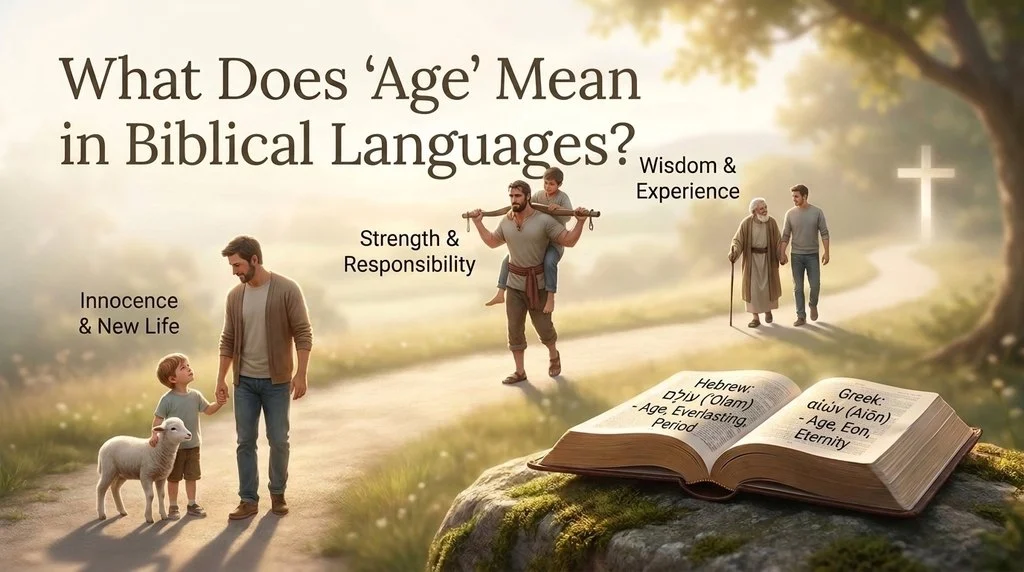
Understanding the original biblical languages helps explain why the word “age” can have different meanings.
Hebrew Words Related to Age
One important Hebrew word is zāqēn, which relates to being old or advanced in age.
Another important concept is dôr, often translated as generation. It can refer to people living in a particular generation or period.
The Hebrew word ʿôlām is also important. Depending on context, it can refer to a long duration, ancient time, perpetuity, or an age.
These words show why translating every occurrence simply as “age” can sometimes miss the original meaning.
Greek Words Related to Age
The New Testament uses several Greek concepts.
Aiōn commonly refers to an age, era, or extended period. It is especially important in expressions such as “this age” and “the age to come.”
Hēlikia can relate to age, stature, or maturity depending on context.
These distinctions are important because biblical “age” can describe either how long someone has lived or a period within God’s unfolding plan.
What Does “This Age” Mean in the Bible?
The New Testament sometimes contrasts this age with the age to come.
This is not primarily about someone’s biological age.
It refers to the present order of human existence in contrast with the future reality associated with God’s kingdom and ultimate purposes.
Jesus speaks about “this age” and “the age to come” in passages such as Mark 10:30 and Luke 18:30.
Paul also uses similar language in places such as Romans 12:2 and Ephesians 1:21.
Therefore, when Christians encounter the phrase “age” in these passages, they should not automatically interpret it as a person’s number of years.
Does Age Represent Wisdom in the Bible?
Age can be associated with wisdom, but age alone does not guarantee wisdom.
Job 32:7–9 presents an important balance. Elihu acknowledges that people often expect wisdom from those who are older, but he also explains that understanding ultimately comes from God.
This gives us a valuable biblical principle:
Experience can provide opportunities for wisdom, but true wisdom comes from God.
Someone who has lived longer may have learned valuable lessons. Yet Scripture repeatedly teaches that the fear of the Lord is the beginning of wisdom.
Psalm 111:10 and Proverbs 9:10 make this connection clear.
Biblical Meaning of Age and Wisdom
The relationship between age and wisdom can be summarized like this:
| Physical age | Biblical perspective |
|---|---|
| More years | More opportunities for experience |
| More experience | Potential for greater practical wisdom |
| More experience without God | Does not guarantee biblical wisdom |
| Growing in God’s Word | Produces godly understanding |
| Faithfulness over time | Can produce a strong testimony |
The Bible therefore encourages us to respect older people without assuming that every older person is automatically wise.
What Does the Bible Say About Age and Purpose?
Your purpose does not disappear because you reach a certain age.
Some people worry that they have missed God’s plan because they are older. Others think they are too young to make a meaningful difference.
Scripture challenges both ideas.
God can use people at different stages of life.
The question is not simply:
“How old am I?”
A more useful biblical question is:
“How can I faithfully serve God in the season of life I am in?”
That question shifts attention from comparison to obedience.
What Does the Bible Say About Numbering Your Days?
Psalm 90:12 says:
“So teach us to number our days, that we may gain a heart of wisdom.”
Numbering our days does not mean becoming obsessed with our age.
It means recognizing that our time is limited and should be used wisely.
This can change everyday decisions.
Instead of endlessly postponing what matters, believers can ask:
- Am I loving people well?
- Am I using my gifts?
- Am I growing in God’s Word?
- Am I forgiving others?
- Am I serving where I can?
- Am I wasting time on things that do not matter?
- Am I preparing for eternity?
Age can therefore become a reminder to live intentionally.
Does the Bible Give Special Meaning to Specific Ages?
The Bible mentions certain ages, but Christians should be careful not to turn every biblical number into a spiritual code.
Some ages are important because they belong to particular historical events or cultural practices.
For example:
- Moses was eighty when he was called to lead Israel.
- Jesus began His public ministry at about thirty.
- Caleb was eighty-five when he spoke about his strength and inheritance in Joshua 14.
- Psalm 90 reflects on seventy or eighty years as a general picture of human lifespan.
These examples have meaning within their contexts.
They do not establish a universal rule saying that everyone experiences the same spiritual event at the same age.
Is There a Biblical Meaning of Turning 30?
The Bible does not teach that turning 30 automatically brings a specific spiritual transformation.
However, age thirty appears in several important biblical contexts.
Joseph was thirty when he entered Pharaoh’s service (Genesis 41:46).
David was thirty when he became king (2 Samuel 5:4).
The Levites had age-related requirements for certain forms of service in different periods of Israel’s history.
Jesus also began His public ministry at about thirty years of age according to Luke 3:23.
These examples are historically and biblically interesting, but they should not be turned into a universal doctrine about the number thirty.
Is There a Biblical Meaning of Turning 40?
Forty is a recurring number in Scripture, appearing in events such as the forty days of rain during the Flood, Israel’s forty years in the wilderness, and Jesus’ forty days of fasting in the wilderness.
However, this does not mean that turning forty has a guaranteed spiritual meaning for every Christian.
The number forty often appears in contexts involving periods of testing, preparation, transition, or judgment.
That biblical pattern can be studied, but a person’s fortieth birthday should not automatically be interpreted as a divine message.
Is There a Biblical Meaning of Turning 50?
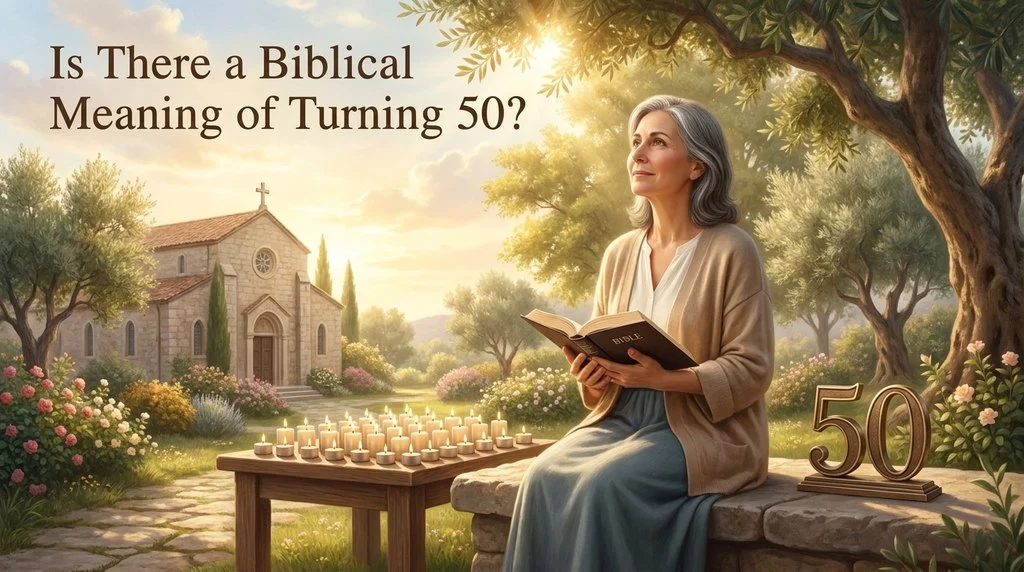
Scripture does mention fifty in several contexts, particularly in Old Testament laws and the organization of Levitical service.
Leviticus 25 also connects the fiftieth year with the Jubilee.
However, the Bible does not say that every Christian who turns fifty enters a particular spiritual season.
If someone is approaching fifty, it may be a useful time for reflection, gratitude, and renewed service, but those applications should not be presented as biblical commands.
Is There a Biblical Meaning of Old Age?
Old age in Scripture can represent experience, wisdom, God’s faithfulness, and the passing of earthly life.
Psalm 71:18 contains a beautiful prayer about continuing to declare God’s power to another generation even in old age.
This gives older believers a meaningful role: remember, testify, teach, encourage, and remain faithful.
Old age is not portrayed simply as decline.
It can also become a season of testimony.
What Does the Bible Say About Respecting Older People?
Leviticus 19:32 says:
“You shall stand up before the gray head and honor the face of an old man.”
This command reflects a broader biblical principle of honoring older people.
Respect for older adults is not based on the idea that every opinion they hold is automatically correct.
Instead, Scripture recognizes the dignity of age and the value of experience.
Christian communities can benefit when different generations learn from one another.
What Does the Bible Say About Children and Age?
Jesus gave children a special place in His teaching.
In Matthew 19:14, Jesus said to let the little children come to Him.
Children are not spiritually irrelevant because they are young.
At the same time, Scripture repeatedly emphasizes the responsibility of adults to teach children God’s ways.
Deuteronomy 6:6–7 instructs God’s people to teach His words diligently to their children.
This creates a beautiful generational pattern:
Older generations teach, younger generations learn, and both continue to know and serve God.
Biblical Meaning of Age and Generations
The Bible frequently speaks about one generation telling another about God’s works.
Psalm 145:4 says:
“One generation shall commend your works to another.”
This shows that age is not merely personal.
It has a generational dimension.
Your life can influence people who come after you.
A parent can teach a child. A grandparent can share testimony. A young Christian can encourage an older believer with fresh faith and energy.
God’s work continues across generations.
What Does the Bible Say About Aging?
The Bible is realistic about aging.
Physical strength changes. Bodies become weaker. Human life eventually ends.
Yet Scripture does not define a person’s worth by physical strength or youthful appearance.
Paul writes in 2 Corinthians 4:16 that although the outer self is wasting away, the inner self can be renewed day by day.
This distinction is deeply important for Christian thinking about aging.
Physical decline does not mean spiritual failure.
Aging can involve loss, but it can also involve deeper dependence on God.
What Age Teaches Us About God’s Timing
Age can remind Christians that God’s timing is different from human expectations.
Abraham waited many years for God’s promise concerning Isaac.
Moses spent decades in preparation before his major leadership role.
David experienced a long period between being anointed and becoming king.
These stories show that waiting is not necessarily wasted time.
A season that feels slow may still contain preparation, character formation, and lessons that become important later.
Biblical Age vs Popular Spiritual Numerology
Many modern teachings assign special spiritual meanings to specific numbers or ages.
Some people claim that turning a certain age automatically signals prosperity, spiritual awakening, or a new divine assignment.
Christians should test such claims against Scripture.
| Biblical teaching | Speculative approach |
|---|---|
| Context matters | Every number has a hidden message |
| Scripture is authoritative | Personal symbolism becomes authoritative |
| God directs His people | Numbers predict individual futures |
| Wisdom comes from God | Numbers guarantee spiritual outcomes |
| Biblical patterns can be studied | Patterns become universal rules |
The Bible contains meaningful numbers, but that does not give Christians permission to create doctrines that Scripture does not teach.
What the Bible Does Not Say About Age
Several popular ideas should be handled carefully.
The Bible does not say:
- Every age has a secret spiritual meaning.
- Turning a particular age guarantees a blessing.
- A certain birthday predicts your future.
- Older people are always wiser.
- Young people cannot be spiritually mature.
- God stops using people after a certain age.
- Every difficult event at a particular age is a divine sign.
- Biblical numbers should always be interpreted symbolically.
These claims go beyond what Scripture clearly teaches.
How Should Christians Respond to Their Age?

Instead of becoming anxious about age, Christians can use each season faithfully.
1. Accept Your Present Season
You do not need to live someone else’s life.
Your current season has its own responsibilities and opportunities.
2. Keep Growing
Physical age increases automatically. Spiritual maturity does not.
Continue reading Scripture, praying, learning, repenting, and practicing obedience.
3. Use Your Experience
If you have learned valuable lessons, share them wisely.
Your mistakes can become warnings for others. Your faithfulness can become encouragement.
4. Learn From Other Generations
Young believers need wisdom from older Christians.
Older believers can also learn from younger Christians.
The body of Christ benefits when generations work together.
5. Make Your Remaining Time Count
None of us knows exactly how many years remain.
That reality should encourage purposeful living rather than fear.
A Simple Biblical Perspective on Every Age
Whatever your current age, several biblical truths remain constant.
If you are young: grow in wisdom and character.
If you are an adult: use your responsibilities and gifts faithfully.
If you are older: continue bearing fruit and sharing what God has taught you.
If you feel behind: remember that Scripture contains many stories of long waiting and unexpected timing.
If you fear aging: remember that your value comes from God, not from youthfulness.
If you feel your best years are gone: Scripture gives examples of people who remained useful in later years.
Frequently Asked Questions
What is the biblical meaning of age?
The biblical meaning of age depends on context. It can refer to a person’s years, a stage of life, maturity, a generation, or a period of history. Scripture does not give every age a secret spiritual meaning. Instead, it emphasizes wisdom, faithfulness, maturity, and making good use of the time God gives us.
Does age have a spiritual meaning in the Bible?
Age can have spiritual significance because Scripture connects different stages of life with learning, responsibility, wisdom, service, and reflection. However, the Bible does not teach that every specific age has a fixed spiritual meaning. Christians should avoid assigning supernatural messages to birthdays without clear biblical support.
What does the Bible say about getting older?
The Bible treats old age with dignity and recognizes the value of experience and wisdom. Passages such as Psalm 71:18 and Psalm 92:14 show that older believers can continue to testify about God and bear spiritual fruit. Aging does not mean that a person’s usefulness or purpose automatically ends.
What age represents maturity in the Bible?
The Bible does not establish one universal age at which a person becomes spiritually mature. Physical maturity and spiritual maturity are different. New Testament teaching emphasizes growing in Christ, wisdom, discernment, love, obedience, and godly character rather than reaching a particular birthday.
Is turning 30 significant in the Bible?
Thirty appears in several biblical accounts, including the ages associated with Joseph’s service, David’s kingship, and Jesus’ beginning of public ministry. However, Scripture does not command Christians to treat turning thirty as a special spiritual milestone. The meaning of each example comes from its specific biblical context.
Is 40 a significant age in the Bible?
Forty is a recurring biblical number and appears in stories involving events such as the Flood, Israel’s wilderness journey, and Jesus’ wilderness fast. However, the Bible does not teach that turning forty automatically produces a particular spiritual event. Biblical patterns should not be turned into personal predictions without scriptural support.
Does the Bible say that older people are wiser?
Scripture often connects age with experience, but it does not teach that every older person is automatically wise. Job 32:7–9 shows that wisdom ultimately comes from God. Age can provide opportunities for learning, but biblical wisdom depends on one’s relationship with God and response to His truth.
Can God use someone at any age?
Yes. Scripture contains examples of God working through people at many stages of life. Moses was called to his major mission at an advanced age, while Timothy was encouraged to serve faithfully despite his youth. The Bible consistently points toward faithfulness rather than a specific age as the foundation for service.
What does it mean to number your days?
Psalm 90:12 asks God to teach His people to number their days so they may gain wisdom. The idea is to recognize that human life is limited and therefore should be lived intentionally. Numbering our days means using our time wisely, pursuing God, loving others, and focusing on what has lasting value.Key Takeaways
- Age in the Bible can mean years, life stages, maturity, generations, or eras.
- Physical age and spiritual maturity are not the same.
- Scripture honors both younger and older people.
- Age does not determine a person’s value before God.
- Older believers can continue bearing fruit and serving others.
- Young believers can demonstrate genuine wisdom and faith.
- Biblical numbers should be interpreted in context.
- The Bible does not give every birthday a secret spiritual meaning.
- Human life is temporary, so Scripture encourages wise use of time.
- God’s purposes are not limited by a person’s age.
Conclusion:
The biblical meaning of age is broader than a number on a birthday cake. Scripture connects age with time, maturity, wisdom, generations, responsibility, and the temporary nature of earthly life.
The Bible does not teach that a particular birthday automatically unlocks a spiritual destiny. Instead, it calls believers of every age to grow in faith, use their time wisely, honor one another, and remain faithful to God.
Whatever season of life you are in, your years can still be used for God’s purposes. What matters most is not simply how old you are, but how faithfully you live the days God has given you.

I’m Chris Robert, a writer at Namefluxo. I decode the hidden spiritual meanings behind biblical names, dreams, and sacred symbols, turning deep scriptural insights into engaging guides that deepen your faith and inspire your journey.
13 thoughts on “Biblical Meaning of Age: What Scripture Really Teaches”