
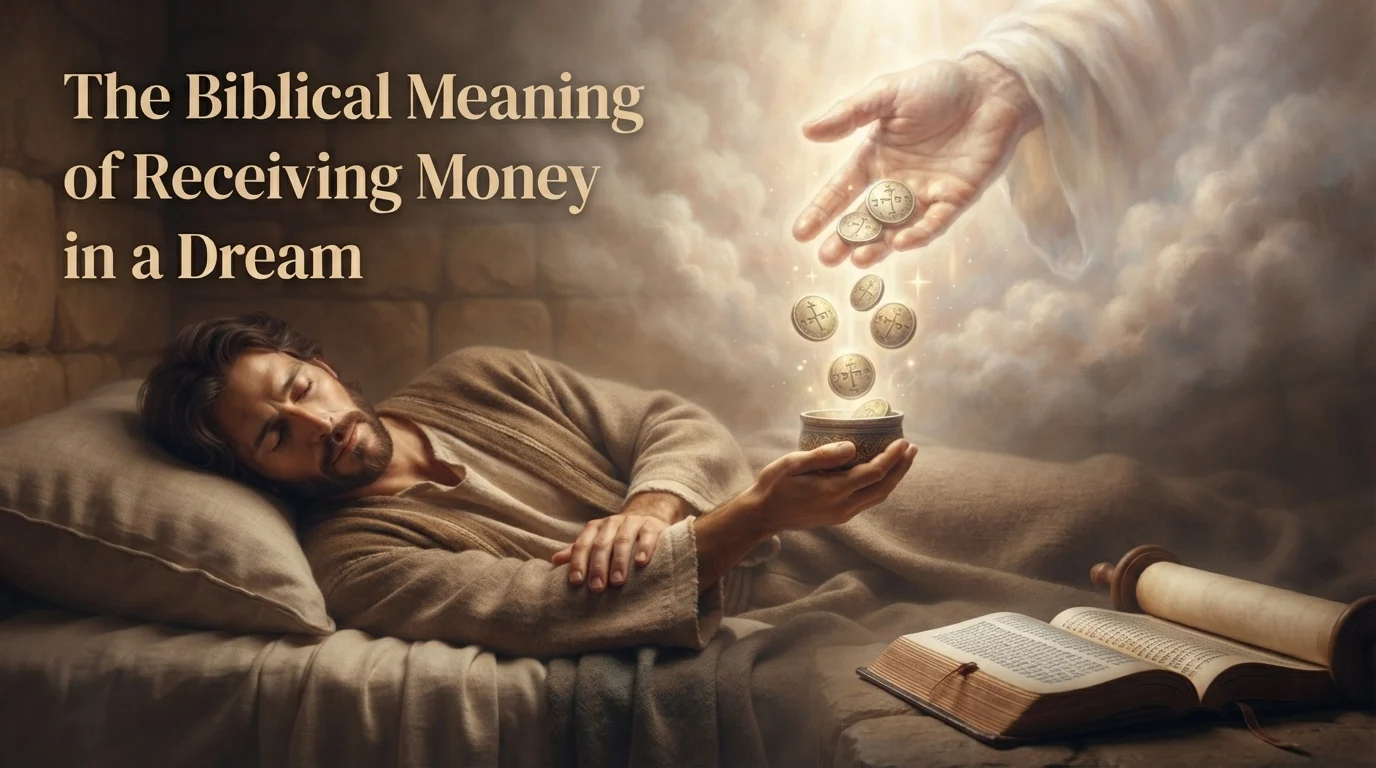
Dreams about receiving money can feel exciting, confusing, or deeply meaningful. You may wake up wondering whether the dream points to financial blessing, an answered prayer, a new opportunity, or something God wants you to notice.
From a biblical perspective, however, receiving money in a dream does not automatically mean that God is promising financial wealth. Scripture shows that God can use dreams to communicate with people, but the Bible also teaches believers to test spiritual impressions carefully.
Money itself has several meanings in Scripture. It can represent provision, stewardship, responsibility, temptation, generosity, earthly security, or the consequences of loving wealth. Therefore, the meaning of receiving money in a dream depends greatly on the dream’s context and on what Scripture teaches about money.
The safest Christian approach is not to chase the dream itself. Instead, examine it through God’s Word, prayer, wisdom, and the circumstances of your life.
Quick Answer

Biblically, receiving money in a dream may symbolize provision, responsibility, opportunity, generosity, or a desire for security, but Scripture does not give one universal meaning for receiving money in dreams.
God sometimes used dreams in biblical history, yet not every dream was a divine message.
A Christian should compare the dream with Scripture rather than assuming it predicts future wealth.
Does the Bible Say Receiving Money in a Dream Has One Meaning?
No.
This is one of the most important points to understand.
The Bible contains several examples of God communicating through dreams. Joseph received dreams that pointed toward future events. Daniel interpreted dreams. Joseph, the husband of Mary, received important guidance through dreams concerning Jesus and His safety.
Yet Scripture never provides a formula saying:
Receiving money in a dream always means financial blessing.
That idea goes beyond what the Bible actually teaches.
Dreams in Scripture had different purposes. Some revealed future events.
- Some exposed what was happening in a person’s heart. Some were warnings. Others required interpretation.
Ecclesiastes 5:3 also connects dreams with the concerns and activities of daily life. This reminds us that not every dream should automatically be treated as supernatural revelation.
Therefore, Christians should approach dreams with humility.
The question should not simply be, “What does money mean in dreams?”
A better question is:
“What does Scripture teach me about money, provision, responsibility, and the condition of my heart?”
That question keeps biblical truth at the center.
What Does Money Represent in the Bible?
Money has a complex role in Scripture.
The Bible does not describe money as inherently evil. Instead, Scripture focuses heavily on how people obtain it, use it, and relate to it.
Money Can Represent Provision
God is repeatedly presented as the ultimate provider.
Jesus taught His followers not to live consumed by anxiety about food, clothing, and material needs. In Matthew 6:25–34, He points believers toward trust in God’s care.
Therefore, if you are currently praying about financial needs, a dream involving receiving money may naturally connect with your desire for provision.
However, this does not mean the dream guarantees a financial payment.
It may simply reveal what is occupying your thoughts and prayers.
Money Can Represent Stewardship
The Bible teaches that possessions come with responsibility.
Jesus’ parables frequently address stewardship. In Matthew 25:14–30, the Parable of the Talents emphasizes faithfulness in handling what has been entrusted to us.
If you dream about receiving a large amount of money, one possible Christian reflection is:
“If God gives me more, how will I use it?”
That question is often more spiritually valuable than asking whether the dream predicts wealth.
Money Can Represent Temptation
Scripture also warns about the dangers connected with wealth.
Paul writes in 1 Timothy 6:9–10 about the dangers of desiring riches and explains that the love of money can lead people into many forms of spiritual harm.
Notice the distinction.
The Bible does not say that possessing money is automatically sinful.
The problem is allowing the desire for money to control the heart.
A dream about receiving money could therefore invite personal reflection about your relationship with wealth.
Money Can Represent Security
Many people naturally associate money with safety.
Money can provide food, housing, education, transportation, and other practical needs. Yet Scripture warns against treating financial resources as ultimate security.
Proverbs 11:28 contrasts trusting in riches with trusting in God.
Jesus similarly warned against storing up earthly treasures while neglecting eternal priorities in Matthew 6:19–21.
So, if receiving money in a dream makes you feel unusually safe or powerful, it may be worth asking whether you are placing too much confidence in financial security.
Biblical Meaning of Receiving Money in a Dream
There is no single biblical interpretation, but several Scripture-based themes may help you think about such a dream responsibly.
| Dream Theme | Possible Biblical Reflection |
|---|---|
| Receiving money happily | Gratitude, provision, or desire for blessing |
| Receiving money unexpectedly | Opportunity, change, or dependence on God |
| Receiving a large amount | Responsibility, stewardship, or desire for abundance |
| Receiving coins | Small resources, careful stewardship, or daily provision |
| Receiving cash | Financial concerns, practical needs, or security |
| Receiving money from a stranger | Uncertainty, unexpected help, or questions about trust |
| Receiving money from family | Relationships, support, responsibility, or dependence |
| Refusing money | Integrity, caution, independence, or fear |
| Losing received money | Fear of instability or concerns about stewardship |
| Feeling guilty about the money | Conviction, conscience, or fear of wrong motives |
| Giving the money away | Generosity, sacrifice, or freedom from materialism |
These are possible reflections, not guaranteed prophetic meanings.
The Bible should remain the final authority.
1. Receiving Money May Reflect God’s Provision
One possible interpretation is provision.
If you have been praying for employment, paying bills, supporting your family, or overcoming a financial difficulty, a dream about receiving money may reflect your deep desire for God’s provision.
Philippians 4:19 reminds believers that God is able to supply their needs according to His riches in Christ.
But there is an important distinction.
The verse does not promise that every financial need will be met in the exact way or timing we expect.
Therefore, the dream should encourage trust rather than create unrealistic expectations.
Instead of saying:
“This dream guarantees money is coming.”
A healthier response is:
“I can bring my financial needs to God and trust Him while acting wisely.”
2. Receiving Money May Represent Responsibility
Sometimes receiving something valuable means receiving responsibility.
This principle appears throughout Scripture.
Jesus taught about faithful stewardship in several parables. The issue was not simply how much a person possessed. The issue was what they did with what they had received.
If you dream of being handed a large amount of money, consider asking:
- Am I being faithful with what I already have?
- Do I manage money responsibly?
- Do I help others when I can?
- Would greater resources make me more generous or more self-centered?
- Have I been asking God for blessing without considering responsibility?
These questions can turn a confusing dream into a meaningful spiritual reflection.
3. Receiving Money May Symbolize an Opportunity
Money in a dream can sometimes represent opportunity rather than literal cash.
For example, you may currently be entering a new season involving:
- A new job
- A business idea
- Education
- A ministry responsibility
- A relationship
- A leadership role
- A creative project
- A new financial responsibility
The dream may reflect your anticipation about receiving something valuable.
However, Christians should not assume every opportunity is automatically from God.
Proverbs 3:5–6 encourages believers to trust God and acknowledge Him in their decisions.
An opportunity should be evaluated through prayer, wisdom, biblical principles, and practical facts.
4. Receiving Money May Reveal Your Desire for Security
This interpretation is especially important.
Sometimes a dream is less about what you will receive and more about what you currently desire.
If money makes you feel safe in the dream, ask yourself:
“What am I depending on for security?”
Money can become emotionally powerful because it appears to solve uncertainty.
But Jesus repeatedly directed His followers away from anxiety and toward trust in God.
Matthew 6:33 teaches believers to seek God’s kingdom and righteousness rather than making material concerns the center of life.
The dream may therefore become an invitation to examine your priorities.
5. Receiving Money May Point to Stewardship
Suppose you receive money in the dream and immediately begin planning how to use it.
That detail may be more important than the money itself.
Scripture consistently values faithful stewardship.
God’s question is not simply:
“How much do you have?”
Biblical teaching repeatedly asks how faithfully you use what has been entrusted to you.
This includes:
- Money
- Time
- Skills
- Relationships
- Opportunities
- Influence
- Knowledge
Receiving something valuable should increase responsibility, not merely consumption.
6. Receiving Money Can Reflect Generosity
Interestingly, a money dream can also prompt thoughts about giving.
Acts 20:35 records the principle that giving is blessed.
If you dreamed about receiving money and then sharing it with others, the dream may naturally connect with biblical themes of generosity and compassion.
This does not mean God is giving you a secret financial prediction.
Rather, it may encourage you to think about your attitude toward abundance.
A Christian view of blessing is bigger than accumulation.
Blessing can include having enough to meet needs and enough to help others.
7. Receiving Money May Expose Greed
Not every money dream should be interpreted positively.
Imagine receiving money in a dream and feeling obsessed with getting more.
The dream could reveal a concern about material desire.
Jesus warned about greed in Luke 12:15, teaching that life does not consist in the abundance of possessions.
That principle is extremely important for interpreting money-related dreams.
A dream that feels exciting may still raise an uncomfortable spiritual question:
“Has money become too important to me?”
That question may produce more spiritual growth than trying to predict your financial future.
What Does It Mean to Receive Money From Someone?
The identity of the giver can add context.

The Bible does not provide a specific dream dictionary for every person who might give you money. Still, relationships can help you reflect on the dream.
Receiving Money From a Family Member
This could naturally bring themes of:
- Family support
- Responsibility
- Inheritance
- Love
- Dependence
- Financial concerns
- Family expectations
If the relationship is currently important in your life, the dream may reflect emotions connected with that person.
Do not automatically interpret it as a literal financial promise.
Receiving Money From a Friend
A friend giving money may bring thoughts about:
- Trust
- Mutual support
- Generosity
- Friendship
- Dependence
- Reciprocity
Consider the emotional atmosphere of the dream.
Did you feel thankful?
Embarrassed?
Uncomfortable?
Safe?
Those details may reveal more about your current concerns than the money itself.
Receiving Money From a Stranger
A stranger can represent uncertainty or something unfamiliar in ordinary dream symbolism.
From a Christian perspective, however, it is wise not to create a fixed spiritual meaning.
Instead, ask:
“What new or unfamiliar situation am I currently facing?”
Perhaps you are considering a new job, moving into a new season, meeting new people, or facing an uncertain financial situation.
The dream may simply reflect those concerns.
Receiving Money From a Deceased Person
This type of dream can feel especially powerful.
Christians should be careful here.
The Bible does not teach believers to seek messages or financial instructions from deceased people. Scripture strongly discourages attempts to communicate with the dead, as seen in Deuteronomy 18:10–12.
Therefore, if you dream that a deceased person gives you money, do not automatically assume the person is communicating with you spiritually.
The dream may reflect grief, memories, unresolved emotions, family history, or financial concerns.
Bring the experience to God rather than attempting to contact the dead.
What Does the Amount of Money Mean?
Many dream interpretations focus heavily on numbers.
For example, someone may dream about receiving $100, $1,000, or $10,000 and immediately search for a hidden biblical meaning.
This can become misleading.
The Bible does use numbers symbolically in certain contexts, but that does not mean every number appearing in a modern dream has a secret biblical code.
Instead, consider the broader context.
Receiving a Small Amount
A small amount might encourage reflection on ordinary provision.
God’s faithfulness is not measured only by dramatic financial breakthroughs.
Daily bread is still provision.
Jesus taught His followers to pray for daily bread in Matthew 6:11.
Receiving a Large Amount
A large amount may naturally trigger thoughts about:
- Abundance
- Responsibility
- Power
- Security
- Temptation
- Generosity
- Stewardship
The larger the imagined resource, the more important the question of responsibility may become.
Receiving an Exact Amount
If the dream contains a very specific amount, resist the temptation to turn the number into a prophecy.
Instead, ask whether the number connects with something meaningful in your waking life.
It may relate to:
- A bill
- A salary
- A debt
- A purchase
- A financial goal
- A past experience
- Something you recently saw or discussed
Context matters.
What Does the Condition of the Money Mean?
The condition of the money can also affect your reflection.
Clean Money
Clean or new money may naturally suggest ideas such as opportunity, freshness, or financial hope.
But again, these are reflections rather than biblical guarantees.
Torn or Damaged Money
Damaged money could cause you to reflect on:
- Financial stress
- Missed opportunities
- Poor stewardship
- Broken trust
- Anxiety about resources
Consider whether any of these themes are present in your life.
Fake Money
Dreaming about counterfeit money may raise questions about deception, false security, or something that appears valuable but is not.
That theme has a clear biblical connection to the importance of truth and integrity.
But do not assume the dream is predicting that someone will deceive you.
Use it as an opportunity for wise reflection.
Coins
Coins may remind you of small amounts, careful stewardship, or the value of seemingly insignificant things.
Jesus used a small coin in several teachings, including the widow’s offering in Mark 12:41–44.
The lesson of that passage is not that coins predict wealth.
It is that God sees the heart behind what a person gives.
Is Receiving Money in a Dream a Sign of Financial Blessing?
It can be a meaningful personal reflection, but the Bible does not establish it as a guaranteed sign of future financial blessing.
This distinction is essential.
Some Christian dream interpretations claim that receiving money always means prosperity is coming.
That claim is too certain.
The Bible does teach that God provides for His people. It also contains examples of material blessing. But Scripture never tells Christians to interpret every dream about money as a financial prophecy.
In fact, Scripture contains many warnings about wealth.
Proverbs 23:4–5 warns against exhausting yourself trying to become rich because wealth can disappear quickly.
Jesus also taught that earthly wealth is temporary.
Therefore, if you dream about money, focus first on faithfulness rather than fortune.
Biblical View vs Popular Dream Interpretation
| Popular Interpretation | Biblical Perspective |
|---|---|
| Money always means wealth is coming | Scripture does not make this promise |
| Receiving cash means financial breakthrough | It may reflect provision, concerns, or desire |
| Every dream is a message from God | The Bible does not teach this |
| Numbers always contain secret meanings | Numbers must be interpreted in biblical context |
| A dream can predict your future | Dreams should not replace Scripture or wisdom |
| Money dreams are always positive | Scripture presents both benefits and dangers of wealth |
| A dream should determine a financial decision | Major decisions require wisdom and discernment |
This distinction protects Christians from fear, superstition, and false certainty.
What the Bible Does NOT Say About Money Dreams
Several popular claims go beyond Scripture.
The Bible Does Not Say Every Dream Is From God
Scripture records God speaking through dreams, but that does not mean every modern dream is divine revelation.
Jeremiah 23:25–32 contains strong warnings about people falsely claiming divine dreams.
That should encourage humility.
The Bible Does Not Give a Universal Dream Dictionary
You will not find a biblical chart stating:
“Receiving money = financial blessing.”
Nor does Scripture provide a fixed meaning for every color, animal, number, person, or object appearing in a dream.
Some biblical dreams had specific interpretations because God revealed their meaning.
That is different from creating a universal dream-symbol system.
The Bible Does Not Promise Wealth to Every Christian
God may bless people materially, but Christianity is not a promise of guaranteed earthly prosperity.
Jesus Himself warned that following Him involves sacrifice.
The New Testament places greater emphasis on spiritual riches, contentment, generosity, faithfulness, and eternal hope.
The Bible Does Not Tell Christians to Chase Signs
Jesus repeatedly challenged people who demanded signs rather than responding faithfully to God’s revealed truth.
Christians should therefore avoid becoming obsessed with dreams.
The foundation of Christian faith is Christ and God’s revealed Word—not dream interpretation.
How Should Christians Respond to a Money Dream?
If you have a dream about receiving money, you do not need to panic or immediately search for a prediction.
Use a simple biblical process.
1. Write Down the Dream
Record the details while they are fresh.
Write down:
- Who gave you the money?
- How much was it?
- Where were you?
- How did you feel?
- What happened before receiving it?
- What happened afterward?
- Was the money clean, damaged, or fake?
- Did you keep it or give it away?
This prevents your memory from changing the details later.
2. Examine Your Current Life
Ask what is happening in your waking life.
Are you:
- Looking for a job?
- Worried about bills?
- Starting a business?
- Praying for provision?
- Experiencing financial pressure?
- Thinking about generosity?
- Making a major purchase?
Dreams can reflect daily concerns.
Ecclesiastes 5:3 provides a useful reminder that dreams can arise from the activity and concerns of life.
3. Compare the Theme With Scripture
Do not ask:
“Which dream dictionary says this means wealth?”
Ask:
“What does Scripture teach about this issue?”
For money, relevant biblical themes include:
- Contentment
- Stewardship
- Generosity
- Work
- Integrity
- Provision
- Wisdom
- Avoiding greed
- Trusting God
4. Pray for Wisdom
James 1:5 teaches that believers can ask God for wisdom.
You do not need to force an interpretation.
You can simply pray:
“Lord, if there is something I need to learn from this experience, give me wisdom and help me remain faithful to Your Word.”
5. Do Not Make Rash Financial Decisions
Never gamble, invest, borrow money, quit a job, or make a major purchase simply because you dreamed about receiving money.
A dream is not a substitute for:
- Research
- Financial planning
- Wise counsel
- Prayer
- Biblical principles
- Practical judgment
This is especially important when the dream feels extremely vivid.
Could a Money Dream Be a Warning?
Yes, it could prompt personal reflection about warning signs—but Christians should avoid declaring that every troubling dream is a divine warning.
For example, a dream involving money disappearing may cause you to consider whether you have been careless with finances.
A dream involving stolen money may cause you to think about trust or insecurity.
A dream involving greed may encourage you to examine your priorities.
The healthy response is not fear.
It is reflection.
Ask:
“Is there anything in my life that Scripture tells me to correct?”
If there is, respond to the biblical principle—not merely to the dream.
Receiving Money and the Biblical Principle of Contentment
One of the strongest biblical lessons connected with money is contentment.
Paul wrote in Philippians 4:11–13 about learning contentment in both abundance and need.
That is a powerful principle for interpreting dreams about wealth.
Imagine two people having the same dream about receiving $10,000.
One person wakes up thinking:
“Finally, I will be happy.”
Another wakes up thinking:
“If I ever have more, I want to use it wisely and help others.”
The dream is the same.
The heart response is different.
That is why biblical interpretation should focus not only on the object in the dream but also on the condition of the heart.
Receiving Money and the Love of Wealth
1 Timothy 6:6–10 provides an important framework.
Paul teaches the value of godliness with contentment and warns about the destructive pursuit of riches.
This gives Christians a helpful test:
Does my desire for money help me serve God, or does money increasingly control me?
Money can become dangerous when it changes from a tool into a master.
Jesus made this point clearly in Matthew 6:24 when He taught that a person cannot serve both God and money.
Therefore, if money dreams occur frequently, consider whether financial concerns are occupying too much mental and emotional space.
What If the Dream Made You Feel Happy?
Positive emotions matter, but they do not prove divine approval.
You might feel:
- Joy
- Relief
- Gratitude
- Excitement
- Freedom
- Security
These emotions may reflect genuine hopes in your waking life.
If you are under financial pressure, receiving money in a dream may produce the emotional relief you deeply desire.
Instead of assuming that the dream guarantees an upcoming payment, allow the emotion to lead you toward prayer.
You can thank God for His ability to provide while remaining realistic about the future.
What If the Dream Made You Feel Afraid?

Fear may point toward financial anxiety, uncertainty, responsibility, or concerns about losing control.
The appropriate biblical response is not superstition.
Bring the fear to God.
Philippians 4:6–7 encourages believers to bring anxieties to God through prayer and thanksgiving.
You can also take practical steps if the fear relates to real financial problems.
Prayer and practical wisdom can work together.
What If You Receive Money and Give It Away?
This can create an especially interesting biblical reflection.
Giving is a major theme throughout Scripture.
Jesus praised generosity that comes from a sincere heart. Paul also taught Christians to give willingly and generously in 2 Corinthians 9:6–8.
If your dream involves receiving money and then helping someone else, consider whether God may be drawing your attention to generosity.
But once again, avoid claiming certainty.
The dream does not automatically prove that God is giving you a financial instruction.
Instead, let Scripture guide the reflection.
Important Bible Verses for Understanding Money
| Scripture | Main Lesson |
|---|---|
| Matthew 6:19–21 | Eternal treasure matters more than earthly accumulation |
| Matthew 6:25–34 | Trust God instead of being consumed by material anxiety |
| Matthew 6:24 | Money must not become your master |
| Luke 12:15 | Life is not measured by possessions |
| Philippians 4:11–13 | Learn contentment in different circumstances |
| Philippians 4:19 | God is able to provide for His people |
| 1 Timothy 6:6–10 | Godliness and contentment are greater than the pursuit of riches |
| 1 Timothy 6:17–19 | Wealth should be used generously and responsibly |
| Proverbs 3:5–6 | Trust God and seek His direction |
| Proverbs 11:28 | Do not place ultimate confidence in riches |
| 2 Corinthians 9:6–8 | God values willing and generous giving |
| Acts 20:35 | Giving is a meaningful expression of Christian love |
Is There a Difference Between Receiving and Giving Money in a Dream?
Yes, the themes can be different.
Receiving naturally emphasizes:
- Provision
- Grace
- Opportunity
- Responsibility
- Dependence
- Receiving help
Giving may emphasize:
- Generosity
- Sacrifice
- Service
- Compassion
- Stewardship
- Freedom from materialism
But the meaning still depends on context.
A Christian should not treat either action as a guaranteed prophecy.
A Simple Biblical Discernment Test
When you are unsure about a dream, use these five questions.
| Question | Why It Matters |
|---|---|
| Does the interpretation agree with Scripture? | God does not contradict His Word |
| Does it produce biblical wisdom? | Truth should lead toward faithful living |
| Is fear controlling my response? | Fear can distort judgment |
| Am I becoming obsessed with the dream? | Obsession can replace healthy faith |
| Does this require practical wisdom? | Spiritual reflection should not eliminate sound judgment |
This approach is safer than relying on symbolic formulas.
Common Mistakes Christians Make With Money Dreams
Mistake 1: Treating the Dream as a Prophecy
A dream can feel extremely real.
That does not make it a guaranteed prediction.
Mistake 2: Assuming Money Always Means Blessing
Biblically, money can represent blessing, but it can also be connected with greed, temptation, injustice, anxiety, and misplaced trust.
Mistake 3: Ignoring the Heart
The emotional response may reveal more about your concerns than the money itself.
Mistake 4: Making Financial Decisions Based on Dreams
Never replace financial wisdom with dream interpretation.
Mistake 5: Using Dreams Instead of Scripture
Dreams are subjective.
Scripture is the foundation of Christian doctrine.
Mistake 6: Seeking a Secret Code for Every Detail
Not every number, color, person, or object needs a hidden spiritual meaning.
Sometimes a dream is simply a dream.
When Should You Take a Dream More Seriously?
Christians can take dreams seriously without becoming obsessed with them.
Pay attention if a dream causes you to recognize a biblical issue that genuinely needs attention.
For example:
If you dream about greed and realize you have become consumed with money, examine your heart.
*If you dream about giving and realize you have become selfish, consider biblical generosity.
If you dream about financial fear and realize you have been overwhelmed by anxiety, bring those concerns to God and take wise practical steps.
The important point is that the biblical principle, not the dream itself, becomes the guide.
A Short Prayer After Dreaming About Money
If the dream has stayed on your mind, you can pray simply:
“Father, thank You for caring about every part of my life. Give me wisdom to understand what I should learn from this experience. Help me not to chase money, signs, or predictions. Teach me to trust You, manage what You have given me faithfully, remain content, and use my resources to honor You and serve others. Give me wisdom for every financial decision and keep my heart focused on Christ. Amen.”
FAQs:
What is the biblical meaning of receiving money in a dream?
The Bible does not assign one universal meaning to receiving money in a dream. It may prompt reflection about provision, stewardship, generosity, responsibility, security, or material desire. The dream should be tested against Scripture rather than treated as a guaranteed prediction.
Does receiving money in a dream mean God will bless me financially?
Not necessarily. God can provide for His people, but Scripture does not teach that dreaming about receiving money guarantees future financial wealth. Christians should distinguish biblical promises about God’s care from personal interpretations of dreams.
Is dreaming about money a good sign?
It can be a useful opportunity for reflection, but it is not automatically a good or bad sign. Money has both positive and negative themes in Scripture. It can support generosity and provision while also becoming a source of greed or misplaced trust.
What does it mean to receive money from someone in a dream?
The person may provide context for your reflection, especially if the relationship is important in your life. However, Scripture does not give a fixed meaning for every person who appears in a dream. Consider the relationship, your emotions, your circumstances, and relevant biblical principles.
What does receiving a large amount of money mean in a dream?
A large amount may cause you to reflect on abundance, responsibility, security, temptation, or generosity. It does not necessarily mean you will become wealthy. The Bible emphasizes faithful stewardship regardless of how much a person possesses.
Can God speak through dreams?
Yes, Scripture records occasions when God communicated through dreams. Joseph, Daniel, and Joseph the husband of Mary are examples. However, this does not mean every dream is from God. Christians should test spiritual impressions against Scripture and avoid making unsupported claims.
Should I make a financial decision because of a dream?
No. A dream should not be the sole basis for a major financial decision. Use prayer, Scripture, sound financial information, wise counsel, and careful judgment before making important decisions.
What if I dream about receiving money from a dead person?
Do not assume the deceased person is communicating with you. Dreams can arise from memories, grief, emotions, and personal concerns. Scripture warns against attempting to communicate with the dead, so Christians should bring such experiences to God rather than seeking contact with the deceased.
Does the amount of money in a dream have a biblical meaning?
Not automatically. Although certain numbers have significance in particular biblical contexts, Scripture does not teach that every number appearing in a modern dream has a hidden spiritual message. Consider the number’s connection to your real-life circumstances before assigning meaning.
What should I do after dreaming about receiving money?
Write down the dream, consider your current circumstances, compare the themes with Scripture, pray for wisdom, and examine your attitude toward money. Do not treat the dream as a guaranteed prophecy or use it as the sole reason for a major decision.
Final Thoughts:
Receiving money in a dream can certainly feel significant, especially when the dream is vivid or emotionally powerful. But biblical wisdom calls Christians to remain grounded.
The Bible does not provide a universal formula that says receiving money in a dream means financial wealth is coming.
Instead, Scripture gives us a much stronger foundation.
God is our provider.
Money is a resource.
Wealth requires stewardship.
Generosity matters.
Contentment protects the heart.
Greed is dangerous.
And our ultimate treasure is not found in earthly possessions.
If you dreamed about receiving money, take a moment to look beyond the money itself.
Ask what the experience may be revealing about your faith, fears, priorities, responsibilities, and relationship with God.
Perhaps you are worried about provision.
*Perhaps you are hoping for a new opportunity.
Perhaps you need to become more responsible with what you already have.
*Perhaps you need to become more generous.
Or perhaps the dream simply reflects something that has been occupying your mind.
Whatever the reason, you do not need to live in fear or chase hidden meanings.
Bring the dream to God.
Open Scripture.
Pray for wisdom.
Use sound judgment.
And remember the central biblical principle: your security, identity, and hope are ultimately found in God—not in money.

I’m Chris Robert, a writer at NameFluxo who explores the deeper meanings behind biblical names, words, dreams, and spiritual symbols. I enjoy turning Bible-based insights into clear, simple, and meaningful articles that help readers understand their faith and Scripture better.