

When Christians search for the Job biblical meaning, they may be asking about the meaning of the name Job, the significance of the man Job, or the spiritual message of the Book of Job. All three questions are connected, but they should not be treated as exactly the same thing.
Job is introduced as a man who was “blameless and upright,” feared God, and turned away from evil (Job 1:1). Yet he experienced devastating loss, physical suffering, grief, and painful questions about God. His story became one of Scripture’s deepest treatments of suffering and faith.
The exact etymology of the Hebrew name אִיּוֹב (ʾIyyov) is uncertain. Some traditional explanations connect it with ideas such as “persecuted” or “hated,” while linguistic evidence has also connected the older form with phrases such as “Where is my father?” or “no father.”
So, rather than forcing one uncertain dictionary definition onto the name, it is safer to understand Job’s biblical significance through his story: a righteous man who suffered, questioned, persevered, encountered God, and learned to trust God’s wisdom beyond his own understanding.
Quick Answer:

The biblical meaning of Job is strongly associated with faithfulness during suffering, perseverance, integrity, humility, and trust in God’s wisdom.
Job’s story shows that suffering is not always proof of personal sin and that believers may face painful circumstances without immediately knowing God’s purpose.
The Book of Job ultimately directs attention away from simple explanations and toward God’s sovereignty, wisdom, and greatness.
What Does the Name Job Mean in the Bible?
The Hebrew name Job
The Hebrew name is אִיּוֹב (ʾIyyov).
The exact origin of the name is debated. Bible Gateway’s biblical encyclopedia notes evidence for an older West Semitic form and discusses possible meanings including “Where is my father?” or “no father.” Another commonly cited name reference gives the meaning “persecuted, hated.”
Because the etymology is uncertain, Christians should be careful about saying that “Job definitely means X.”
A more responsible explanation is:
| Aspect | Meaning |
|---|---|
| Hebrew name | ʾIyyov (אִיּוֹב) |
| Exact etymology | Uncertain |
| Common traditional meaning | Persecuted or hated |
| Other proposed connection | “Where is my father?” / “no father” |
| Biblical significance | Faithfulness through severe suffering |
| Central lesson | Trust God even when His purposes are unclear |
Why the story matters more than the name
The Bible does not build Job’s significance around a dictionary definition of his name.
Instead, Scripture introduces him through his character.
Job 1:1 describes him as blameless and upright, a person who feared God and rejected evil.
That description becomes especially important because Job’s suffering creates a major question:
Can a person genuinely love and serve God even when there is no obvious earthly reward for doing so?
That question drives much of the book.
Who Was Job in the Bible?
Job was a wealthy man from the land of Uz. Scripture presents him as a man of strong character, substantial possessions, a family, and a deep reverence for God.
His life initially appeared stable.
Then everything changed.
Job lost his possessions and children and later experienced severe physical suffering. Yet the opening chapters emphasize that his suffering was not presented as a simple punishment for hidden wrongdoing.
This is one of the most important points in understanding Job.
Job was not presented as a secretly wicked man
Job’s friends repeatedly tried to explain his suffering by connecting it to sin.
Their basic argument was:
You are suffering, therefore you must have done something seriously wrong.
But the book rejects that simplistic conclusion in Job’s particular case.
The biblical encyclopedia notes that the friends treated suffering as proportionate to sin, while Job’s experience demonstrates that righteous people can suffer without their suffering being direct punishment for a particular sin.
This gives Christians an important warning:
Do not automatically assume that someone’s suffering proves God is punishing that person.
What Is the Main Message of the Book of Job?

The Book of Job explores the difficult relationship between suffering, righteousness, God’s justice, and human understanding.
It does not give a simple philosophical explanation for every instance of suffering. In fact, one biblical introduction notes that the book does not definitively solve the problem of innocent suffering. Instead, it brings the reader into Job’s struggle with God’s wisdom and sovereignty.
Job teaches that suffering is not always punishment
This may be the most important practical lesson.
The Bible contains examples of suffering connected to sin, but it does not teach that every suffering person is suffering because of a particular personal sin.
Job’s friends made that mistake.
Their theology sounded religious, but it was too narrow for Job’s situation.
Christians should therefore be careful when speaking to someone who is grieving, sick, unemployed, experiencing financial hardship, or walking through another painful season.
Sometimes the most biblical response is not an explanation.
It is compassion.
Job teaches that faith can include honest questions
Job did not pretend everything was fine.
He cried out.
He questioned.
He grieved.
He expressed confusion and frustration.
His words show that biblical faith is not the same as pretending that pain does not exist.
Job wanted answers from God. Yet even while wrestling with profound questions, he continued engaging with God rather than simply walking away.
That distinction matters.
Faith does not require you to deny your pain.
It calls you to bring your pain honestly before God.
What Does Job Teach About Suffering?
Suffering can challenge our understanding of God
Before his suffering, Job knew God.
During his suffering, Job began wrestling with what he thought he knew about God’s justice.
This is one reason the book remains so powerful.
It does not present suffering as a simple equation:
Good people prosper.
Bad people suffer.
Real life is more complicated.
The Book of Job challenges the idea that visible circumstances always reveal someone’s spiritual condition.
God does not give Job the simple explanation he wanted
When God finally speaks in Job 38–41, He does not provide Job with a detailed explanation of every event.
Instead, God points Job toward the extraordinary complexity and greatness of creation.
Job’s response in Job 42 shows a renewed humility before God’s wisdom. The book’s final chapters therefore shift the focus from “Why did this happen?” toward the greater reality of who God is.
This does not make suffering painless.
It does show that human beings do not possess enough knowledge to understand everything God is doing.
What Is the Spiritual Meaning of Job?
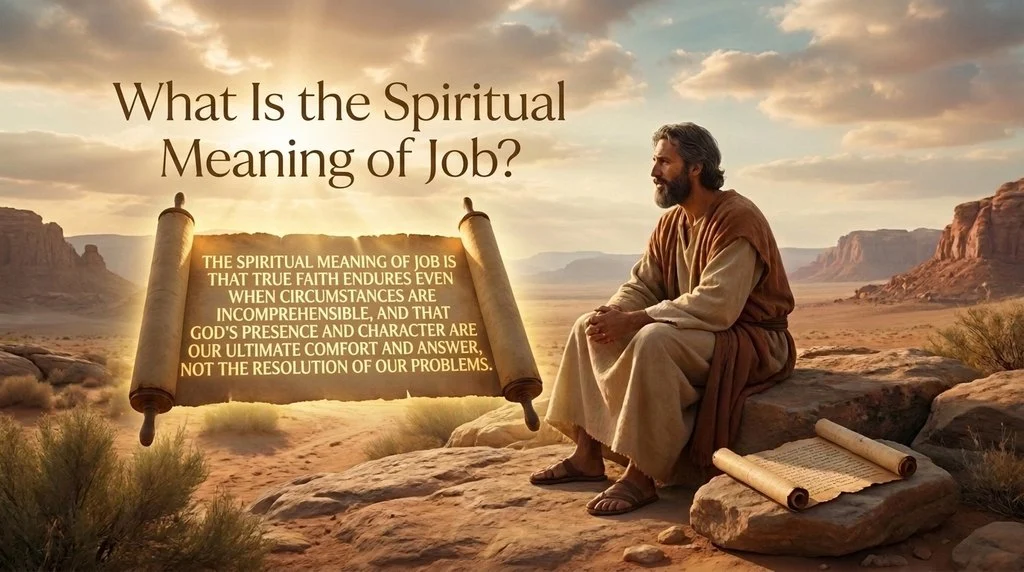
The spiritual meaning of Job can be understood through several major themes.
Faith during hardship
Job’s story shows that faith can survive seasons that make no earthly sense.
His circumstances changed dramatically, but his story did not end with his suffering.
Integrity when nobody understands
Job’s friends misunderstood him.
That can happen to Christians today.
Sometimes people make quick judgments about suffering because they want a simple explanation. Job reminds us that another person’s struggle may be far more complicated than it appears.
Perseverance without easy answers
Job did not receive immediate relief.
His story unfolded over time.
This makes Job particularly meaningful for people who have prayed for something repeatedly and still do not understand why circumstances have not changed.
Humility before God’s wisdom
Job eventually recognizes the limits of his own understanding.
Job 42:2 declares God’s unlimited power and purpose. The biblical message is not that every question is answered in detail, but that God remains greater than human understanding.
Job Biblical Meaning: Key Lessons for Christians
| Lesson | What Job teaches |
|---|---|
| Faith | Trust God even during painful seasons |
| Suffering | Hardship is not automatically proof of personal sin |
| Integrity | Remain faithful even when circumstances are confusing |
| Prayer | Bring honest pain and questions to God |
| Humility | Human understanding is limited |
| Compassion | Do not judge another person’s suffering too quickly |
| Perseverance | Continue seeking God through difficult seasons |
| Hope | Present circumstances do not tell the whole story |
What Does Job Teach About Faith?
Job demonstrates a form of faith that is tested by circumstances.
It is easy to trust God when life is comfortable.
The harder question is whether we can continue trusting Him when our circumstances appear to contradict what we believe about Him.
Job’s story gives Christians permission to acknowledge that this struggle is real.
His faith was not emotionless.
He experienced grief, fear, frustration, and confusion.
Yet the story continues moving toward a deeper encounter with God.
Faith does not mean understanding everything
One of the strongest lessons from Job is that trust and understanding are not identical.
You may not know why something happened.
You may not know how God will resolve it.
You may not even understand what God is doing right now.
But biblical faith can still choose to trust God’s character.
Did Job Sin?

Job was not sinless.
Like every human being, he was a limited and imperfect person.
However, Scripture does not present the calamities that came upon him as straightforward punishment for a specific hidden sin.
That distinction is essential.
Job’s friends assumed his suffering proved guilt. The narrative ultimately shows that their explanation was inadequate. God Himself rebukes Job’s friends near the end of the book for not speaking rightly about Him as Job had.
So the lesson is not:
“Job never made a mistake.”
The lesson is:
“Job’s suffering cannot be explained simply by saying that he was suffering because he was secretly wicked.”
What the Bible Does NOT Say About Job
Several popular ideas go beyond what Scripture actually teaches.
The Bible does not say every suffering person has sinned
Job’s friends made this assumption, and the book exposes its weakness.
The Bible does not promise Christians an explanation for every hardship
God never gives Job a complete explanation of the heavenly events described at the beginning.
The Bible does not teach that faith prevents suffering
Job was deeply devoted to God, yet he suffered tremendously.
The Bible does not tell Christians to suppress grief
Job openly mourned.
Biblical faith can coexist with tears.
The Bible does not reduce God to a formula
Job’s friends attempted to explain God’s actions through a simple system of reward and punishment.
The book shows that God’s wisdom is far greater than such formulas.
Job and the Problem of Innocent Suffering
Theologically, Job is one of Scripture’s deepest treatments of theodicy—the question of how God’s justice and goodness relate to human suffering.
The book does not offer a simple philosophical solution.
Instead, it challenges the assumption that humans can always determine God’s purposes from present circumstances.
This is why Job remains relevant.
A Christian may ask:
- Why did God allow this?
- Why did my prayer seem unanswered?
- Why do good people suffer?
- Why do dishonest people sometimes prosper?
- Why did God not intervene?
- Can I trust God when I do not understand Him?
Job does not make those questions disappear.
It teaches believers how to wrestle with them while continuing to face God.
Job’s Friends: An Important Warning
Job’s three main friends—Eliphaz, Bildad, and Zophar—spent much of the book trying to explain his suffering.
Their words sometimes contained statements that sound wise.
But their central application to Job was wrong.
They assumed that his extraordinary suffering must reveal extraordinary guilt.
This provides an important lesson about Christian counsel:
A true statement can still be wrongly applied.
For example, Scripture teaches that sin has consequences. That does not mean every person experiencing hardship is being punished for a specific sin.
Good biblical counseling requires both truth and wisdom.
What Does Job 42 Mean?
Job 42 is the turning point of the book.
After God speaks, Job responds with humility and acknowledges God’s greatness.
He says:
“I know that thou canst do every thing, and that no thought can be withholden from thee.” — Job 42:2, KJV
Job’s response is not simply, “Now I understand every reason I suffered.”
Rather, his encounter with God changes his perspective.
He recognizes that God’s wisdom is greater than his own.
Job also prays for his friends
The story then takes another surprising turn.
God tells Job’s friends that they have not spoken rightly about Him as Job has. Job subsequently prays for them, and the narrative describes restoration afterward.
This highlights another spiritual lesson:
God can transform suffering into a place where forgiveness and spiritual maturity grow.
Is Job a Symbol of Patience?
Yes, within Christian tradition Job is strongly associated with perseverance.
James refers to Job as an example of endurance:
James 5:11 points believers to the perseverance of Job and the Lord’s compassion and mercy.
But it is important not to reduce Job to the phrase “the patient man.”
Job was not quietly emotionless throughout the story.
He complained.
He questioned.
He grieved.
He wrestled.
His perseverance included continuing to engage with God through the struggle.
That makes his example more realistic and more helpful.
Job Biblical Meaning for Your Life Today
Job’s story can speak directly to modern Christian struggles.
If you are suffering
Do not automatically conclude that your suffering proves God has rejected you.
Job’s story challenges that assumption.
If you are waiting for answers
Remember that God’s silence does not necessarily mean God’s absence.
Job experienced a long period of uncertainty before God’s response.
If people misunderstand your struggle
You do not have to accept every judgment others make about your circumstances.
Job’s friends did not understand his situation correctly.
If you are angry or confused
Bring those emotions honestly to God rather than pretending they do not exist.
Job’s prayers demonstrate that Scripture makes room for honest lament.
If you are tempted to give up
Job’s story encourages perseverance without pretending that perseverance is easy.
Sometimes faithfulness means simply continuing to seek God one day at a time.
A Simple Christian Response to the Message of Job
When life becomes confusing, consider these five steps.
- Be honest with God.
Tell Him what you genuinely feel. - Stay rooted in Scripture.
Do not build your theology entirely on your current circumstances. - Avoid quick conclusions.
Your suffering does not automatically reveal its cause. - Seek wise Christian support.
Choose people who listen before they explain. - Trust God’s character.
You may not know what God is doing, but you can continue seeking Him.
A Short Prayer Inspired by Job
Heavenly Father,
When I do not understand what is happening in my life, help me remain faithful to You. Give me wisdom when I have questions, strength when I am weak, and humility when I cannot see the whole picture.Keep me from judging others unfairly because of their struggles. Teach me to trust Your wisdom and remember Your goodness even in difficult seasons. Give me the perseverance to keep seeking You. In Jesus’ name, amen.
FAQs:
What is the biblical meaning of Job?
The biblical significance of Job centers on faith, perseverance, integrity, suffering, humility, and trust in God’s wisdom. The exact Hebrew etymology of the name is uncertain, so the story’s theological meaning is more reliable than assigning one absolute dictionary definition to the name.
What does the name Job mean in Hebrew?
Job is written אִיּוֹב (ʾIyyov) in Hebrew. Its exact etymology is debated. Some sources connect it with “persecuted” or “hated,” while biblical linguistic research also discusses an older West Semitic form associated with “Where is my father?” or “no father.”
What is the main message of the Book of Job?
The Book of Job explores suffering, righteousness, divine justice, human limitations, and God’s wisdom. It shows that suffering cannot always be explained as punishment for personal sin and calls readers to trust God’s greater wisdom.
Was Job a righteous man?
Yes. Job 1:1 describes him as blameless and upright, one who feared God and turned away from evil. His righteousness is important because the book specifically challenges the assumption that severe suffering automatically proves severe personal sin.
Why did God allow Job to suffer?
The opening chapters present a heavenly test involving Job’s faithfulness, but Job himself does not know this explanation while he is suffering. When God finally speaks, He does not give Job a detailed explanation of every event. Instead, God emphasizes His sovereign wisdom and power.
What does Job teach Christians about suffering?
Job teaches that suffering is not necessarily evidence of personal sin. It also shows that believers can experience grief, confusion, and questions while continuing to seek God. The book encourages humility because human beings cannot always see the full purpose behind their circumstances.
Is Job a symbol of patience?
Job is traditionally regarded as an example of perseverance. James 5:11 specifically refers to Job’s endurance. However, Job’s perseverance should not be confused with never expressing grief or asking questions. His story includes deep lament and honest wrestling with God.
What can Christians learn from Job today?
Christians can learn to avoid judging suffering too quickly, remain faithful during uncertainty, bring honest emotions to God, seek wise counsel, and trust God’s wisdom even when circumstances are difficult to understand.
Does Job’s story mean God will restore everything we lose?
No. Job’s restoration is part of the specific ending of his biblical story, but Scripture should not be turned into a guarantee that every Christian will receive the same earthly restoration. The central lesson is deeper than material recovery: God remains sovereign, and faith should not depend solely on earthly circumstances.
Final Thoughts:
The Job biblical meaning is best understood through the whole story rather than through one disputed definition of the name. Job represents a believer wrestling honestly with suffering while continuing to encounter God.
His story reminds Christians that hardship is not automatically evidence of God’s punishment. It also shows that human beings do not always have enough knowledge to explain God’s purposes.
Job’s greatest lesson is not simply, “Be patient until your situation improves.”
It is a deeper invitation to remain faithful, humble, and honest before God—even when the answers have not yet come.

I’m Chris Robert, a writer at Namefluxo. I decode the hidden spiritual meanings behind biblical names, dreams, and sacred symbols, turning deep scriptural insights into engaging guides that deepen your faith and inspire your journey.
7 thoughts on “Job Biblical Meaning: Faith, Suffering & Hope”