
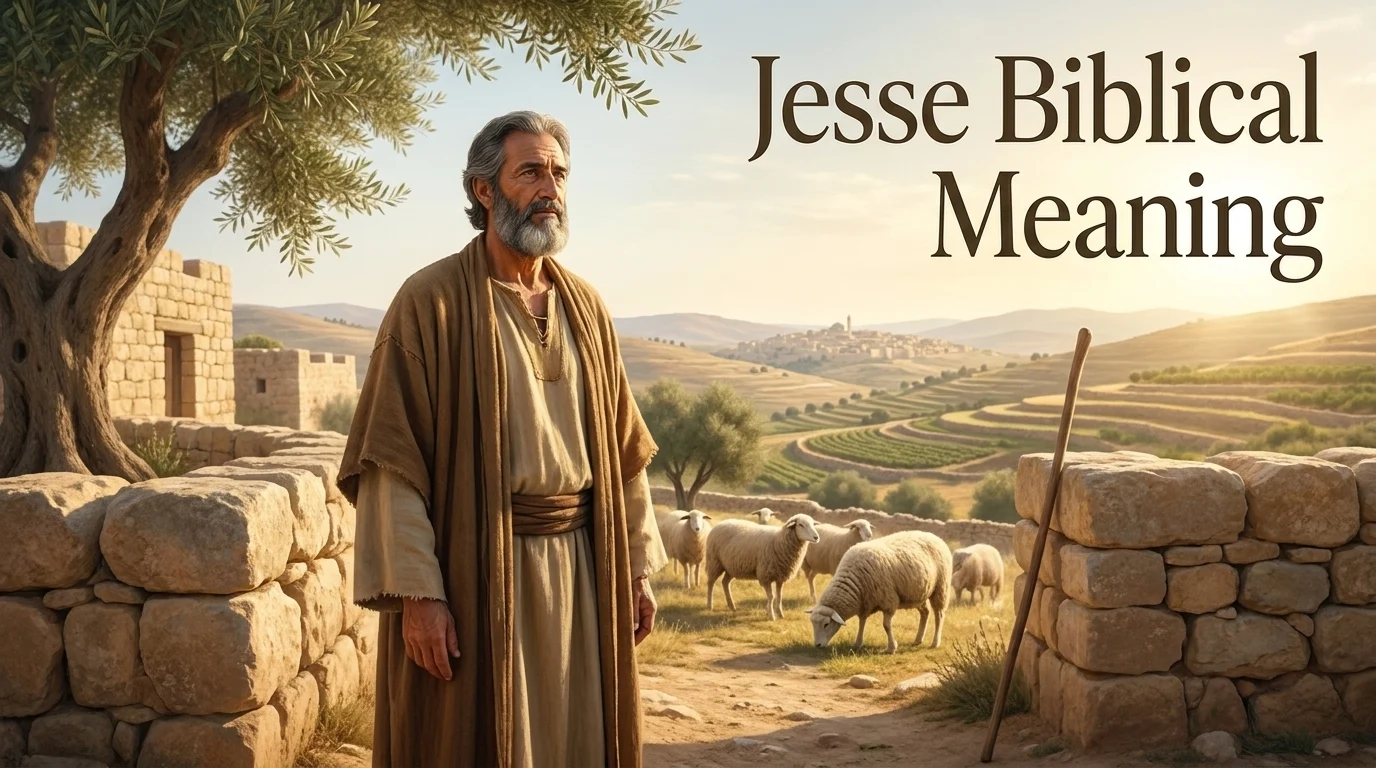
Jesse is one of those biblical names that becomes much more meaningful when you look at the story behind it. He was the father of David, the shepherd who became Israel’s king, and his family line eventually became part of the biblical story of Jesus Christ.
The name Jesse comes from the Hebrew יִשַׁי (Yishay). However, scholars caution that the precise etymology is uncertain, so popular definitions should not be presented as if the Bible itself gives a fixed meaning for the name.
What Scripture does make very clear is Jesse’s place in God’s redemptive story. He came from Bethlehem, was the father of David, and became the ancestor associated with the messianic hope described by Isaiah.
Quick Answer:

The biblical meaning of Jesse is best understood through his identity and role in Scripture rather than through a certain dictionary definition.
Jesse, Hebrew Yishay, was the father of King David and the son of Obed, making him a descendant of Boaz and Ruth. His family line became central to Israel’s royal history and the Bible’s expectation of the Messiah.
Key Facts About Jesse in the Bible
| Biblical fact | What Scripture shows |
|---|---|
| Hebrew name | Yishay (יִשַׁי) |
| English name | Jesse |
| Father | Obed |
| Grandparents | Boaz and Ruth |
| Son | David |
| Hometown | Bethlehem |
| Tribe | Judah |
| Important event | David’s anointing |
| Messianic connection | Isaiah’s “stump” and “root” of Jesse |
| New Testament connection | Jesse appears in Jesus’ genealogical line |
Jesse is therefore much more than a name attached to David’s father. His place in Scripture connects family, kingship, Bethlehem, David, and the Messiah.
The Hebrew Meaning of Jesse
What does the Hebrew name Jesse mean?
Jesse is written in Hebrew as יִשַׁי (Yishay). Strong’s Hebrew lexicon identifies the word as a proper masculine name and connects it with Jesse, David’s father. It also notes that the name’s derivation is uncertain.
This point matters because some Bible-name resources give definitions such as “wealthy,” “firm,” or phrases connected with God. These traditional explanations should be treated cautiously because the exact etymology of Yishay is debated.
So, if you are asking for the most responsible biblical answer, it is this:
Jesse is the Hebrew name Yishay, but its exact original meaning is uncertain. Its strongest biblical significance comes from Jesse’s role as David’s father and ancestor in the messianic line.
That distinction keeps the article faithful to Scripture rather than turning a traditional name definition into a biblical fact.
Who Was Jesse in the Bible?
Jesse was the father of David
Jesse is most prominently known as the father of David, who became king of Israel.
When the prophet Samuel came to Bethlehem, God instructed him to visit Jesse because God had chosen one of Jesse’s sons. Jesse presented several of his sons before Samuel, but David was not initially among them. David was out tending the sheep.
Samuel eventually asked for him to be brought in. God then directed Samuel to anoint David.
This story is recorded in 1 Samuel 16:1–13.
The lesson is striking: Jesse’s youngest son was working in the fields while the family gathered for an important spiritual event. Yet God had chosen David.
Jesse was a Bethlehemite
Scripture identifies Jesse as a Bethlehemite. Bethlehem was not merely a geographic detail. It became deeply important in the biblical story.
David came from Bethlehem, and later biblical prophecy connected Bethlehem and David’s royal line with God’s future purposes.
Jesse’s association with Bethlehem therefore becomes part of a much larger biblical pattern involving David and the Messiah.
Jesse was descended from Boaz and Ruth
Jesse was the son of Obed, and Obed was the son of Boaz and Ruth.
Ruth 4:17–22 traces the family line from Perez to David through Boaz, Obed, and Jesse. Matthew 1 also identifies Obed as Jesse’s father and Jesse as David’s father.
This means Jesse stands within a remarkable family story that includes:
Boaz → Obed → Jesse → David
And through David’s line, the New Testament connects Jesse’s family history with Jesus Christ.
Jesse’s Family Tree in the Bible
The basic family relationship can be shown simply:
| Person | Relationship to Jesse |
|---|---|
| Boaz | Grandfather |
| Ruth | Grandmother |
| Obed | Father |
| Jesse | — |
| David | Son |
| Jesus | Messiah connected to David’s line |
Matthew’s genealogy explicitly places Jesse between Obed and David, while Luke also traces Jesus’ genealogy through David and Jesse.
Why Is Jesse Important in the Bible?
Jesse’s importance goes beyond his personal story
Jesse does not receive the same amount of attention in Scripture as David. Yet his name becomes important because of what comes from his family.
David becomes Israel’s great king, and later biblical prophecy looks back to Jesse when describing the future messianic king.
Isaiah 11:1 speaks of a shoot coming from the stump of Jesse. Isaiah 11:10 then speaks of the root of Jesse and connects this figure with the nations.
The imagery is powerful. A tree may appear cut down, but God can bring new life from what seems finished.
For Christians, this prophecy points forward to the Messiah. Paul later applies the “root of Jesse” language to Christ in Romans 15:12.
Jesse represents a family line God used
The Bible repeatedly shows God working through people whose stories may initially seem ordinary.
Jesse was a father and Bethlehemite. His youngest son was a shepherd. Yet that shepherd became David, Israel’s king.
This does not mean Jesse himself was insignificant. It shows that biblical importance is not always measured by how much attention a person receives in the narrative.
Jesse and David: A Father-and-Son Story
David was initially overlooked
One of the clearest lessons from Jesse’s story appears in 1 Samuel 16.
Samuel saw Jesse’s older sons and considered their appearance and stature. But God told Samuel that He looks at the heart rather than merely outward appearance.
David, the youngest son, was eventually brought in from the field and chosen.
The point is not that God rejects physical appearance or natural ability. Rather, the passage teaches that human judgment cannot replace God’s knowledge of a person’s heart.
Jesse’s family reminds us not to judge by appearance
This is one of the most practical lessons connected with Jesse.
A person may appear too young, too ordinary, too quiet, or too unimportant to have a significant role. Yet Scripture repeatedly teaches that God’s purposes are not limited by human expectations.
David was not even standing with the other sons when Samuel first began the selection process.
God knew where he was.
Jesse and the Messianic Promise
What does Jesse have to do with Jesus?
Jesse is connected to Jesus through the Davidic family line.
Matthew begins his Gospel by presenting Jesus as the Messiah and tracing His genealogy through David. In Matthew 1:5–6, the genealogy moves from Boaz and Ruth to Obed, Jesse, and David.
Isaiah also uses Jesse’s name when describing the future ruler who would arise from David’s family.
The New Testament then connects this prophetic language with Christ. Paul quotes Isaiah’s reference to the root of Jesse in Romans 15:12 while discussing Christ’s hope for the nations.
Why does the “stump of Jesse” matter?
Isaiah’s picture of a stump suggests something that has been cut down.
The image carries a message of hope: what appears lifeless is not necessarily finished.
For Christians, this becomes especially meaningful in light of the Messiah. God’s promises continue even when circumstances appear to contradict them.
The emphasis is not that Jesse personally performed some miraculous work. Rather, his family line became part of the larger story through which God fulfilled His promises.
Spiritual Meaning of Jesse
The Bible does not give a verse saying, “The spiritual meaning of the name Jesse is…” Therefore, Christians should avoid presenting every devotional association as a direct biblical definition.
Still, Jesse’s story supports several biblical lessons.
God sees beyond human expectations
David was not the obvious choice in his family.
Yet God chose him.
Jesse’s family reminds believers that God’s purposes cannot always be recognized by outward appearances or human rankings.
Ordinary family life can matter to God
Jesse was a father in Bethlehem.
His story shows that God’s work often unfolds through ordinary relationships and generations.
Parents may not know how God will use the lives of their children. Faithfulness in ordinary responsibilities can become part of a much larger story.
God works across generations
Jesse did not live to see the complete significance of the line that came through his family.
Boaz, Ruth, Obed, Jesse, David, and later generations all form part of the biblical story.
This teaches an important spiritual principle: we may contribute to God’s purposes without seeing the full result ourselves.
God can bring hope from apparent loss
Isaiah’s image of the stump of Jesse reminds Christians that God’s promises do not depend on circumstances looking strong.
A stump looks like the end of a tree.
Yet Isaiah describes new growth.
That makes Jesse’s name especially meaningful within the biblical story of hope, restoration, and God’s faithfulness.
What Does Jesse Teach Christians Today?
Do not underestimate people
Jesse’s youngest son was overlooked by those gathered for Samuel’s visit.
Christians should therefore be careful about judging someone’s future based on age, position, appearance, wealth, or social status.
Trust God’s perspective
Samuel had to learn that God’s choice was different from human expectations.
This principle remains relevant whenever Christians make judgments about themselves or others.
Be faithful in ordinary places
David was tending sheep when he was called.
His ordinary responsibility came before his public leadership.
That is a useful reminder that faithfulness does not begin when someone becomes visible. It begins with what God has already placed in front of them.
Think beyond your own generation
Jesse’s story is also a reminder that a person’s influence may extend far beyond their lifetime.
Faithfulness can affect children, grandchildren, communities, churches, and future generations.
Jesse Biblical Meaning vs. Popular Name Definitions
| Claim | Biblical support |
|---|---|
| Jesse was David’s father | Clearly stated in Scripture |
| Jesse was from Bethlehem | Clearly stated in Scripture |
| Jesse descended from Obed | Clearly stated in Scripture |
| Jesse descended from Boaz and Ruth | Established through Ruth’s genealogy |
| Jesse’s name means one single exact thing | Uncertain; Hebrew etymology is debated |
| Jesse is connected with the Messiah | Yes, through David’s line and Isaiah’s prophecy |
| Jesse himself was the Messiah | No |
| “Root of Jesse” refers to the messianic hope | Yes; Paul applies the Isaiah language to Christ |
This distinction is important. A biblical article should not turn uncertain etymology into certain doctrine.
What the Bible Does Not Say About Jesse

The Bible does not give a detailed biography of Jesse
Scripture tells us important facts about Jesse, but it does not provide a long account of his entire life.
Much of what people want to know about his personality, private thoughts, or later years is simply not recorded.
We should allow that silence to remain.
The Bible does not give a guaranteed prophetic meaning for the name Jesse
There are traditional explanations of Jesse’s name, but the exact Hebrew etymology is uncertain.
Therefore, it is better to say that Jesse’s biblical significance is clear even though his name etymology is not.
Jesse is not the source of David’s success
Jesse was David’s father, but Scripture attributes David’s calling and anointing to God’s choice.
David’s future kingship should therefore not be explained as simply the result of Jesse’s family status.
Jesse in the Old Testament
Jesse appears especially in connection with David’s calling and family identity.
In 1 Samuel 16, Samuel visits Jesse’s household and anoints David.
Later, David is repeatedly identified as “son of Jesse.” At times this expression is used negatively by David’s enemies, while elsewhere it becomes a recognized title associated with David.
Jesse’s name also becomes important in prophetic passages.
Isaiah 11 looks beyond the immediate royal situation toward a future ruler arising from the line of Jesse.
Jesse in the New Testament
Jesse appears in Jesus’ genealogy
Matthew’s genealogy identifies:
Obed → Jesse → David
and places David within the genealogy of Jesus the Messiah.
Luke likewise includes Jesse in the genealogy leading through David.
Paul connects Jesse with Christ
Romans 15:12 quotes Isaiah’s prophecy concerning the root of Jesse.
Paul uses the passage while explaining Christ’s mission and the hope of the nations.
For Christian readers, this makes Jesse part of the larger biblical movement from Israel’s history toward the universal hope found in Christ.
Is Jesse a Good Biblical Name?
Yes, Jesse is a biblically established name with a strong place in Scripture.
However, its value should not depend on assigning it a made-up or overly certain definition.
A Christian family choosing Jesse may appreciate its connection with:
- David
- Bethlehem
- God’s calling
- Faith across generations
- The Davidic line
- Biblical hope
- The messianic promise
The strongest reason to appreciate the name is its biblical story, not an uncertain dictionary gloss.
Biblical Lessons From Jesse’s Story
1. God can use people others overlook
David was the youngest son and was initially outside with the sheep.
God saw what others did not.
2. Your current responsibility may prepare you for future work
David was faithfully caring for sheep before he became king.
Ordinary responsibilities should not be treated as meaningless.
3. God’s promises can survive difficult seasons
Isaiah’s stump imagery communicates hope even when the visible situation appears broken.
4. Family influence can reach future generations
Jesse’s significance continued through David and the later messianic story.
5. God’s work is bigger than one person’s lifetime
Jesse could not have known the full historical and theological significance that his family line would eventually have.
A Simple Reflection From Jesse’s Story
If you feel unnoticed, Jesse’s family story gives you a reason to keep being faithful.
David was not in the room when Samuel first looked over Jesse’s sons. He was doing his ordinary work.
That does not mean every unnoticed person will receive a public position. The biblical lesson is deeper: your value before God is not determined by how visible you are to other people.
God sees what people may miss.
Prayer Inspired by Jesse’s Story

Father, help me trust You when I feel overlooked or uncertain about my place. Teach me to be faithful in ordinary responsibilities and patient with Your timing.
Give me wisdom not to judge people only by outward appearances. Help me remember that Your purposes can reach beyond what I can see. May my life point others toward Your faithfulness and hope. In Jesus’ name, amen.
FAQs:
What is the biblical meaning of Jesse?
Jesse is the Hebrew name Yishay, but its exact etymology is uncertain. Biblically, Jesse is best known as the father of King David and an ancestor in the Davidic line connected with the Messiah.
What does the name Jesse mean in Hebrew?
The Hebrew form is יִשַׁי (Yishay). Lexical sources note that the origin and precise meaning of the name are uncertain. Therefore, definitions such as “wealthy” should be treated as traditional interpretations rather than a certain biblical definition.
Who was Jesse in the Bible?
Jesse was the son of Obed, the grandson of Boaz and Ruth, and the father of David. He lived in Bethlehem and is especially remembered because Samuel came to his family and anointed David as Israel’s future king.
Was Jesse the father of King David?
Yes. Scripture repeatedly identifies David as the son of Jesse. Matthew’s genealogy also states that Jesse was the father of David the king.
What is the connection between Jesse and Jesus?
Jesse is part of Jesus’ biblical genealogy through David. Isaiah also speaks of a shoot from the stump of Jesse and a root of Jesse, language that the New Testament connects with Christ.
What does the stump of Jesse mean?
Isaiah’s “stump of Jesse” describes new growth coming from what appears to have been cut down. In its messianic context, the image points toward the future ruler arising from Jesse’s family line. Paul later applies the “root of Jesse” passage to Christ.
Is Jesse a Christian or biblical name?
Yes. Jesse is a clearly biblical name associated with David’s father and appears in both Old Testament genealogical material and the New Testament genealogies connected with Jesus.
What spiritual lesson can Christians learn from Jesse?
One important lesson is that God works through ordinary people and family generations. Jesse’s youngest son, David, was initially outside tending sheep, yet God chose him for a major role in Israel’s history.
Is Jesse’s name mentioned in prophecy?
Yes. Isaiah refers to the “stump of Jesse” and “root of Jesse” in Isaiah 11. These passages concern the future ruler associated with Jesse’s line, and the New Testament connects the root-of-Jesse language with Christ.
Final Thoughts:
The Jesse biblical meaning is best understood through the story Scripture gives us rather than through an uncertain name definition.
Jesse was the father of David, a Bethlehemite, and a descendant of Boaz and Ruth. His family became part of Israel’s royal history and the biblical expectation of the Messiah.
His story also carries a simple message for Christians: God sees beyond appearances, works through ordinary generations, and can bring new hope from situations that appear finished.
Most importantly, Jesse’s biblical significance ultimately points beyond Jesse himself—to David, the Davidic promise, and the Christian understanding of Jesus as the promised Messiah.

I’m Chris Robert, a writer at Namefluxo. I decode the hidden spiritual meanings behind biblical names, dreams, and sacred symbols, turning deep scriptural insights into engaging guides that deepen your faith and inspire your journey.