
Music is everywhere. It lives in songs, movies, games, TikTok videos, and even your favorite ringtone. Yet many beginners still ask one simple question: What are music notes names? 🎼
If you’ve ever looked at piano keys, guitar tabs, or sheet music and felt confused, you’re not alone. Musical notes can look like secret symbols at first. However, once you understand the names behind them, music suddenly becomes easier, more exciting, and way more fun.
The good news? You do not need to be a music genius to learn music notes names. In fact, most people can memorize the basics in a single day with the right method.
This guide breaks everything down in a super simple way. You’ll learn note names, scales, symbols, reading tricks, beginner shortcuts, and expert tips without boring jargon. Whether you play piano, guitar, violin, or sing in the shower, this article will help you understand music faster. 🚀
Music Notes Names are the basic labels used to identify musical sounds. The seven natural notes are A, B, C, D, E, F, and G. These notes repeat in patterns across instruments and form scales, melodies, chords, and songs. Learning them helps beginners read music, play instruments, and understand musical theory quickly. 🎵
Quick Tips for Learning Music Notes Names
- 🎹 Start with only 7 natural notes: A to G
- 🎵 Practice note recognition daily for 10 minutes
- 📖 Use mnemonic phrases to remember staff notes
- 🎸 Match note names with your instrument keys or strings
- 🎤 Sing notes aloud to improve memory faster
- 🧠 Learn patterns instead of memorizing randomly
- 🚀 Focus on progress, not perfection
What Are Music Notes Names?
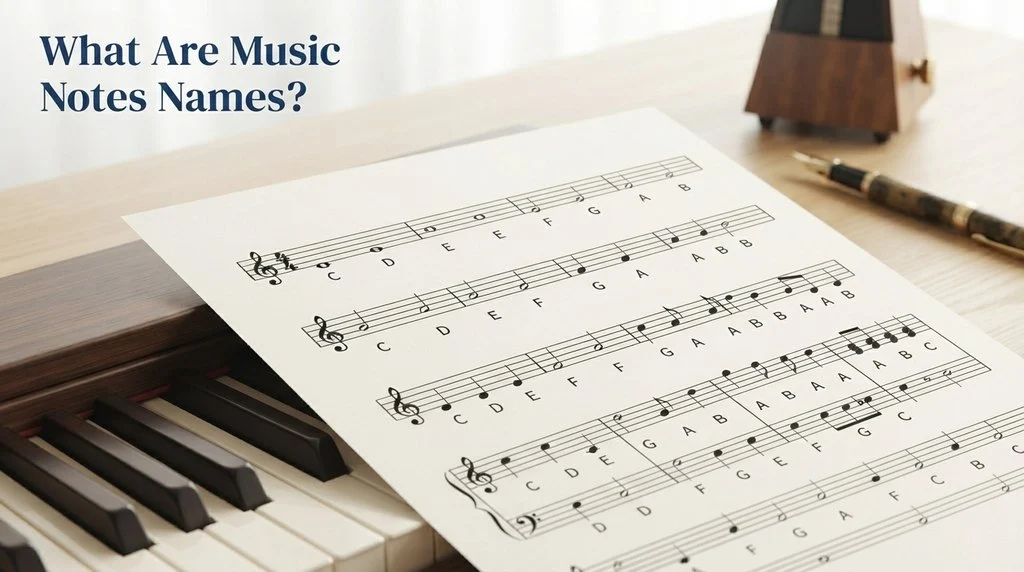
Music notes names are labels used to represent sounds in music. Every musical sound has a specific note name attached to it.
Here are the main natural music notes:
- A
- B
- C
- D
- E
- F
- G
- A repeats again
- Notes move higher in pitch
- Notes can move lower in pitch
- Every instrument uses note names
- Songs are built from notes
- Chords combine multiple notes
- Scales follow note patterns
- Notes help musicians communicate
- Sheet music uses note symbols
- Piano keys match note names
- Guitar strings contain notes
- Singing also follows note names
- Notes create melody and harmony
These seven letters repeat endlessly in music. Once you reach G, the cycle starts again with A.
👉 Which musical instrument do you want to learn first? 🎶
The 7 Natural Music Notes
The seven natural notes are the foundation of almost every song ever written.
- A — often used for tuning instruments
- B — sits between A and C
- C — commonly the starting point for beginners
- D — appears in many major chords
- E — important for guitar tuning
- F — often harder on piano for beginners
- G — commonly used in pop songs
- Notes repeat in octaves
- Natural notes have no sharps or flats
- Piano white keys represent natural notes
- They build scales and melodies
- Beginners should memorize them first
- Most music theory starts here
- They appear in every genre
- Songs use combinations of these notes
- They are universal worldwide
- Reading music becomes easier after learning them
- Notes can sound bright or dark
- They create emotional moods
- They are the alphabet of music 🎵
👉 Can you memorize all seven notes in under one minute?
Music Notes Names on the Piano
The piano is one of the easiest instruments for learning notes visually.
- White keys show natural notes
- Black keys show sharps and flats
- Middle C is a famous reference point
- Piano patterns repeat every octave
- Two black keys help identify C
- Three black keys help identify F
- Notes move left to right
- Left side sounds lower
- Right side sounds higher
- Beginners often start with C major
- Piano layouts teach music theory quickly
- Chords become easier visually
- Finger placement matters
- Reading sheet music connects well with piano
- Piano improves pitch recognition
- Keyboard apps help beginners practice
- Small keyboards still use full note systems
- Piano note charts simplify learning
- Kids often learn faster on keyboards
- Piano training improves overall musicianship 🎹
👉 Have you tried finding Middle C on a keyboard yet?
Music Notes Names on Guitar
Guitar players also rely heavily on note names.
- Standard tuning starts with E
- Guitar has six strings
- Each string has note names
- Frets change note pitch
- Open strings produce natural notes
- Chords combine several notes
- Power chords use root notes
- Barre chords move patterns
- Guitar tabs often hide note theory
- Learning notes improves improvisation
- Lead guitar requires note awareness
- Scales connect across the fretboard
- Pentatonic scales use note patterns
- Notes repeat on multiple strings
- Octave shapes simplify navigation
- Bass guitars use note systems too
- Acoustic and electric guitars share note layouts
- Guitar solos depend on note choices
- Ear training improves fret recognition
- Mastering notes boosts confidence 🎸
👉 Do you prefer acoustic guitar or electric guitar?
Understanding Sharps and Flats
Not all music notes are natural. Some are sharp or flat versions.
- Sharp means slightly higher
- Flat means slightly lower
- Sharp symbol looks like #
- Flat symbol looks like ♭
- C sharp becomes C#
- D flat becomes D♭
- Black piano keys represent many sharps/flats
- Enharmonic notes sound identical
- Sharps appear in upbeat keys
- Flats appear in softer keys
- Songs use both often
- Key signatures contain sharps/flats
- Guitar bends can mimic sharps
- Singing accuracy depends on pitch
- Classical music uses many accidentals
- Jazz uses complex note variations
- Scales change with sharps/flats
- Understanding them improves theory
- Beginners should learn natural notes first
- Sharps and flats add musical color 🎶
👉 Which symbol feels easier to remember: sharp or flat?
Music Notes in Sheet Music
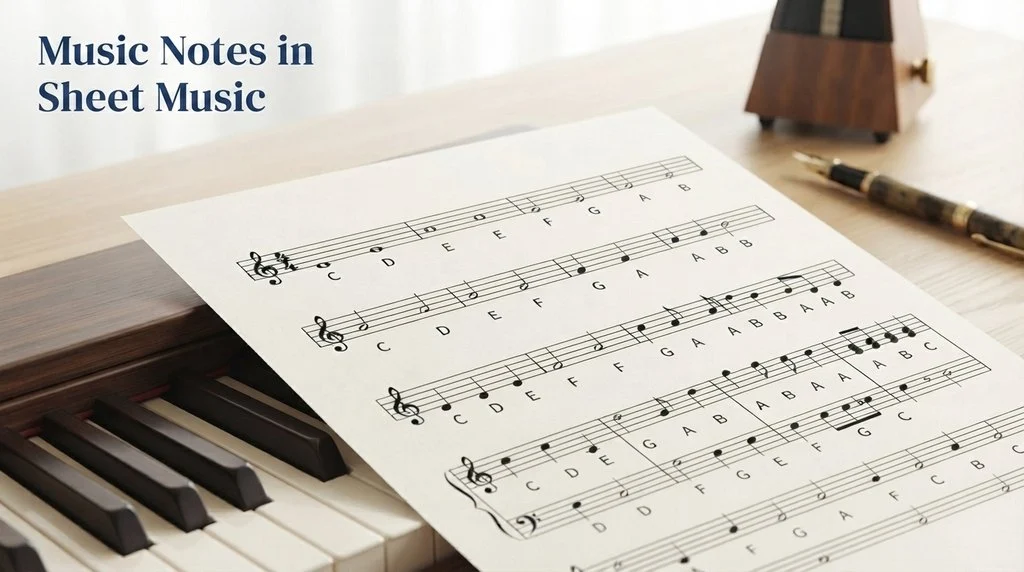
Sheet music is the written language of music.
- Notes appear on lines and spaces
- Staff contains five lines
- Treble clef handles higher notes
- Bass clef handles lower notes
- Notes have different shapes
- Whole notes last longer
- Half notes split timing
- Quarter notes are very common
- Eighth notes move faster
- Rests represent silence
- Time signatures organize rhythm
- Measures divide musical sections
- Ledger lines extend note range
- Dynamics show loudness
- Tempo marks speed
- Sheet music works worldwide
- Classical musicians rely on notation
- Choir singers use sheet music
- Piano students practice reading daily
- Reading notes unlocks endless songs 📖
👉 Have you ever tried reading real sheet music before?
Easy Tricks to Memorize Music Notes Names
Memorization becomes easier with patterns and shortcuts.
- FACE helps remember treble spaces
- Every Good Boy Does Fine is popular
- Mnemonics speed up learning
- Flashcards improve memory
- Repetition builds confidence
- Singing notes helps retention
- Apps make practice fun
- Color coding improves recognition
- Keyboard stickers help beginners
- Daily practice beats long sessions
- Start slowly
- Learn one clef first
- Practice with simple songs
- Watch tutorial videos
- Draw staffs by hand
- Use musical games
- Quiz yourself regularly
- Connect notes to sounds
- Practice with friends
- Celebrate small wins 🎉
👉 Which memory trick works best for you?
Why Music Notes Matter in Songs
Without notes, music could not exist.
- Notes create melodies
- Chords build harmony
- Rhythm depends on timing
- Songs need structure
- Notes trigger emotions
- Different notes change mood
- Major notes sound happy
- Minor notes sound emotional
- Movie soundtracks use note psychology
- Pop songs repeat catchy note patterns
- Jazz explores advanced note choices
- Rock music uses power notes
- EDM layers repeating notes
- Classical music develops themes
- Singing follows note accuracy
- Music producers edit notes digitally
- Notes guide improvisation
- Instrument tuning depends on notes
- Bands communicate using notes
- Every genre relies on note systems 🎵
👉 What song made you fall in love with music?
Major and Minor Music Notes Scales
Scales organize notes into musical patterns.
- Major scales sound brighter
- Minor scales sound sadder
- C major uses no sharps
- A minor shares C major notes
- Scales train the ear
- Piano exercises use scales
- Singers practice scales daily
- Guitarists learn scale boxes
- Jazz musicians master many scales
- Pentatonic scales simplify solos
- Blues scales add emotion
- Harmonic minor sounds dramatic
- Melodic minor changes ascending notes
- Modes create unique feelings
- Scales improve improvisation
- Finger exercises increase speed
- Scale practice boosts confidence
- Beginners should start simple
- Consistency matters most
- Scales are musical roadmaps 🚀
👉 Which sounds better to you: major or minor scales?
Music Notes Names in Singing
Singers depend on notes just like instrumentalists.
- Vocal warmups use scales
- Pitch accuracy matters
- Choirs read notes together
- Harmony requires note matching
- Solfege uses Do Re Mi
- Breath control affects note quality
- High notes need practice
- Low notes require support
- Vibrato colors notes
- Singing apps detect pitch
- Karaoke improves confidence
- Pop singers train note control
- Opera singers master range
- Rappers also follow pitch patterns
- Ear training improves tuning
- Notes help songwriting
- Studio recording edits notes digitally
- Vocal coaches teach note recognition
- Practice builds vocal strength
- Singing becomes easier with theory 🎤
👉 What’s your favorite song to sing loudly?
How Music Notes Work Together
Individual notes become powerful when combined.
- Chords use multiple notes
- Triads contain three notes
- Harmony supports melody
- Bass notes create depth
- Rhythm ties notes together
- Arpeggios separate chord notes
- Countermelodies add texture
- Orchestras layer many notes
- Producers stack sounds digitally
- Songs use repeating progressions
- Tension and release affect emotion
- Dissonance creates drama
- Consonance sounds smooth
- Melodies guide listeners
- Notes form hooks
- Song intros use memorable notes
- Bridges change note flow
- Endings resolve musical tension
- Music theory explains relationships
- Great songs balance simplicity and complexity 🎼
👉 Have you noticed repeating note patterns in famous songs?
Common Mistakes Beginners Make
Many beginners slow themselves down with avoidable mistakes.
- Memorizing without practicing
- Ignoring rhythm completely
- Learning too many scales early
- Skipping ear training
- Avoiding sheet music
- Practicing inconsistently
- Playing too fast
- Forgetting note positions
- Depending only on tabs
- Ignoring posture
- Not using a metronome
- Comparing progress unfairly
- Quitting too early
- Fear of mistakes
- Practicing without goals
- Not listening carefully
- Overcomplicating theory
- Ignoring basics
- Using poor finger placement
- Avoiding repetition 🚫
👉 Which beginner mistake sounds most familiar to you?
Expert Tips to Learn Music Notes Faster
Professionals use smart learning systems.
- Practice daily in short sessions
- Train ears alongside reading
- Use real songs immediately
- Record your progress
- Focus on weak areas
- Slow practice improves accuracy
- Learn intervals early
- Use rhythm exercises
- Study simple melodies first
- Mix fun with discipline
- Repeat difficult sections
- Practice mentally away from instruments
- Watch skilled musicians
- Join music communities
- Use backing tracks
- Improvise creatively
- Teach someone else
- Build muscle memory
- Stay patient during plateaus
- Enjoy the learning process 🌟
👉 What’s your biggest music learning goal this year?
How Music Notes Names Help Songwriting
Songwriters use notes to create emotional stories.
- Melodies start with note choices
- Chords influence mood
- Minor notes feel emotional
- Major notes feel uplifting
- Hooks rely on catchy note patterns
- Repetition builds familiarity
- Bridges change musical direction
- Basslines support energy
- Piano notes inspire melodies
- Guitar riffs create identity
- Vocal notes carry lyrics
- Producers arrange note layers
- Electronic music edits notes digitally
- Songwriting apps suggest notes
- Rhythm and notes work together
- Great choruses use memorable intervals
- Simplicity often wins
- Contrast keeps songs interesting
- Experimentation sparks creativity
- Strong notes create unforgettable songs 🎶
👉 Have you ever tried writing your own melody?
Digital Tools for Learning Music Notes

Technology makes music education easier than ever.
- Piano learning apps
- Virtual keyboards
- Guitar tuner apps
- Ear training software
- MIDI keyboards
- Interactive sheet music
- Online music courses
- YouTube tutorials
- AI music generators
- Rhythm training games
- Digital metronomes
- Recording apps
- Slow-down practice tools
- Music theory websites
- Printable note charts
- Smart instruments
- Singing pitch detectors
- Online jam sessions
- Backing track libraries
- Cloud-based music production 🎧
👉 Which music app do you use the most?
FAQs:
What are the 7 music notes names?
The seven natural music notes are A, B, C, D, E, F, and G. After G, the sequence repeats again. These notes form the foundation of scales, melodies, chords, and songs across all musical instruments.
Why does music start with A instead of C?
Music notation historically evolved over centuries, and the letter A became the first note in the alphabetical system. However, many beginners learn starting from C because the C major scale contains only natural notes.
Are sharps and flats different notes?
Sharps and flats represent slightly higher or lower pitches. For example, C# is one semitone above C, while D♭ is one semitone below D. In many cases, they sound identical on instruments like piano.
How can beginners memorize music notes quickly?
Beginners can memorize notes faster using mnemonics, flashcards, apps, singing exercises, and daily practice. Consistent short practice sessions usually work better than long, exhausting sessions.
What is the easiest instrument for learning notes?
Many beginners find piano easiest because the note layout is visual and organized clearly. However, guitar, ukulele, and singing are also excellent starting points depending on personal preference.
Why are music notes important?
Music notes help musicians read, write, play, and understand music. They create melodies, harmony, rhythm, and emotional expression. Without notes, structured music communication would be impossible.
Do singers need to learn music notes?
Yes. Learning music notes improves pitch accuracy, harmony, ear training, songwriting, and vocal control. Even basic note knowledge can make singing much easier and more professional.
What is Middle C in music?
Middle C is a central piano note commonly used as a beginner reference point. It connects treble and bass clefs and helps musicians understand keyboard positioning and sheet music reading.
Final Thoughts:🎵
Learning music notes names may seem confusing at first, but it becomes surprisingly simple once you understand the patterns. The seven natural notes create the backbone of nearly every song you hear daily.
The secret is consistency. Practice a little every day, connect notes to real songs, and keep things fun instead of stressful. Over time, those mysterious symbols will turn into a language you can actually understand.
Music is not only about theory. It is about emotion, creativity, confidence, and expression. Whether you dream of playing piano, shredding guitar solos, singing confidently, or writing songs, mastering note names is your first big step.

I am Preston Morgan, the creator of Namefluxo, sharing simple, clear, and easy-to-understand content that helps people enjoy and learn online effortlessly.
6 thoughts on “157+ Music Notes Names: Brilliant Ideas 🎵”