

The Jonas biblical meaning is closely connected to the biblical name Jonah, which comes from the Hebrew yônâ, meaning “dove.”
Jonah was an Old Testament prophet called by God to preach to Nineveh. His story is about more than a great fish. It explores obedience, repentance, mercy, God’s sovereignty, and the danger of allowing personal feelings to resist God’s purposes.
Quick Answer:

Jonas means “dove” in the biblical tradition. Jonas is the Greek form of the Hebrew name Jonah, written yônâ (יוֹנָה). The name refers to a dove or pigeon.
In Scripture, Jonah was a prophet and son of Amittai whom God sent to Nineveh. His story teaches important lessons about obedience, repentance, compassion, and God’s mercy toward people from every nation.
The name itself does not mean “obedient,” “prophet,” or “peaceful person.” Those ideas may be connected devotionally to the story, but they are not the direct lexical meaning of Jonas.
Jonas and Jonah: Are They the Same Biblical Name?
Yes. Jonas is a form of Jonah.
The Hebrew Old Testament uses יֹונָה (Yônâ), while the Greek form is Iōnas. English translations generally use Jonah, but Jonas appears in some New Testament and traditional translation forms.
| Name | Language/Form | Meaning |
|---|---|---|
| Jonah | Hebrew/English | Dove |
| Jonas | Greek form | Dove |
| Yônâ | Hebrew | Dove or pigeon |
| Iōnas | Greek | Jonah/Jonas |
So, if someone asks about the biblical meaning of the name Jonas, the clearest answer is:
Jonas means “dove,” and it is the Greek form of Jonah.
This distinction matters because the name Jonas can sometimes be treated as though it belongs to a completely different biblical character. In the New Testament, “Jonas” is used for Jonah in passages such as Matthew 12:39–41 and Luke 11:29–32.
The Hebrew Meaning of Jonas
Jonas comes from the Hebrew name Jonah
The Hebrew name behind Jonah is yônâ (יוֹנָה). Biblical Hebrew dictionaries identify yônâ with a dove or pigeon.
That makes “dove” the safest and most direct meaning when discussing Jonas from a biblical perspective.
The Bible uses the same Hebrew word for the bird in other contexts. It is not a word invented specifically for the prophet Jonah. The name comes from an ordinary Hebrew word for a dove or pigeon.
Does “dove” have spiritual symbolism?
It can, but we should be careful.
The Bible uses doves in several meaningful settings. Doves could be associated with sacrifices, mourning, love, and other images. However, Scripture does not explicitly say that Jonah’s name predicts his personality or ministry.
That means Christians can reflect on the symbolism of a dove, but should not turn that reflection into a biblical fact.
A helpful distinction is:
| Statement | Biblical status |
|---|---|
| Jonas/Jonah means “dove” | Biblical language fact |
| Jonah was a prophet | Biblical fact |
| Jonah was sent to Nineveh | Biblical fact |
| Jonah struggled with obedience | Clearly shown in Scripture |
| The dove symbol predicts Jonah’s character | Not stated by Scripture |
| Jonas means “peaceful” | Not the direct Hebrew meaning |
This approach keeps the meaning of the name grounded in Scripture rather than adding symbolism that the Bible itself does not give.
Who Was Jonah in the Bible?
Jonah was a prophet of Israel and the son of Amittai. He is identified in 2 Kings 14:25 as a prophet from Gath-hepher who lived during the reign of Jeroboam II.
The Book of Jonah gives us the better-known part of his story.
God told Jonah to go to Nineveh, a major Assyrian city, and preach against its wickedness. Instead, Jonah attempted to flee in the opposite direction.
A storm followed him onto the sea. Jonah was eventually thrown overboard, and the biblical account says that God appointed a great fish to swallow him. After Jonah prayed, God delivered him, and Jonah received his commission again.
This time, he went to Nineveh.
The people responded to his warning with repentance. God showed mercy to them, but Jonah became angry about that mercy.
That final part is essential to understanding the book.
Jonah’s greatest problem was not simply that he ran away. His deeper struggle was that he did not want mercy to be shown to people he believed deserved judgment.
What Is the Main Message of Jonah?

The central message of Jonah is not simply “obey God or you will be punished.”
The book goes deeper.
It shows that:
- God is sovereign over His creation.
- God takes sin seriously.
- God can call His people to difficult assignments.
- Genuine repentance matters.
- God’s mercy can reach people we might consider undeserving.
- God’s compassion is broader than human prejudice.
- Religious service does not automatically produce a compassionate heart.
- God cares about people beyond one nation’s boundaries.
The Book of Jonah ends with God’s question about Nineveh rather than a simple statement about Jonah’s final response. That ending forces the reader to examine his or her own heart.
Bible Gateway’s biblical encyclopedia notes that the book emphasizes God’s universal rule and His mercy toward people from different nations, while repentance remains central to receiving that mercy.
Jonah’s Story in Four Important Stages
The story becomes easier to understand when viewed as a spiritual journey.
| Stage | What happens | Main lesson |
|---|---|---|
| 1. Calling | God sends Jonah to Nineveh | God gives His servants assignments |
| 2. Running | Jonah flees from God’s command | Disobedience cannot hide from God |
| 3. Returning | Jonah prays and is delivered | God can restore a struggling servant |
| 4. Learning | Nineveh repents and Jonah becomes angry | God’s mercy may challenge our own hearts |
Jonah’s story is therefore not simply about failure.
It is also about God’s patience with a flawed servant.
Why Did Jonah Run From God?
Jonah did not run because he misunderstood the assignment.
He knew exactly where God wanted him to go.
Jonah 1:2 tells him to go to Nineveh. Jonah 1:3 then describes his attempt to flee. Later, Jonah explains why he did not want to go.
He knew that God is “gracious and merciful, slow to anger and abounding in steadfast love” (Jonah 4:2).
That is one of the most surprising details in the story.
Jonah was afraid that Nineveh might actually repent and receive mercy.
His problem was not that he doubted God’s ability to judge Nineveh. He struggled with God’s willingness to forgive.
A lesson for Christians today
Sometimes obedience becomes difficult when God’s answer does not match our personal feelings.
We may happily pray for mercy when we need it.
But we may struggle when God extends patience to someone who has hurt us.
Jonah reminds Christians that following God is not only about doing what He commands. It also involves allowing God to shape how we see other people.
What Does the Dove Symbolize in the Bible?
The dove has several biblical associations, but these should not automatically be transferred to Jonah.
Doves can appear in worship and sacrifice
Doves and pigeons appear in Old Testament sacrificial laws. They were especially important as offerings available to people who could not afford more expensive animals.
Doves can represent tenderness or mourning
The biblical imagery of doves can also communicate emotional qualities. Scripture sometimes uses dove imagery in poetic descriptions of love, sorrow, or vulnerability.
The Holy Spirit and the dove
Christians may naturally connect the word “dove” with the baptism of Jesus, where the Holy Spirit descends “like a dove” (Matthew 3:16).
But this does not mean Jonah’s name specifically predicts the Holy Spirit or gives Jonah a special connection to the Spirit.
The two ideas should remain separate.
Jonas means “dove.” The Holy Spirit’s appearance like a dove is a separate biblical image.
That distinction protects the meaning from becoming overly symbolic.
What Does Jonas Mean Spiritually?
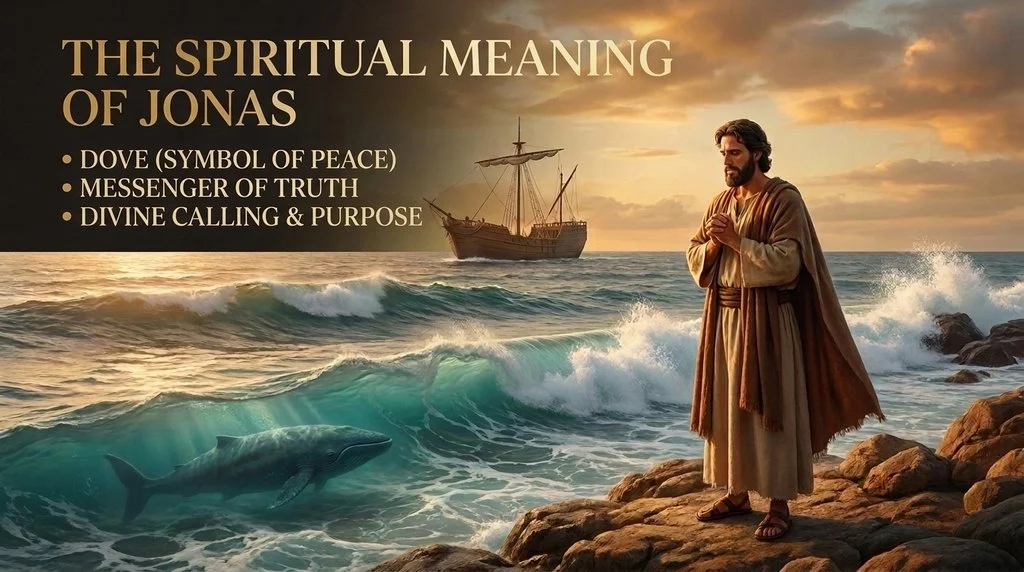
The direct biblical meaning of Jonas is “dove.”
The spiritual lessons associated with Jonah’s life, however, are much broader.
Obedience matters even when the assignment is difficult
Jonah did not receive an easy assignment.
Nineveh was not a place he wanted to visit. Yet God called him to go.
Christian obedience often involves trusting God when the path is uncomfortable.
God can restore people after failure
Jonah ran.
He resisted.
He experienced severe consequences.
Yet God spoke to him again.
Jonah 3:1 begins with another divine command to Jonah after his deliverance.
That is a powerful picture of restoration.
Failure does not mean God has finished with a person.
At the same time, restoration does not mean that disobedience does not matter. Jonah’s story shows both truths together: God disciplines, and God restores.
God’s mercy is bigger than our preferences
Jonah wanted judgment.
God showed compassion.
This tension is one of the strongest spiritual lessons in the book.
Christians are called to take sin seriously while also remembering that God delights in mercy.
God cares about people outside our circle
Nineveh was a foreign city and an enemy of Israel.
Yet God cared about its people.
The book challenges narrow thinking about who deserves God’s attention.
What Does Jonah Teach Christians About God’s Mercy?
Jonah 4 is especially important.
After Nineveh repents, Jonah becomes angry because God does not destroy the city.
God then uses a plant, a worm, and the heat to teach Jonah a lesson.
Jonah feels deeply upset about the plant.
God contrasts Jonah’s concern for the plant with God’s concern for the people of Nineveh.
The point is striking:
Jonah cared more about his personal comfort than about the lives of thousands of people.
The story does not minimize evil. Nineveh’s wickedness was serious. But it demonstrates that repentance can lead to mercy.
This is consistent with a broader biblical picture of God as compassionate and ready to forgive those who turn from sin.
Jonas Biblical Meaning and Christian Character
If you are considering Jonas as a Christian baby name, it is helpful to separate the name’s literal meaning from the life lesson associated with its biblical bearer.
Literal meaning
Jonas = dove.
Biblical association
Jonas/Jonah = the prophet sent to Nineveh.
Major character lessons
Obedience: Jonah had to learn to follow God’s command.
Repentance: Nineveh responded to God’s warning with repentance.
Mercy: God demonstrated compassion toward repentant people.
Humility: Jonah needed to learn that God’s perspective was greater than his own.
Calling: Jonah’s personal reluctance did not cancel God’s purpose.
These associations can make Jonas a meaningful Christian name, but parents should not assume that giving a child the name guarantees any particular personality or spiritual destiny.
What Does the Bible Say About Jonah and Jesus?

The New Testament gives Jonah special importance.
Jesus referred to Jonah when speaking about His own death and resurrection.
In Matthew 12:39–40, Jesus described the “sign of Jonah” in connection with Jonah’s experience in the great fish and the Son of Man’s coming death and resurrection.
Jesus also compared the response of the Ninevites with the response of His generation. The Ninevites responded to Jonah’s preaching, while Jesus was greater than Jonah.
This creates an important Christian connection.
Jonah’s story points beyond the prophet himself.
Jonah and Christ are not equal
There is a crucial difference.
Jonah was a reluctant and disobedient prophet.
Jesus was perfectly obedient to the Father.
Jonah eventually went to Nineveh after resisting.
Jesus willingly carried out the Father’s saving mission.
So, when Christians see Jonah as pointing toward Christ, it should not erase the contrast between Jonah’s weakness and Jesus’ perfect obedience.
Bible Gateway’s biblical encyclopedia notes that the New Testament interprets Jonah’s three days in the fish in relation to Jesus’ death and resurrection and also contrasts the Ninevites’ response with the response to Jesus.
Jonas Biblical Meaning vs. Popular Name Meanings
Many baby-name websites attach extra qualities to Jonas, such as “peace,” “gentleness,” “hope,” or “messenger.”
Some of these may be reasonable devotional associations, but they should not be presented as the literal biblical definition.
| Meaning or claim | Biblical support |
|---|---|
| Dove | Strong |
| Pigeon | Strong |
| Jonah/Jonas | Strong |
| Prophet | Describes Jonah, not the word’s meaning |
| Messenger | Describes his role, not the name’s meaning |
| Peace | Not the direct Hebrew meaning |
| Obedience | A lesson from his story, not the lexical meaning |
| Mercy | A major theme of the book, not the literal meaning |
This distinction is important for trustworthy Christian naming content.
A name can have a direct linguistic meaning and a separate spiritual association. They are not necessarily the same thing.
What the Bible Does Not Say About Jonas
A careful Christian explanation should also identify what Scripture does not say.
The name Jonas does not mean “prophet”
Jonah was a prophet, but yônâ means “dove.”
The name does not mean “obedient”
Jonah’s story actually begins with disobedience.
The name does not guarantee peace
Although a dove can carry peaceful associations in modern culture, the biblical word itself does not mean “peace.”
The Bible does not say Jonah was a perfect example
He obeyed eventually, but his anger in chapter 4 shows that his heart still needed correction.
Scripture does not tell us that Jonah’s name predicted his destiny
That is an interesting idea, but it goes beyond what the biblical text says.
Staying with what Scripture actually teaches makes the interpretation stronger, not weaker.
5 Major Lessons From the Life of Jonah
1. You cannot outrun God’s presence
Jonah attempted to flee from his assignment, but he could not escape God’s presence.
Psalm 139 gives the broader biblical truth that God’s presence cannot be escaped.
For Christians, this can be comforting.
God is not absent when obedience becomes difficult.
2. Delayed obedience is still disobedience
Jonah knew what God commanded.
His problem was not confusion.
He simply did not want to do it.
That is a useful warning for believers who keep postponing something they already know they should do.
3. God can use imperfect people
Jonah was flawed, yet God still used his preaching.
This does not excuse sin.
Instead, it shows that God’s purposes are not dependent on human perfection.
4. Repentance should lead to changed behavior
Nineveh’s response is one of the strongest examples of repentance in the Old Testament.
They heard the warning and responded with humility.
The Christian lesson is simple: repentance is more than feeling bad. It turns a person toward God.
5. God’s compassion should reshape our hearts
Jonah wanted mercy for himself but struggled with mercy toward others.
Christians can fall into the same trap.
We may want forgiveness when we fail but justice when someone else fails.
Jonah asks us to examine that inconsistency.
A Simple Christian Reflection on the Name Jonas
If your name is Jonas, or you are considering Jonas for a child, the biblical story offers a meaningful reflection:
Am I willing to follow God even when His direction challenges my preferences?
The question is more important than trying to find a hidden prophecy inside the name.
The name reminds us of Jonah.
Jonah’s story reminds us that God is sovereign, patient, merciful, and concerned with the nations.
That is a much richer Christian association than simply attaching a list of personality traits to the name.
Biblical Verses Connected With Jonah
| Scripture | Why it matters |
|---|---|
| 2 Kings 14:25 | Identifies Jonah as a prophet and son of Amittai |
| Jonah 1:1–3 | God calls Jonah and Jonah runs |
| Jonah 1:9 | Jonah identifies the Lord as the God of heaven |
| Jonah 2:1–10 | Jonah prays from inside the fish |
| Jonah 3:1–10 | Jonah obeys and Nineveh repents |
| Jonah 4:1–11 | God teaches Jonah about mercy |
| Matthew 12:39–41 | Jesus refers to the sign of Jonah |
| Luke 11:29–32 | Jesus again uses Jonah’s story as a comparison |
Jonah’s story is therefore connected to both the Old Testament prophetic tradition and Jesus’ teaching in the New Testament.
Is Jonas a Good Christian Name?
Yes, Jonas can be a meaningful Christian name, especially for families who appreciate biblical names connected with God’s mercy and calling.
But its meaning should be understood accurately.
Jonas means “dove.”
The name is connected to Jonah, the prophet whose story teaches about:
- God’s calling
- obedience
- repentance
- mercy
- forgiveness
- humility
- God’s concern for the nations
There is also an important warning in the story.
Jonah was God’s servant, but he still needed God to correct his heart.
That makes the name especially interesting because the biblical story is honest about human weakness. It does not present Jonah as flawless.
Is Jonas a Biblical Name?
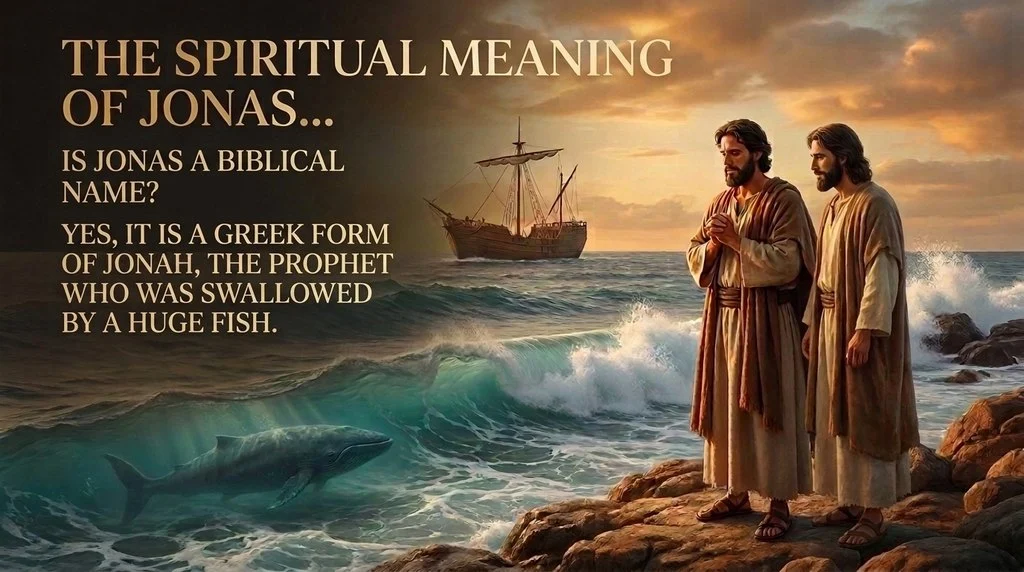
Yes.
Jonas is a biblical form of Jonah. The Greek form appears in the New Testament tradition, while Jonah is the common English form.
The prophet Jonah is explicitly identified in 2 Kings 14:25, and the Book of Jonah tells his story.
So Jonas is not merely a modern variation that happens to sound biblical.
It has a genuine biblical-language connection.
Is Jonas a Hebrew or Greek Name?
The answer depends on which form you mean.
Jonah is the Hebrew form associated with yônâ, meaning “dove.”
Jonas is the Greek form used for Jonah.
So when someone asks, “Is Jonas Hebrew?” the most accurate answer is that Jonas is the Greek form of the Hebrew biblical name Jonah.
Is Jonah’s Name Connected to the Dove?
Yes, linguistically.
The Hebrew word yônâ means “dove” or “pigeon,” and this same word is used elsewhere in the Old Testament for the bird.
However, Scripture does not explicitly interpret Jonah’s name as a prophecy about his personality.
That is an important distinction.
The name’s meaning is certain.
The additional symbolism is a matter of interpretation.
Does Jonah’s Story Mean God Forgives Everyone Without Repentance?
No.
Jonah’s story strongly highlights God’s mercy, but the Ninevites respond to Jonah’s warning with repentance.
The book therefore should not be used to claim that repentance does not matter.
Instead, it shows the opposite: God’s warning can lead people to turn from their evil, and God responds with mercy.
This fits the broader biblical pattern in which God calls people to turn from sin.
What Can Christians Learn From Jonah Today?
Jonah’s world was ancient, but his heart struggles remain familiar.
A Christian may know God’s command but resist it because the assignment feels uncomfortable.
A believer may want God to forgive personal failures while finding someone else’s failure difficult to forgive.
A church may care deeply about people who are similar to its members while becoming indifferent toward outsiders.
Jonah confronts all three attitudes.
His story encourages Christians to ask:
- Am I obeying God or avoiding something He has clearly asked me to do?
- Do I trust God’s wisdom when I disagree with His direction?
- Am I willing to show mercy to people I dislike?
- Do I care about people or only about my own comfort?
- Does my view of others reflect God’s compassion?
These questions turn the story from ancient history into personal discipleship.
A Short Prayer Inspired by Jonah
Lord, help me obey You even when Your calling is difficult. Give me a heart that values people the way You do. Keep me from running from Your will or becoming angry when You show mercy.
Teach me humility, compassion, repentance, and faithful obedience. Help me trust Your wisdom even when I do not understand Your ways. Amen.
FAQs:
What does Jonas mean in the Bible?
Jonas means “dove.” It is the Greek form of the Hebrew name Jonah, which comes from yônâ. The name is connected with the prophet Jonah, who was sent by God to preach to Nineveh.
Is Jonas the same as Jonah in the Bible?
Yes. Jonas is the Greek form of Jonah. English Bibles commonly use “Jonah,” while “Jonas” appears in traditional New Testament forms and in the Greek name behind passages referring to Jonah.
What is the Hebrew meaning of Jonas?
The Hebrew name behind Jonas is Jonah, or Yônâ, meaning “dove” or “pigeon.” This is the direct linguistic meaning rather than a symbolic interpretation.
What does Jonah symbolize in Christianity?
Jonah’s story is often understood as illustrating obedience, repentance, God’s mercy, and His concern for the nations. Jesus also used Jonah’s experience as the “sign of Jonah,” connecting it with His death and resurrection.
What is the spiritual lesson of Jonah?
One major lesson is that God’s mercy can be much wider than our personal preferences. Jonah wanted judgment for Nineveh, while God demonstrated compassion when the people responded to the warning. The story also teaches obedience and humility.
Was Jonah a good prophet?
Jonah was genuinely called by God and delivered God’s message, but Scripture also openly records his disobedience and anger. He is therefore not presented as a flawless prophet. His story shows both God’s use of imperfect servants and God’s correction of their hearts.
Why did Jonah not want to preach to Nineveh?
Jonah feared that Nineveh might repent and receive God’s mercy. In Jonah 4:2, he explains that he knew God was gracious, compassionate, slow to anger, and rich in mercy. His anger reveals how strongly he struggled with God’s compassion toward his enemies.
Does Jonas mean “peace”?
Not directly. The biblical meaning of Jonas is “dove.” Peace may be a modern symbolic association with doves, but it should not be presented as the literal Hebrew meaning of the name.
Is Jonas a good Christian baby name?
Yes. Jonas has a genuine biblical connection and means “dove.” Its connection with Jonah also gives it rich associations with obedience, repentance, mercy, calling, and God’s compassion. Parents should distinguish these biblical lessons from the name’s literal meaning.
What does Jonah teach us about God’s mercy?
Jonah teaches that God’s mercy is not limited by human preference. Nineveh was an enemy city, yet God cared about its people and responded to their repentance. The book challenges believers to reflect God’s compassion rather than deciding that certain people are beyond mercy.
Conclusion:
The Jonas biblical meaning is straightforward: “dove.” Jonas is the Greek form of the Hebrew name Jonah, and the name is connected to one of the Old Testament’s most memorable prophets.
But Jonah’s story gives the name much deeper Christian significance. His life reminds us about obedience, repentance, humility, God’s sovereignty, and the surprising reach of divine mercy.
Most importantly, Jonah teaches that God’s heart can be bigger than our own. We may struggle to forgive, understand, or care for certain people, but God calls His people to trust His wisdom and reflect His compassion.

I’m Chris Robert, a writer at NameFluxo who explores the deeper meanings behind biblical names, words, dreams, and spiritual symbols. I enjoy turning Bible-based insights into clear, simple, and meaningful articles that help readers understand their faith and Scripture better.