
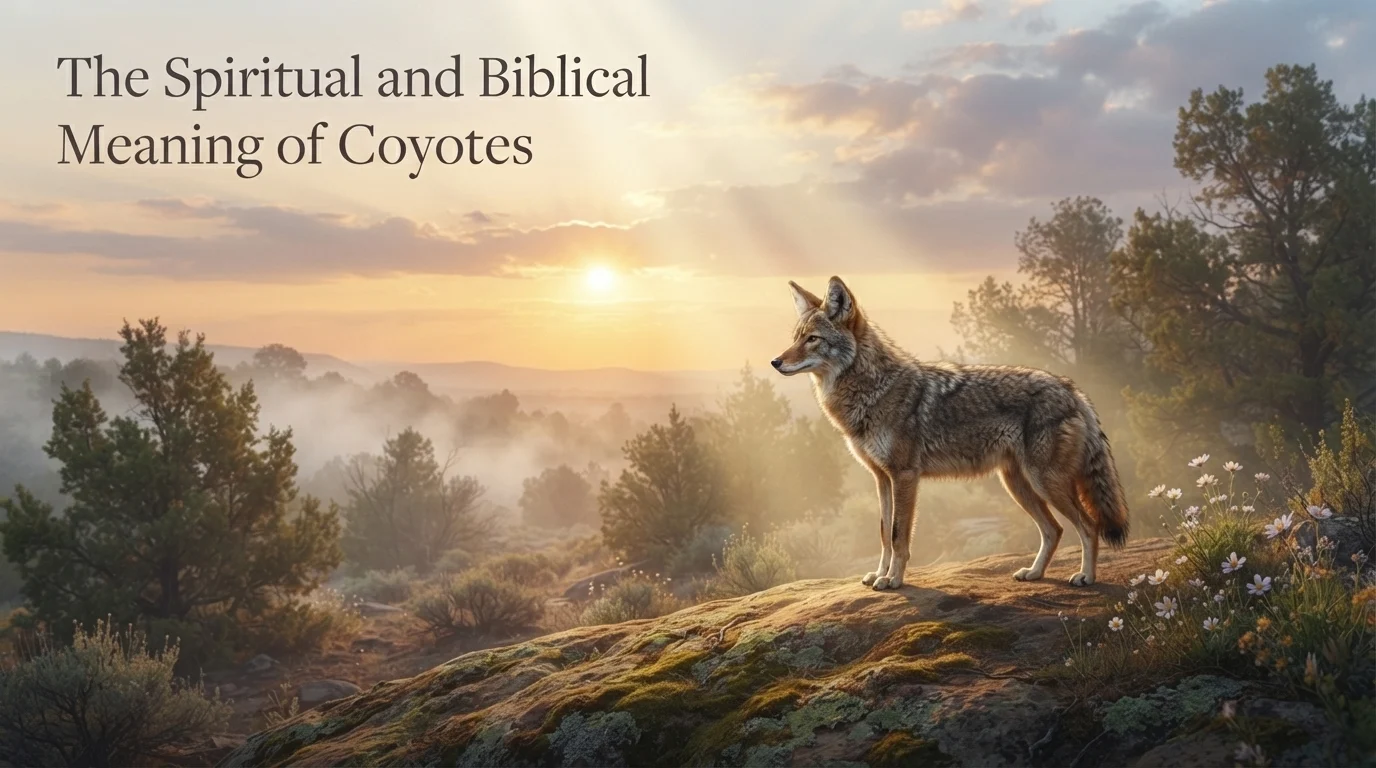
A coyote can be an unforgettable sight.
You may see one crossing a road at night, hear one calling in the distance, or dream about a coyote standing near your home. Because the animal is often associated with wilderness, cleverness, danger, and survival, it is natural to wonder whether the encounter has a deeper spiritual meaning.
For Christians, however, there is an important starting point: the Bible does not specifically identify the coyote as a spiritual symbol.
Coyotes are native to North America and belong to the dog family. They are highly adaptable animals that live in many environments, including forests, deserts, grasslands, and urban areas. The National Park Service describes them as intelligent and adaptable predators that often live in family groups and communicate through vocal calls.
So, when asking about the spiritual and biblical meaning of coyotes, we should not treat popular symbolism as biblical fact.
Instead, we can ask a better question:
What biblical truths can help a Christian think wisely about a coyote, a coyote dream, or a repeated encounter with one?
That approach keeps Scripture at the center while still allowing room for personal reflection, prayer, and spiritual discernment.
Quick Answer:

The Bible does not give the coyote a specific symbolic meaning because coyotes are not directly mentioned in Scripture. Therefore, Christians should not claim that seeing a coyote automatically means danger, deception, spiritual attack, or a divine message.
However, a coyote can become a useful point of biblical reflection on wisdom, alertness, adaptability, creation, fear, discernment, and dependence on God.
The meaning of a dream or encounter depends on its context, your circumstances, and whether the interpretation agrees with Scripture.
Are Coyotes Mentioned in the Bible?
The simple biblical answer
No. The modern North American coyote, Canis latrans, is not specifically named in the Bible.
This matters because many articles online assign a fixed biblical meaning to animals that Scripture never directly discusses.
Coyotes are native to North and Central America. Historical records and modern wildlife research show that their range expanded greatly across North America, and they are now found in many different habitats.
The Bible was written in the ancient Near Eastern world, long before modern North American wildlife terminology existed.
Therefore, it would be inaccurate to say:
“The Bible says coyotes represent deception.”
It does not.
A more responsible Christian approach is to examine biblical references to animals that Scripture actually discusses and then apply broader biblical principles carefully.
Coyote vs. Biblical Animals
Some people connect coyotes with animals mentioned in Scripture, especially jackals, wolves, dogs, or foxes.
That comparison can be useful only if we do not confuse the animals.
| Animal | Mentioned in Bible? | Biblical symbolism? | Same as a coyote? |
|---|---|---|---|
| Coyote | No | No fixed biblical symbolism | — |
| Wolf | Yes | Often associated with danger or false teachers | No |
| Jackal | Yes | Often connected with desolation and ruined places | No |
| Dog | Yes | Meaning varies by context | No |
| Fox | Yes | Sometimes associated with destruction or cunning | No |
Modern coyotes have sometimes been called “prairie wolves,” “brush wolves,” or even “American jackals,” but these common names do not make them the biblical animals bearing those names.
The National Park Service notes these alternative names while identifying the animal scientifically as Canis latrans.
That distinction is important for biblical accuracy.
What Does Scripture Say About Similar Animals?
Wolves: a warning about false teachers
Jesus used wolves as an image of spiritual danger:
“Beware of false prophets, who come to you in sheep’s clothing but inwardly are ravenous wolves.” — Matthew 7:15
Here, the wolf represents something harmful hiding behind an innocent appearance.
Paul also warned the elders at Ephesus about “fierce wolves” entering among God’s people (Acts 20:29).
Because of these passages, Christians may naturally associate wolf-like animals with danger or deception.
But that symbolism belongs to the biblical context of wolves.
It should not automatically be transferred to coyotes.
Jackals: desolation and abandoned places
Jackals appear in several Old Testament passages.
Isaiah 34:13, for example, describes ruined places becoming a dwelling place for jackals.
This imagery is connected with judgment, destruction, and desolation in its context.
Again, this does not establish a biblical meaning for coyotes.
Dogs: different meanings in different passages
Dogs also appear throughout Scripture.
Sometimes dogs are associated with contempt or impurity. In other contexts, they are simply animals in the cultural setting of the passage.
This teaches us an important lesson:
Biblical animal symbolism is contextual.
You cannot take one reference and create a universal meaning for every animal that looks similar.
The Spiritual Meaning of Coyotes
Since Scripture does not assign coyotes a specific meaning, any spiritual interpretation should be presented as reflection rather than revelation.
Several themes can provide helpful Christian reflection.
1. Wisdom and discernment
Coyotes are highly adaptable animals. They can live in many environments and adjust their behavior to changing conditions. The National Park Service describes them as remarkably adaptable and successful in different habitats.
This can remind Christians of the importance of wisdom.
Proverbs 4:7 says:
“The beginning of wisdom is this: Get wisdom.”
Christian wisdom is not simply cleverness.
It means learning to recognize what is good, avoiding what is harmful, and making decisions that honor God.
If a coyote encounter makes you think about discernment, ask:
Where do I need greater wisdom right now?
2. Alertness
Coyotes are often active around dawn, dusk, and nighttime, and their vocal calls can carry over long distances.
This can provide a simple spiritual reminder about staying alert.
Peter wrote:
“Be sober-minded; be watchful.” — 1 Peter 5:8
The verse is not about coyotes.
Its subject is spiritual vigilance.
Still, seeing an alert wild animal can remind a believer to examine his or her own spiritual life.
Are you becoming careless about temptation?
*Are you ignoring warning signs?
Are you paying attention to God’s Word?
Those are far more important questions than trying to decode the animal itself.
3. Adaptability without compromising faith
Coyotes have survived in changing environments because they are highly adaptable. Research and National Park Service observations show that they have expanded into many habitats, including human-dominated areas.
For Christians, adaptability can be a useful lesson.
Our circumstances change.
Jobs change.
Relationships change.
Technology changes.
Communities change.
But Christian faith should not be built on changing circumstances.
Romans 12:2 teaches believers not to be conformed to the world but to be transformed by the renewing of their minds.
The lesson is:
Adapt your methods when necessary, but do not surrender biblical truth.
4. Survival and dependence on God
A coyote’s ability to survive difficult conditions may remind a Christian of perseverance.
Scripture repeatedly encourages believers to endure hardship.
James 1:2–4 teaches that trials can produce perseverance and maturity.
But there is a major difference between biblical perseverance and self-reliance.
The Christian message is not:
“I can survive everything by myself.”
It is:
“God gives me strength to remain faithful.”
Philippians 4:13 should therefore be understood in its biblical context of learning contentment in different circumstances, not as a promise that believers will accomplish every personal goal.
5. The value of God’s creation
A coyote can also simply remind you of the creativity and variety of God’s creation.
Genesis 1 repeatedly describes God’s creation as good.
Psalm 104 celebrates God’s provision for creatures throughout the natural world.
You do not need to turn every animal into a hidden message.
Sometimes an animal can simply cause you to stop, notice creation, and thank God.
That can be spiritually meaningful without becoming mystical.
What Does Seeing a Coyote Mean Spiritually?
Seeing a coyote does not automatically mean that God is sending you a specific message.
A Christian may see a coyote because coyotes live in the area.
That explanation may be completely ordinary.
At the same time, an encounter can become an opportunity for personal reflection.
For example, seeing a coyote might remind you to:
- Pray for wisdom.
- Pay attention to your surroundings.
- Examine a difficult decision.
- Trust God during uncertainty.
- Practice healthy caution.
- Reflect on God’s creation.
- Remain faithful during changing circumstances.
- Avoid fear-driven superstition.
The key is to distinguish between a personal reminder and a biblical promise.
That distinction protects Christians from both extremes: ignoring spiritual reflection completely or assigning supernatural meaning to everything.
What Does a Coyote Mean in a Dream?

The Bible does not give a coyote dream dictionary
This is one of the most important points.
The Bible contains dreams and visions, but it does not provide a universal dictionary saying:
- coyote = deception
- black coyote = evil
- white coyote = blessing
- attacking coyote = spiritual warfare
- howling coyote = warning
Those formulas are not biblical rules.
Some dreams in Scripture clearly carried significance.
Joseph received dreams in Genesis.
Daniel interpreted dreams by God’s help.
Joseph, the husband of Mary, received divine guidance through dreams in Matthew 1–2.
But Scripture also warns against false spiritual claims.
Therefore, Christians should never assume that every dream comes directly from God.
A coyote attacking you in a dream
If you dream that a coyote is attacking you, the dream may reflect fear, stress, conflict, vulnerability, or something you have recently experienced.
A Christian should not immediately conclude:
“A demon is attacking me.”
Instead, pray and examine your life.
Ask:
- What was I feeling in the dream?
- Am I facing conflict?
- Is there something I fear?
- Am I feeling unsafe or pressured?
- Have I recently seen or thought about coyotes?
- Is there a real-life situation requiring wisdom?
- Does any interpretation agree with Scripture?
The dream may be psychologically meaningful without being prophetic.
A peaceful coyote in a dream
A calm coyote does not have a fixed biblical meaning either.
You might use the dream as a prompt to reflect on wisdom, adaptability, creation, or a situation that requires careful attention.
But do not build a major life decision on the dream alone.
Scripture, prayer, wise counsel, and sound judgment should carry much greater weight.
A coyote chasing you
A chasing dream can feel intense.
It may represent anxiety or a sense that something in your life is difficult to escape.
But there is no biblical rule that says a coyote chasing you means a particular spiritual enemy.
Instead, bring the fear to God.
Psalm 56:3 gives a simple principle:
“When I am afraid, I put my trust in you.”
The biblical response to fear is trust.
Positive and Negative Symbolism
Because the Bible does not define coyote symbolism, these categories should be treated as possible reflections, not established doctrine.
| Possible reflection | Helpful Christian question |
|---|---|
| Alertness | What am I failing to notice? |
| Wisdom | Where do I need God’s guidance? |
| Adaptability | How can I adjust without compromising faith? |
| Caution | Is there a genuine danger I should address? |
| Perseverance | Where am I being called to remain faithful? |
| Fear | What am I trusting instead of God? |
| Cleverness | Am I using wisdom or manipulation? |
| Wilderness | Am I experiencing a season of uncertainty? |
| Solitude | Do I need healthy time with God? |
| Creation | Have I paused to appreciate God’s work? |
When a Coyote May Represent Caution
There are situations where the image of a coyote may naturally make you think about caution.
Coyotes are wild animals and should be treated with respect. The National Park Service advises people not to approach or feed them because habituated wildlife can create safety problems.
This gives us a practical Christian lesson:
Faith does not eliminate wisdom.
Jesus told His followers to be “wise as serpents and innocent as doves” (Matthew 10:16).
Being cautious is not the same as being afraid.
A wise Christian can recognize danger without becoming controlled by fear.
When a Coyote May Remind You of Spiritual Discernment
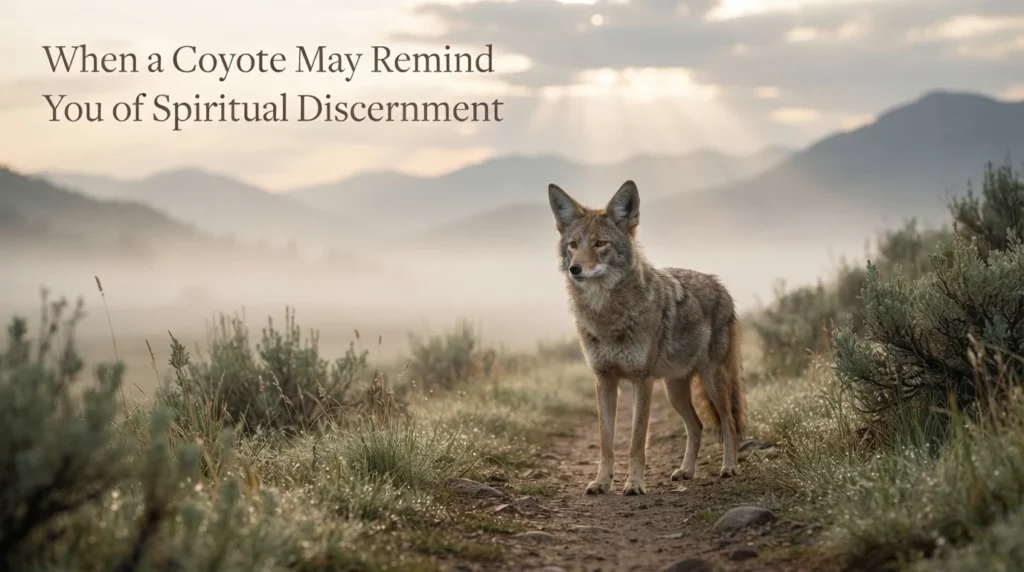
Discernment is one of the strongest biblical applications.
Not everything that looks spiritual is from God.
*Not every dream is a prophecy.
Not every coincidence is a divine sign.
*Not every unusual event carries a hidden message.
John writes:
“Do not believe every spirit, but test the spirits.” — 1 John 4:1
That principle is extremely useful when thinking about animal symbolism.
If someone tells you, “God sent the coyote to tell you that something terrible will happen,” you do not have to accept that claim.
Test it.
Does it agree with Scripture?
Does it produce truth and godly wisdom?
Is there evidence?
Is fear being manipulated?
Does the message point you toward Christ or toward superstition?
Biblical discernment protects believers from unnecessary fear.
What the Bible Does NOT Say About Coyotes
A trustworthy Christian article should also explain what Scripture does not say.
The Bible does not say:
- Coyotes are demonic animals.
- Seeing a coyote guarantees spiritual warfare.
- Coyotes always represent deception.
- A coyote dream predicts death.
- A coyote crossing your path is a prophecy.
- Coyotes are cursed animals.
- A coyote howl is a supernatural warning.
- Every repeated coyote sighting is a message from God.
- The color of a coyote determines its spiritual meaning.
- Christians should fear coyotes because of biblical symbolism.
These claims go beyond Scripture.
Christian faith should be based on God’s revealed Word rather than fear-based animal interpretations.
Biblical Meaning vs. Popular Spiritual Beliefs
| Popular belief | Biblical assessment |
|---|---|
| Coyotes always symbolize deception | Not established by Scripture |
| Coyote dreams are prophetic | Not necessarily |
| Coyotes represent evil spirits | No biblical basis |
| Seeing a coyote means danger is coming | Not a biblical rule |
| A coyote can remind someone to seek wisdom | Reasonable personal reflection |
| Nature can inspire praise of God | Consistent with Scripture |
| Christians should test spiritual claims | Strongly biblical |
| Fear should control our decisions | Contrary to biblical trust |
This distinction is essential for responsible Christian teaching.
How Christians Should Respond to a Coyote Encounter
1. Stay calm
If you see a coyote, first respond naturally.
Do not panic.
Do not assume something supernatural is happening.
Remember that coyotes are ordinary wild animals living in many North American environments.
2. Use practical wisdom
Keep a safe distance.
Do not approach or feed the animal.
If the coyote behaves unusually or aggressively, follow local wildlife guidance.
Faith and common sense work together.
3. Pray if the encounter prompts reflection
You might simply pray:
“Lord, help me notice what You want me to learn from this moment, and keep me grounded in Your Word.”
That prayer does not assume the coyote carries a secret message.
It simply invites God to use the moment for reflection.
4. Examine your circumstances
Ask whether there is a real issue in your life that requires attention.
Perhaps you are facing:
- A difficult decision.
- A stressful relationship.
- A season of uncertainty.
- A temptation.
- A major change.
- Fear about the future.
- A need for better boundaries.
The animal may not be the message.
The encounter may simply have caused you to stop and think about something that already needs attention.
5. Compare every interpretation with Scripture
This is the most important step.
If an interpretation contradicts Scripture, reject it.
- If it encourages fear without biblical foundation, be cautious.
If it points you toward prayer, wisdom, repentance, love, and trust in God, it may provide a useful moment for reflection.
A Simple Biblical Discernment Test
When an unusual animal encounter or dream feels spiritually important, use this five-step process.
| Step | Question |
|---|---|
| 1. Pause | Am I reacting from fear? |
| 2. Pray | Have I asked God for wisdom? |
| 3. Search Scripture | Does my interpretation agree with God’s Word? |
| 4. Examine reality | Is there a real-life issue requiring action? |
| 5. Seek counsel | Would a mature Christian give the same advice? |
James 1:5 gives believers a direct invitation to ask God for wisdom.
That is much safer than depending on an internet list of dream symbols.
Coyote Symbolism and Christian Character
A fascinating way to approach this topic is to ask not, “What does the coyote predict?” but:
“What character qualities should this sight remind me to develop?”
Wisdom instead of cleverness
Coyotes are often described as clever and adaptable.
Christians should seek something deeper than cleverness: wisdom.
Cleverness can manipulate.
Wisdom serves.
Proverbs repeatedly encourages people to seek wisdom, understanding, and discernment.
Courage instead of recklessness
A coyote may appear fearless in the wild.
But Christian courage does not mean taking unnecessary risks.
Biblical courage means trusting God while doing what is right.
Joshua 1:9 connects courage with God’s presence.
Adaptability without compromise
Life changes quickly.
Christians may need to change plans, learn new skills, move into new seasons, or respond to unexpected problems.
But biblical convictions should not be casually abandoned.
The Christian can adapt without losing identity.
Awareness without anxiety
Being alert is wise.
Living in constant fear is exhausting.
First Peter 5:8 calls believers to watchfulness, while many passages also encourage trust in God.
Healthy Christian alertness says:
“I will pay attention, but I will not live in fear.”
Can God Use a Coyote to Speak to Someone?
God is sovereign and can use ordinary circumstances to get someone’s attention.
However, Christians should be careful with this statement.
Saying “God can use an experience” is different from saying “God definitely sent this animal with a message.”
The second claim requires knowledge that we may not have.
Scripture gives us a better foundation.
God’s Word provides the standard by which spiritual impressions are tested.
So if a coyote causes you to think about forgiveness, wisdom, courage, or trust, you can respond to those biblical truths without claiming supernatural certainty about the animal.
Should Christians Be Afraid of Coyotes?
No.
Christians should respect wild animals, but biblical faith does not require superstition or fear.
Second Timothy 1:7 reminds believers that God gives a spirit not of fear but of power, love, and self-control.
That does not mean ignoring real physical danger.
It means fear should not become a spiritual master.
If a wild coyote is nearby, use sensible precautions.
*If the encounter causes emotional fear, pray.
If the encounter raises spiritual questions, search Scripture.
But do not give the animal spiritual authority that Scripture never gives it.
A Biblical Prayer After Seeing a Coyote
Prayer for wisdom and discernment
“Father, thank You for the beauty and variety of Your creation. When I see something that makes me wonder about spiritual meaning, help me remain grounded in Your Word.
Give me wisdom to know what is true, discernment to reject superstition, and courage to face anything happening in my life.
Help me trust You rather than fear signs or symbols. Guide my thoughts, decisions, and actions so that they honor You. In Jesus’ name, amen.”
Common Mistakes When Interpreting Coyote Symbolism
Mistake 1: Treating symbolism as doctrine
A symbolic interpretation is not automatically biblical truth.
Always distinguish personal reflection from Scripture.
Mistake 2: Assuming every dream is prophetic
The Bible records meaningful dreams, but that does not mean every modern dream is a divine revelation.
Dreams can have many causes.
Mistake 3: Confusing coyotes with biblical animals
A coyote is not automatically a jackal, wolf, fox, or biblical “wild dog.”
Animal identification matters.
Mistake 4: Using fear to interpret everything
If your interpretation always leads to “something bad is coming,” step back.
Fear can distort judgment.
Mistake 5: Ignoring the context
The same image can mean different things to different people.
Your emotional response, circumstances, and actual biblical context matter.
Mistake 6: Replacing Scripture with dream dictionaries
Online symbolism lists can be interesting, but they are not Scripture.
Use the Bible as your foundation.
FAQs:
What is the biblical meaning of a coyote?
There is no specific biblical meaning of a coyote because coyotes are not directly mentioned in Scripture. Christians can reflect on themes such as wisdom, alertness, adaptability, and creation, but these should not be presented as fixed biblical symbolism.
Is seeing a coyote a sign from God?
Not necessarily. A coyote sighting may simply be an ordinary wildlife encounter. If it prompts you to pray or reflect on biblical truth, you can use that moment spiritually without claiming that the animal itself carries a guaranteed message from God.
What does a coyote mean in a dream biblically?
The Bible does not provide a specific interpretation for coyote dreams. A dream may reflect emotions, experiences, fears, or personal concerns. Christians should test spiritual interpretations against Scripture rather than relying on fixed dream-symbol formulas.
Does a coyote symbolize deception in Christianity?
Not specifically. The Bible uses wolves and other animals in certain contexts involving danger or deception, but Scripture does not say that coyotes symbolize deception. Applying wolf symbolism directly to coyotes would go beyond the biblical text.
Are coyotes mentioned in the Bible?
No. Coyotes are North American animals and are not specifically named in the biblical text. Scripture does mention animals such as wolves, jackals, dogs, and foxes, but these should not automatically be identified with coyotes.
What does it mean if a coyote attacks me in a dream?
A coyote attack dream does not have one guaranteed biblical meaning. It may reflect fear, stress, conflict, or vulnerability. Instead of assuming a supernatural warning, examine your circumstances, pray for wisdom, and compare any interpretation with Scripture.
Does hearing a coyote howl have spiritual meaning?
The Bible does not assign a spiritual meaning to a coyote’s howl. Coyotes naturally use vocalizations to communicate. If hearing one makes you reflect on prayer, alertness, or God’s creation, that reflection can be meaningful without treating the howl as a prophecy.
Are coyotes a symbol of evil?
No biblical passage identifies coyotes as symbols of evil. Coyotes are wild animals that play ecological roles and have adapted to many environments. Christians should avoid labeling an animal as spiritually evil without biblical evidence.
What should I do after dreaming about a coyote?
Pray, write down the dream, examine your emotions and circumstances, and compare any spiritual interpretation with Scripture. Avoid making major decisions based only on the dream.
Can God use animals to teach spiritual lessons?
God’s creation can certainly inspire people to recognize His power, wisdom, and creativity. Scripture frequently uses nature to teach spiritual truths. However, Christians should distinguish a personal lesson from a guaranteed divine message.
Final Thoughts:
The spiritual and biblical meaning of coyotes begins with an important truth:
The Bible does not give coyotes a fixed spiritual meaning.
That does not make the subject meaningless.
It makes biblical discernment even more important.
A coyote can remind you to think about wisdom, alertness, adaptability, courage, perseverance, and God’s creation. A coyote dream can prompt you to examine your fears, decisions, and circumstances. An unexpected encounter can become a moment of prayer.
But the animal itself should never replace Scripture.
If you see a coyote, respect the animal.
*If you dream about a coyote, examine the dream carefully.
If you feel afraid, take that fear to God.
*If you believe something has spiritual significance, test it against Scripture.
And if you need wisdom, ask God.
The strongest Christian response is not to become obsessed with signs. It is to become more grounded in truth.
Coyotes may be fascinating creatures, but Christ—not animal symbolism—is the center of Christian discernment.

I’m Chris Robert, a writer at NameFluxo who explores the deeper meanings behind biblical names, words, dreams, and spiritual symbols. I enjoy turning Bible-based insights into clear, simple, and meaningful articles that help readers understand their faith and Scripture better.