
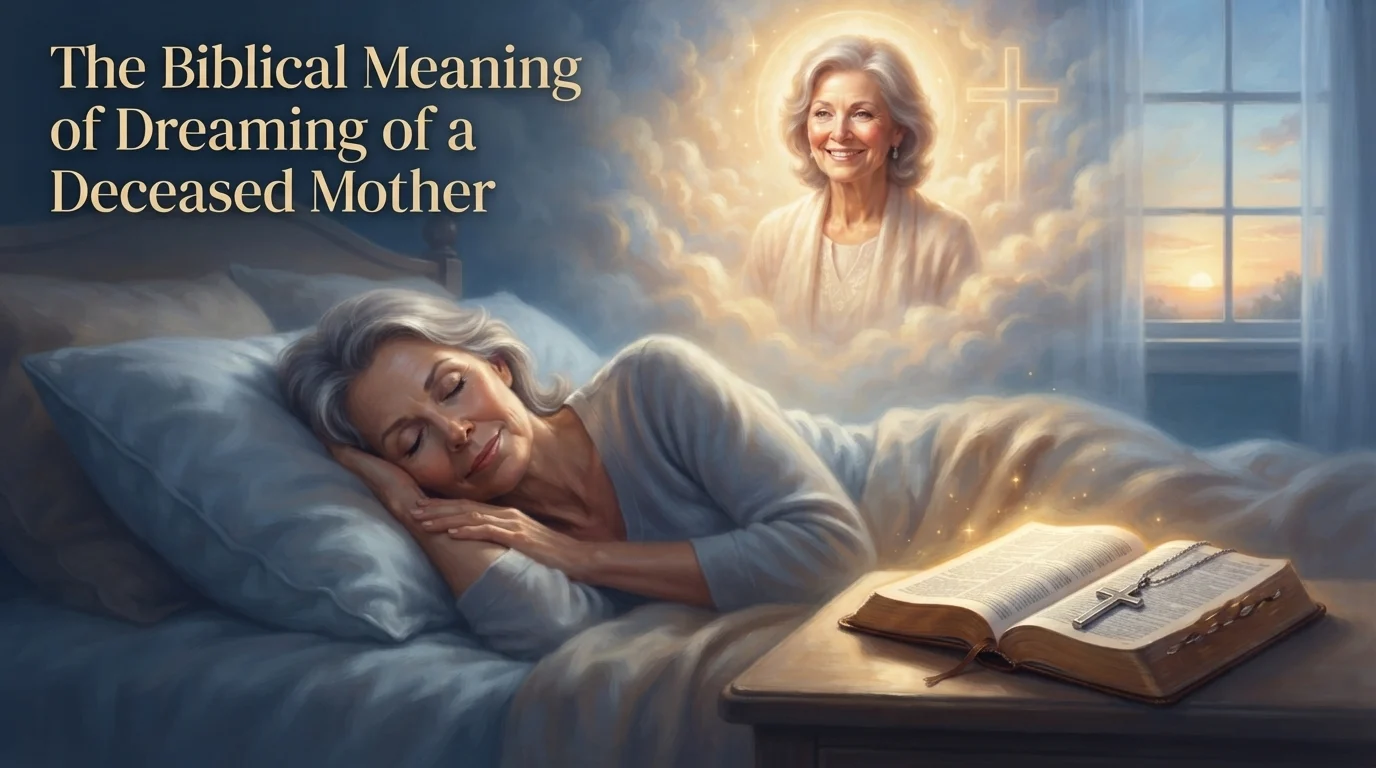
Losing a mother can leave an ache that words cannot easily describe. Even years later, a dream about her may suddenly bring back her voice, smile, advice, or presence. Sometimes the dream feels peaceful. Other times, it leaves you confused, frightened, or wondering whether God is trying to tell you something.
If you have experienced this, you are not alone. A 2023 Pew Research Center survey found that 46% of U.S. adults said they had been visited by a deceased family member in a dream at some point. The study did not determine whether these experiences were supernatural; they could reflect memories, grief, spiritual beliefs, or other experiences.
For Christians, the most important question is not simply, “What does my dream mean?” It is “What does the Bible allow me to conclude from this dream?”
That distinction matters.
The Bible contains examples of God using dreams, but it never teaches that every dream is a message from God. Scripture also warns believers to use discernment and to avoid practices that attempt to communicate with the dead.
So, if you dreamed about your deceased mother, you do not need to panic or immediately assume that she was visiting you from heaven. You can bring the dream to God, examine it through Scripture, acknowledge your grief, and rest in the hope of Christ.
Quick Answer

The biblical meaning of dreaming about a deceased mother is not automatically a message from her or a sign from God. Scripture does not provide a specific interpretation for dreams about deceased parents. Such dreams may arise from grief, memories, emotions, or ordinary dreaming.
Christians should test spiritual impressions against Scripture, pray for wisdom, avoid attempting to contact the dead, and find comfort in God’s promise of resurrection and eternal life through Christ.
What Does the Bible Say About Dreams?
The Bible takes dreams seriously, but it does not treat every dream as divine revelation.
God sometimes used dreams to communicate with people. Joseph received significant dreams in Genesis. Daniel interpreted dreams. Joseph, the husband of Mary, received guidance through dreams in Matthew.
However, Scripture also recognizes that dreams can come from ordinary human concerns.
Ecclesiastes 5:3 connects dreams with many cares and much activity. In other words, what occupies the mind can influence what happens during sleep.
This gives Christians an important principle:
A dream can be emotionally meaningful without being a direct message from God.
That principle is especially important when the dream involves someone we deeply loved.
Why Do People Dream About a Deceased Mother?
Grief can continue long after death
Grief does not follow a strict calendar.
You may feel peaceful for months and then suddenly dream about your mother. A birthday, holiday, family event, familiar smell, photograph, song, or difficult life decision can bring old memories back to the surface.
Your sleeping mind can then connect those memories into a vivid dream.
This does not mean your faith is weak.
It means the relationship mattered.
Memories remain emotionally powerful
A mother often represents safety, family, childhood, correction, encouragement, sacrifice, or love.
Because of that, dreaming about a deceased mother may bring emotions connected to much more than the person herself.
For example, a dream may leave you thinking about:
- A lesson she taught you
- Something you wish you had said
- A decision you wish she could see
- A family tradition
- A painful memory
- A sense of protection
- A longing to hear her voice again
The dream may therefore reveal something about your present emotional experience, rather than revealing something about the spiritual condition of your mother.
Dreams can come during seasons of stress
Ecclesiastes gives room for the ordinary relationship between mental activity and dreams. It says dreams can come with many cares.
If you are facing a major decision, family problem, loneliness, or stressful season, your mind may return to a person who once gave you comfort.
For a Christian, that can become an opportunity to bring those feelings to God.
Does Dreaming About a Dead Mother Mean She Is Visiting You?
The Bible does not give Christians enough evidence to make that conclusion.
A vivid dream can feel incredibly real. You may hear your mother’s voice, see her face, hug her, or have a conversation that feels completely natural.
But emotional intensity is not the same thing as biblical proof.
The Bible teaches believers to seek God rather than attempting to communicate with the dead. Scripture repeatedly directs God’s people away from occult practices and attempts to obtain supernatural guidance through forbidden means.
Therefore, Christians should avoid turning a dream into a method of communicating with a deceased loved one.
You can appreciate the memory without treating the dream as proof that your mother was physically or spiritually communicating with you.
What Is the Spiritual Meaning of Dreaming of a Deceased Mother?
There is no single biblical meaning.
However, the dream may prompt several biblically appropriate reflections.
| Possible reflection | What it may reveal | Biblical response |
|---|---|---|
| Grief | You still miss her | Bring your sorrow to God |
| Love | Her influence remains important | Give thanks for her life |
| Regret | You remember unfinished conversations | Receive God’s grace |
| Need for comfort | You feel vulnerable | Seek God’s presence |
| Major decision | You wish you had her advice | Ask God for wisdom |
| Fear of loss | Death feels especially close | Remember resurrection hope |
| Happy memory | You treasure your relationship | Give thanks |
| Spiritual confusion | You wonder if the dream was supernatural | Test it against Scripture |
These are possible reflections, not guaranteed interpretations.
That distinction protects you from assigning spiritual meaning where Scripture has not given one.
Biblical Lessons From Dreaming About a Deceased Mother

God cares about your grief
The Bible never tells believers to pretend that death does not hurt.
Jesus Himself wept at the tomb of Lazarus.
John 11:35 simply says, “Jesus wept.”
That short verse is powerful. Christ knew Lazarus would be raised, yet He still entered into the sorrow surrounding death.
Your grief does not make you less faithful.
You can miss your mother and still trust God.
Death is not the final Christian hope
Christian hope is not based on receiving messages through dreams.
It is based on Christ.
Paul reminds believers that Christians grieve differently because they have hope concerning the resurrection. See 1 Thessalonians 4:13–18.
The Christian answer to death is therefore bigger than dream interpretation.
It is resurrection.
God invites you to bring your emotions to Him
Psalm 34:18 teaches that the Lord is near to the brokenhearted.
If your dream makes you cry, pray.
Best If it makes you thankful, pray.
If it frightens you, pray.
Most If it leaves you confused, pray.
You do not need to solve the mystery before you can approach God.
God’s Word should remain your authority
A dream can be memorable.
*A dream can be emotional.
A dream can even feel spiritual.
But Scripture remains the standard by which Christians evaluate spiritual claims.
This prevents dreams from becoming more authoritative than God’s revealed Word.
Biblical View vs Popular Beliefs
Many online dream interpretations make confident claims that Scripture itself never makes.
Consider the difference:
| Popular claim | Biblical position |
|---|---|
| Your deceased mother is definitely visiting you | Scripture does not establish this |
| Every dream has a spiritual message | The Bible does not teach this |
| The dead regularly send messages through dreams | Scripture does not provide this doctrine |
| Seeing your mother means she needs something | No biblical basis |
| A peaceful dream proves she is in heaven | The dream cannot establish this |
| A frightening dream means a spiritual attack | Not necessarily |
| Dreams can reveal hidden future events | Only some biblical dreams were divinely given |
| Christians should contact deceased relatives | Scripture warns against seeking the dead |
The safest Christian approach is discernment rather than certainty.
What the Bible Does Not Say About This Dream
This may be the most important section for someone searching for an answer.
The Bible does not say:
- Dreaming about your dead mother always means she is visiting you.
- Your mother can automatically communicate with you through dreams.
- Every appearance of a deceased person in a dream carries prophetic meaning.
- A particular dream proves where a deceased person is now.
- Specific colors, clothing, locations, or conversations always have fixed biblical meanings.
- Every frightening dream comes from Satan.
- Every peaceful dream comes directly from God.
Be careful with websites or videos that assign absolute spiritual meanings to every detail.
Christian discernment requires humility.
Could the Dream Be From God?
It is possible for God to use dreams. Scripture clearly records divine dreams.
But we should not confuse “God can use dreams” with “this particular dream was from God.”
Those are different statements.
A Christian should ask:
- Does the message agree with Scripture?
- Does it lead me toward Christ?
- Does it encourage obedience to God’s Word?
- Is it producing wisdom or unhealthy fear?
- Am I treating my own interpretation as certain when Scripture is silent?
- Am I being tempted to seek communication with the dead?
If a supposed message contradicts Scripture, it should not be accepted as God’s truth.
Why Your Mother May Appear in Different Dream Situations
The details of a dream can affect the emotions you experience, but they should not be treated as a fixed biblical code.
Dreaming of your deceased mother smiling
This may simply be a comforting memory.
You may associate your mother with happiness, security, or love.
Instead of declaring that the dream proves she sent you a message, you can thank God for the good memories you shared.
Dreaming of your mother talking to you
A conversation can feel especially powerful.
Perhaps she gives advice.
Perhaps she says something you desperately needed to hear.
Treat the experience carefully. You can reflect on whether the advice agrees with biblical wisdom, but you should not automatically treat the dream conversation as supernatural instruction.
Dreaming that your mother is alive again
This kind of dream can happen because your mind remembers life before the loss.
It may be beautiful while you are dreaming and painful when you wake.
That emotional contrast is normal.
Let the dream remind you of your love without requiring you to believe that death has somehow been reversed.
Dreaming that your mother is sick again
This may reopen memories connected with her illness or death.
Rather than assuming it predicts something, recognize the possibility that your mind is revisiting a painful period.
Pray for peace and allow yourself to grieve.
Dreaming that your mother is angry
Do not immediately conclude that she is displeased with you from beyond the grave.
The dream could reflect guilt, unresolved conflict, fear, or your own inner emotions.
If you remember something you genuinely need to make right, take the biblical path: confess sin to God, seek forgiveness where appropriate, and pursue peace with living people.
Dreaming that your mother is crying
This can be deeply upsetting.
But the Bible does not establish a rule saying that a deceased person’s tears in a dream reveal their condition in the afterlife.
Do not carry unnecessary fear because of the dream.
Bring the emotion to God.
Does Dreaming of a Deceased Mother Mean She Needs Prayer?
Christians can certainly pray to God for comfort, wisdom, and peace when remembering someone who has died.
But Scripture does not instruct believers to pray to deceased people or communicate with them.
A healthier biblical practice is:
Remember her → thank God → grieve honestly → pray to God → trust Christ.
If your mother was a believer, you can also rest in God’s character and the Christian hope of resurrection rather than trying to obtain information about her present condition through dreams.
What About Unfinished Business With Your Mother?

Sometimes a dream brings old regrets to the surface.
Maybe you never said “thank you.”
*Maybe you had an argument.
Maybe you wish you had visited more.
*Maybe you were angry with her.
Maybe you simply wish you had one more conversation.
These feelings can be painful.
But you do not need a supernatural dream to begin processing them.
Bring your regret to God
The gospel leaves room for repentance and grace.
If you sinned against your mother, confess it to God.
Best If you need to forgive her for something, ask God to help you release the bitterness.
If you need to forgive yourself for something God has already forgiven, remember that Christian freedom is rooted in God’s grace, not endless self-punishment.
Write what you wish you could say
One practical exercise is to write a private letter to your mother.
Tell her:
- What you miss
- What you appreciate
- What hurt you
- What you wish had been different
- What you learned
- What you hope to carry forward
You do not need to send it anywhere.
It can simply help you put grief into words before God.
How Christians Should Respond After This Dream
1. Do not panic
A strange dream does not automatically mean something dangerous is happening.
Take a breath.
You are allowed to wake up confused.
2. Pray
Ask God for wisdom and peace.
A simple prayer is enough:
“Lord, help me understand what I should learn from this experience, and keep my heart grounded in Your Word.”
3. Compare the dream with Scripture
If you believe the dream contains a message, ask whether that message agrees with biblical teaching.
Never place a dream above Scripture.
4. Do not attempt to contact the dead
Do not use the dream as a reason to seek mediums, séances, occult practices, or other methods of contacting deceased people.
That is not the biblical path.
5. Accept that you may not know the meaning
This is difficult, but important.
Sometimes the most honest answer is:
“I don’t know.”
Christian faith does not require us to explain every unusual experience.
6. Look at the fruit
Ask what the experience is producing in you.
Is it moving you toward:
- Prayer?
- Peace?
- Gratitude?
- Repentance?
- Scripture?
- Christian community?
- Hope in Christ?
Or is it producing:
- Obsession?
- Fear?
- Superstition?
- Dependence on dream interpretations?
- Attempts to communicate with the dead?
That distinction can help you respond wisely.
A Simple Christian Discernment Guide
| Question | Healthy response |
|---|---|
| Did the dream feel real? | Remember that vividness does not prove divine origin |
| Did my mother speak to me? | Do not assume supernatural communication |
| Did I feel peaceful? | Thank God for comfort without making claims |
| Did I feel afraid? | Pray and seek biblical reassurance |
| Did the dream contradict Scripture? | Reject the contradiction |
| Do I feel guilty? | Bring guilt to God and seek appropriate reconciliation |
| Am I obsessed with the dream? | Step back and focus on Christ |
| Do I want to contact my mother? | Talk to God instead |
| Do I need help grieving? | Seek trusted Christian support |
What If the Dream Keeps Happening?
Recurring dreams can be especially unsettling.
Do not assume repetition automatically means God is trying harder to get your attention.
Instead, look at your life.
Are you under unusual stress?
Are you approaching an anniversary?
Have you recently experienced another loss?
Are you facing a decision connected with something your mother taught you?
Are you carrying unresolved grief?
These questions can provide useful context.
You can also keep a simple dream journal for a short period. Write down the date, main emotions, major details, and what was happening in your life.
The goal is not to create a secret dream code.
The goal is to notice patterns in your emotions and bring them thoughtfully before God.
The Role of Grief in Dreams About the Dead
Dreams involving deceased loved ones are not unusual.
Pew Research Center reported that 53% of U.S. adults said they had experienced a deceased family member appearing in a dream or another form. The researchers also emphasized that their survey did not establish what these experiences mean or whether they have supernatural causes.
That finding is useful because it puts the experience in perspective.
If you dreamed about your mother, you are not strange.
You are not automatically spiritually gifted.
You are not automatically under spiritual attack.
And you do not automatically have evidence of communication from the afterlife.
You may simply be experiencing one of the ways grief and memory can remain part of human life.
What Christian Hope Says About Losing a Mother
The deepest answer is not hidden inside the dream.
It is found in Christ.
The New Testament presents death as an enemy, but it also presents resurrection as Christian hope.
Jesus said in John 11:25, “I am the resurrection and the life.”
That promise changes how Christians think about loss.
We still cry.
*We still miss people.
We still experience painful dreams.
But death does not get the final word.
For Christians, the future is not endless searching for signs from the dead.
The future is resurrection and life with Christ.
Should You Be Worried About a Dream of Your Deceased Mother?
Usually, there is no biblical reason to panic simply because you dreamed about someone who died.
Pay attention if the experience is causing severe fear, disrupting your sleep, or making it difficult to function. In those circumstances, it can be wise to speak with a trusted pastor, mature Christian, or qualified mental-health professional.
Seeking help is not a lack of faith.
God can use wise people to help us carry difficult seasons.
Common Mistakes Christians Make With These Dreams
Mistake 1: Treating every dream as prophecy
Not every dream is a revelation.
Scripture itself recognizes ordinary dreams connected with human cares.
Mistake 2: Looking for a secret symbol dictionary
Christianity does not teach that every object in a dream has one universal spiritual meaning.
A white dress, a door, water, a house, or a particular number does not automatically carry one biblical interpretation in every dream.
Mistake 3: Assuming the dead are speaking
A dream can feel like a conversation.
That does not prove that the deceased person initiated it.
Mistake 4: Ignoring grief
Sometimes people become so focused on finding a spiritual meaning that they forget the obvious truth:
They miss someone they loved.
Grief deserves compassion.
Mistake 5: Letting fear control faith
A frightening dream can stay in your mind all day.
But Christians are called to ground their confidence in God rather than in the emotional power of a dream.
A Biblical Way to Think About the Dream
When you wake from a dream about your mother, consider this four-part framework:
Remember.
What did the dream bring to mind?
Reflect.
What emotions did it uncover?
Test.
Does anything you believe the dream means agree with Scripture?
Release.
Give the unanswered questions to God.
This approach allows you to take the experience seriously without giving it more authority than Scripture gives it.
A Prayer After Dreaming About Your Deceased Mother
You do not need complicated words.
You can pray honestly.
Father, thank You for the life of my mother and for the memories we shared. You know how much I miss her and You understand the emotions this dream has brought to the surface. Give me wisdom to respond according to Your Word.
Help me not to be controlled by fear, superstition, or confusion. Comfort my heart, strengthen my faith, and remind me that my hope is in Jesus Christ and His promise of resurrection. Help me honor my mother’s memory by living faithfully before You. In Jesus’ name, amen.
FAQs:
Is dreaming about a deceased mother biblical?
Dreaming about a deceased mother is not condemned in Scripture. However, the Bible does not provide a special interpretation for this type of dream. Christians should avoid claiming that every such dream is a message from God or the deceased person.
Does dreaming of my dead mother mean she is visiting me?
Not necessarily. The Bible does not establish that deceased relatives routinely visit living people through dreams. A dream may reflect memory, grief, emotions, stress, or ordinary dreaming. Its vividness does not prove supernatural communication.
Can God use a dream about my deceased mother?
God can use dreams, as several biblical accounts demonstrate. But that does not mean every dream comes from God. Any interpretation should be tested against Scripture, and Christians should remain humble when the Bible does not provide a clear answer.
What does it mean when my deceased mother talks to me in a dream?
There is no single biblical meaning. The conversation may reflect memories, emotions, unresolved grief, or things you wish you could still discuss. Do not automatically treat the conversation as communication from the dead.
Is dreaming about a dead mother a sign from heaven?
The Bible does not teach that dreaming about a deceased loved one is automatically a sign from heaven. A comforting dream can be appreciated without claiming that it provides information about the person’s present spiritual condition.
What if my deceased mother gives me advice in a dream?
Compare the advice with Scripture. If it agrees with biblical wisdom, you may reflect on it, but you still should not assume that your mother delivered the message supernaturally. Scripture, not the dream, remains the authority for Christian belief and conduct.
Does the Bible say the dead can communicate with the living?
The Bible does not encourage believers to seek communication with the dead. Scripture instead warns against practices intended to obtain supernatural information through the dead. Christians should direct prayer and spiritual dependence toward God.
Why do I keep dreaming about my deceased mother?
Recurring dreams can occur during grief, stress, anniversaries, major life changes, or periods when memories of your mother become especially active. Repetition alone does not prove that the dream has a supernatural origin.
Should I pray for my deceased mother after dreaming about her?
You can certainly bring your feelings about your mother to God in prayer. However, Christian prayer is directed to God rather than to deceased relatives. Ask God for comfort, wisdom, peace, and hope.
What should I do after dreaming about my deceased mother?
Pray, reflect on the emotions the dream brought up, compare any perceived message with Scripture, avoid attempts to contact the dead, and give the unanswered questions to God. If the dream causes persistent distress, seek wise pastoral or professional support.
Key Takeaways
- The Bible does not give one fixed meaning for dreaming about a deceased mother.
- Dreams can come from many sources, including ordinary thoughts and cares.
- God did use dreams in some biblical situations, but not every dream was divine revelation.
- A dream does not prove that a deceased loved one is communicating with you.
- Christians should not attempt to contact the dead.
- Grief can make dreams about deceased loved ones especially vivid and emotional.
- Scripture should remain the Christian’s highest authority.
- Prayer is a healthy response to confusion, grief, fear, or gratitude.
- The ultimate Christian hope is found in Christ and the resurrection, not in dream interpretation.
Conclusion:
The biblical meaning of dreaming of a deceased mother cannot be reduced to one secret symbol or guaranteed spiritual message.
Sometimes a dream may simply be your heart remembering someone you deeply loved.
Best Sometimes it may uncover grief that needs attention.
Sometimes it may remind you of wisdom your mother gave you.
And while Christians believe God can use dreams, Scripture does not give us permission to declare that every dream involving a deceased loved one is a supernatural visitation.
So do not let the dream frighten you into superstition.
Instead, let it lead you toward something Scripture clearly teaches: prayer, wisdom, gratitude, comfort, and hope in Christ.
You can miss your mother without fearing that you have lost your faith.
You can treasure the dream without turning it into doctrine.
And you can leave the questions you cannot answer in the hands of the God who understands both your grief and your hope.
Your mother’s memory may remain precious.
But your ultimate confidence belongs to God.

I’m Chris Robert, a writer at NameFluxo who explores the deeper meanings behind biblical names, words, dreams, and spiritual symbols. I enjoy turning Bible-based insights into clear, simple, and meaningful articles that help readers understand their faith and Scripture better.