
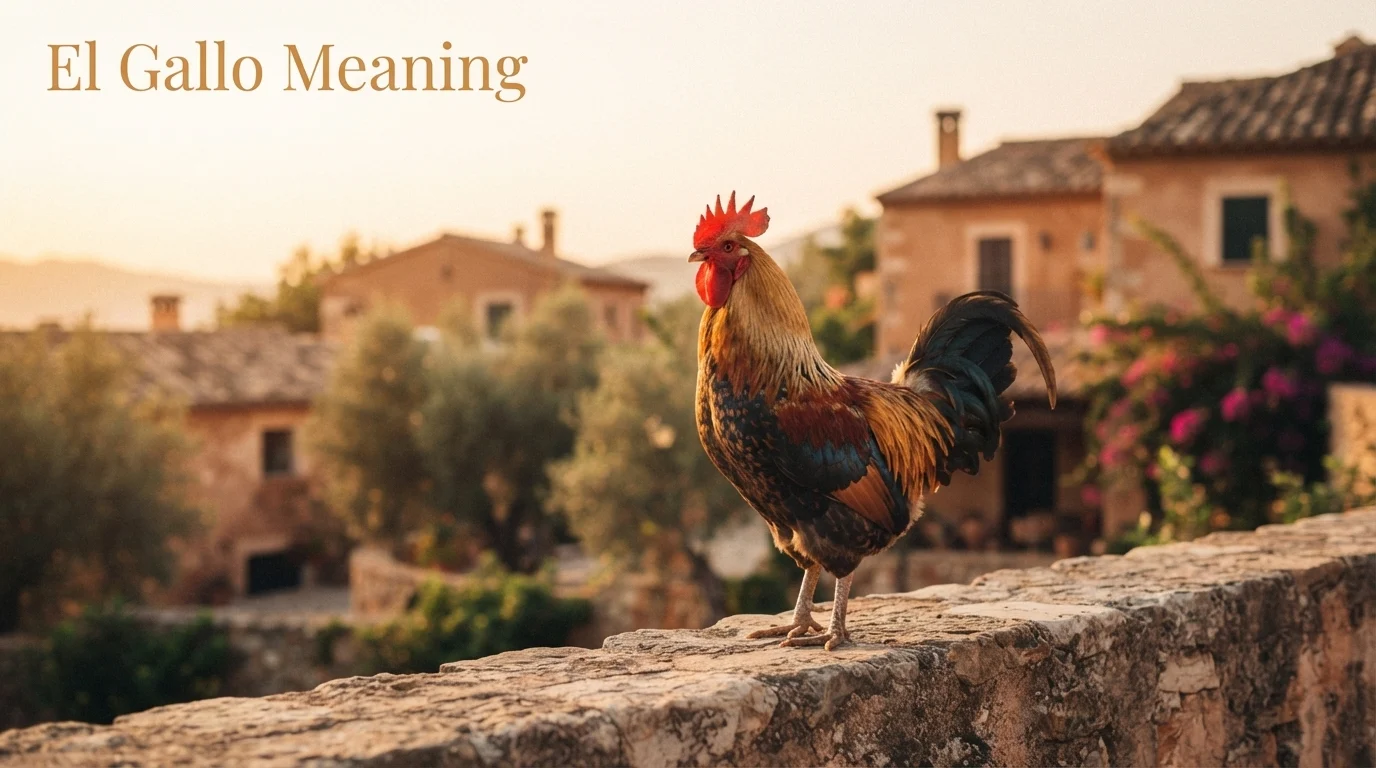
Have you heard the phrase “El Gallo” and wondered what it means?
In ordinary Spanish, the answer is simple: el gallo means “the rooster.” Spanish dictionaries define gallo as a rooster or cock, while el is the masculine singular article meaning “the.”
But Christians may ask a deeper question: Does El Gallo have a biblical or spiritual meaning?
The Bible does not use the Spanish phrase El Gallo. Spanish developed centuries after the biblical languages of Hebrew and Greek. However, the rooster itself appears in the New Testament, most famously in the story of Peter denying Jesus three times.
That makes the rooster an important part of one of the Gospels’ most moving scenes.
The rooster’s crow did not magically carry a secret code. Instead, it became a real-world sound connected with Jesus’ prediction, Peter’s failure, and Peter’s realization that Jesus had spoken the truth.
For Christians, that story offers a powerful lesson: failure does not have to be the end of your story.
Quick Answer:

El Gallo literally means “the rooster” in Spanish. Biblically, the rooster is especially associated with Peter’s three denials of Jesus. When the rooster crowed, Peter remembered Christ’s warning and recognized his failure. Therefore, Christians may view the rooster as a reminder of watchfulness, self-awareness, repentance, humility, and the importance of remaining faithful to Christ.
The important distinction is this:
El Gallo = “the rooster” linguistically; its Christian significance comes from Scripture’s use of the rooster, not from the Spanish phrase itself.
What Does El Gallo Mean in Spanish?
Breaking Down the Phrase
The phrase has two simple parts:
| Spanish | English | Meaning |
|---|---|---|
| El | The | Masculine singular article |
| Gallo | Rooster | Adult male chicken |
| El gallo | The rooster | Literal translation |
The word gallo refers to a male chicken. Cambridge also translates rooster as gallo in Spanish.
So if someone says:
“El gallo canta.”
it simply means:
“The rooster crows.”
There is no hidden biblical meaning in the phrase itself.
How Do You Pronounce El Gallo?
A simple English-friendly pronunciation is:
el GAH-yoh
The double ll in gallo commonly has a “y”-like sound in many varieties of Spanish, although pronunciation varies across Spanish-speaking regions.
Is El Gallo a Biblical Phrase?
No, Not Literally
This is where confusion can easily happen.
“El Gallo” is Spanish, not a phrase found in the original biblical manuscripts.
The Old Testament was written primarily in Hebrew, with portions in Aramaic, while the New Testament was written in Greek.
Therefore, we should not claim that El Gallo is a biblical name, biblical title, or special spiritual term.
What the Bible does contain is the rooster and the crowing of the rooster, particularly in the Gospel accounts surrounding Peter’s denial.
That distinction matters because good biblical interpretation begins with what Scripture actually says.
Where Does the Rooster Appear in the Bible?
Peter’s Denial of Jesus
The most important biblical connection appears during the final hours before Jesus’ crucifixion.
Jesus warned Peter that he would deny knowing Him.
In Luke 22:34, Jesus told Peter that before the rooster crowed, Peter would deny Him three times.
John records a similar warning. Jesus told Peter that the rooster would not crow until Peter had denied Him three times.
Mark gives a slightly different detail: Jesus says that before the rooster crows twice, Peter will deny Him three times.
The differences in wording do not change the central point.
Jesus predicted Peter’s denial.
Peter insisted he would remain loyal.
Then Peter denied Jesus.
And the rooster crowed.
The Moment Peter Realized His Failure
John 18:27 records that after Peter’s third denial, a rooster crowed immediately.
That sound became a moment of recognition.
Peter had probably believed he was stronger than he actually was.
Jesus knew Peter’s weakness before Peter recognized it himself.
When the rooster crowed, Peter was confronted with the truth.
The rooster did not cause Peter’s repentance.
It marked the moment when Peter remembered Jesus’ words.
That is an important spiritual distinction.
What Does the Rooster Symbolize in the Bible?
The Bible does not give one official statement saying, “The rooster symbolizes X.”
Instead, Christians can draw themes from the passages where the rooster appears.
1. A Reminder to Stay Awake
One biblical theme connected with the night and the rooster is watchfulness.
In Mark 13:35, Jesus tells His followers to stay alert because they do not know when the master will return. The passage mentions evening, midnight, cockcrow, and morning.
The rooster’s crow therefore fits naturally into the biblical imagery of night, waiting, and alertness.
For a Christian, this can become a practical reminder:
Do not drift spiritually simply because everything seems quiet.
Faith requires attention.
2. A Reminder of Human Weakness
Peter loved Jesus.
Yet Peter still denied Him.
That is one of the uncomfortable truths of the story.
Sometimes our confidence in ourselves is greater than our actual spiritual strength.
Peter said he was willing to die for Jesus, but fear overcame him when the pressure came.
The rooster’s crow exposed that gap between what Peter thought he would do and what he actually did.
That makes the story deeply relevant today.
A Christian can sincerely love Christ and still fail.
3. A Call to Repentance
After the rooster crowed, Peter remembered what Jesus had said.
Luke 22:61-62 describes Peter recognizing Jesus’ prediction and then weeping bitterly.
His response shows the seriousness of his failure.
But Peter’s story did not end beside that fire.
Later, Jesus restored Peter and entrusted him with responsibility among His followers.
That means the rooster can remind Christians not only of failure but also of the road that follows failure:
recognition → repentance → restoration → renewed obedience.
4. A Reminder That Jesus Knows Us Completely
Peter thought he knew himself.
Jesus knew Peter better.
Christ knew Peter would fail before Peter failed.
Yet Jesus still continued to work in Peter’s life.
This is one of the most comforting lessons in the story.
God does not discover our weaknesses after we make mistakes.
He already knows them.
Christian faith is therefore not based on pretending to be perfect.
It is based on trusting Christ while honestly confronting our need for His grace.
El Gallo Meaning and Peter’s Denial
The relationship can be summarized simply:
| Event | Biblical Meaning |
|---|---|
| Jesus warns Peter | Christ knows what is coming |
| Peter expresses confidence | Human confidence can be misplaced |
| Peter denies Jesus | Fear can expose weakness |
| Rooster crows | Peter is confronted with Christ’s warning |
| Peter remembers | Failure becomes clear |
| Peter weeps | Genuine remorse follows recognition |
| Jesus later restores Peter | Failure is not necessarily the end |
The rooster is therefore best understood as a narrative reminder, not a magical symbol.
Scripture gives the event its meaning.
What Is the Spiritual Meaning of El Gallo?
If you encountered a rooster, dreamed about one, heard one repeatedly, or simply feel drawn to the phrase El Gallo, it can be tempting to ask whether God is sending you a personal message.
Christians should approach that question carefully.
The Bible does not teach that every rooster sighting is a supernatural sign.
However, the biblical story can provide useful spiritual reflection.
Spiritual Meaning 1: Wake Up Spiritually
The rooster naturally calls attention to morning.
Biblically, that can remind us of spiritual alertness.
Ask yourself:
- Have I become spiritually distracted?
- Have I neglected prayer?
- Have I stopped reading Scripture?
- Am I allowing fear to control my choices?
- Have I become comfortable with habits that weaken my faith?
Sometimes the most valuable spiritual “wake-up call” is simply realizing that we have drifted.
Spiritual Meaning 2: Examine Your Faith
Peter believed he would never deny Jesus.
Yet he did.
His story encourages believers to examine themselves honestly.
Instead of saying:
“I would never do that.”
a wiser Christian response is:
“Lord, help me remain faithful when pressure comes.”
That is humility.
Spiritual Meaning 3: Remember God’s Warnings
The rooster’s crow reminded Peter of something Jesus had already told him.
Likewise, Scripture contains warnings that are meant to protect believers.
God’s Word repeatedly calls Christians to:
- remain watchful,
- resist temptation,
- avoid pride,
- persevere,
- confess sin,
- love others,
- remain faithful.
The lesson is not to fear every sign.
The lesson is to take God’s Word seriously.
Spiritual Meaning 4: Failure Can Become a Turning Point
Peter’s denial was terrible.
But God was not finished with Peter.
This is important for Christians who carry guilt over past mistakes.
A failure can become a turning point when it leads to genuine repentance and renewed dependence on Christ.
The rooster’s crow was not the final chapter.
Neither was Peter’s denial.
Does the Bible Say the Rooster Is a Symbol of God?
No.
Scripture does not identify the rooster as a symbol or representation of God.
It would therefore be inaccurate to say:
- “The rooster is God’s secret messenger.”
- “Every rooster is a divine sign.”
- “Seeing a rooster means God is about to change your life.”
- “El Gallo is another name for God.”
Those claims go beyond Scripture.
Christians can draw lessons from biblical events without turning ordinary objects into guaranteed supernatural messages.
Does El Gallo Mean “God’s Warning”?
Not by definition.
El Gallo literally means “the rooster.”
The idea of warning comes from the biblical story involving Peter, not from the Spanish words themselves.
A Christian devotional interpretation might use the rooster as a reminder to pay attention to God’s Word, but that should be described as a spiritual application rather than a direct biblical definition.
This distinction protects us from reading ideas into Scripture that Scripture does not actually teach.
The Meaning of Cockcrow in the Bible
A Time Marker
The Bible sometimes uses cockcrow as a reference to a period of the night.
Mark 13:35 includes cockcrow among the divisions or times of the night when the master could return.
The Greek term alektorophōnia is associated with cockcrow and can refer to the third night watch, traditionally associated with the period between midnight and about 3 a.m.
This gives useful historical context.
The biblical references to cockcrow are therefore not always intended as mystical symbolism. Sometimes they simply identify a time of night.
The Actual Rooster in Peter’s Story
In the Peter narrative, the evidence strongly supports an actual rooster crowing.
A NET Bible note on John 18:27 explains that although some scholars have discussed “cockcrow” as a technical term for a night watch, the Gospel context makes an actual rooster more likely.
So Christians should not turn every reference to cockcrow into a mysterious spiritual code.
Old Testament vs. New Testament Perspective
The rooster has a much more noticeable role in the New Testament than in the Old Testament.
| Biblical Section | Connection |
|---|---|
| Old Testament | No major theological rooster narrative comparable to Peter’s denial |
| Gospels | Rooster associated strongly with Peter’s denial |
| Jesus’ teaching | Cockcrow appears as a night-time reference in Mark 13 |
| Christian application | Watchfulness, humility, repentance, and faithfulness |
The strongest Christian meaning therefore comes from the Gospel narratives, not from an elaborate Old Testament symbolism.
El Gallo Meaning: Biblical Fact vs. Interpretation
This distinction is especially important for Christian readers.
| Statement | Biblical Fact or Interpretation? |
|---|---|
| El gallo means “the rooster” | Linguistic fact |
| Peter denied Jesus three times | Biblical fact |
| Jesus predicted Peter’s denial | Biblical fact |
| A rooster crowed after Peter’s denial | Biblical fact |
| The rooster can remind Christians to remain watchful | Biblically grounded application |
| Every rooster is a personal message from God | Not taught by Scripture |
| Seeing a rooster guarantees a coming blessing | Not taught by Scripture |
| El Gallo is a name for God | Not biblical |
Keeping these categories separate makes Christian interpretation more trustworthy.
What Does Seeing a Rooster Mean Spiritually?
There is no universal biblical rule that says seeing a rooster has one specific spiritual meaning.
Instead, use the moment as an opportunity for reflection.
Ask Yourself These Questions
Am I spiritually awake?
Maybe you have been distracted or complacent.
Am I relying too much on myself?
Peter’s confidence reminds us that self-confidence alone cannot replace dependence on Christ.
Is there something I need to confess?
The rooster’s connection with Peter points naturally toward honest repentance.
Am I afraid to stand for my faith?
Peter’s story shows how fear can influence behavior.
Do I need to remember God’s Word?
Peter’s turning point began when he remembered Jesus’ words.
These questions are more biblically useful than trying to decode a rooster as a guaranteed supernatural prediction.
What Does a Rooster Mean in a Dream?
This question often appears alongside searches for El Gallo Meaning.
The Bible contains dreams and visions, and God sometimes communicated through them. But Scripture does not provide a universal dream dictionary saying that a rooster always means one particular thing.
Therefore, if you dream about a rooster, do not automatically conclude that God is giving you a prophecy.
Instead:
- Consider the dream carefully.
- Compare any spiritual interpretation with Scripture.
- Avoid interpretations that contradict biblical teaching.
- Pray for wisdom.
- Consider the circumstances of your life.
- Do not build major decisions on a dream alone.
A rooster in a dream may remind a Christian of Peter, watchfulness, repentance, or a new morning—but those are possible reflections, not guaranteed biblical interpretations.
Is El Gallo a Good or Bad Spiritual Sign?
Neither automatically.
The rooster itself is not presented in Scripture as inherently evil.
The Christian significance depends on the biblical context.
In Peter’s story, the rooster is associated with a painful moment of failure. But that same event ultimately becomes part of Peter’s journey toward humility and restoration.
So the lesson can be both uncomfortable and hopeful.
The rooster reminds us that failure is serious—but God’s grace is greater than our failure.
Lessons Christians Can Learn From El Gallo
Stay Watchful
Jesus repeatedly called His followers to remain alert.
Spiritual life can become weak when we stop paying attention.
Do Not Trust Pride
Peter’s confidence was sincere, but it was not enough.
Humility keeps us dependent on God.
Take Temptation Seriously
Peter did not plan to deny Jesus.
Yet circumstances exposed his weakness.
Small compromises can prepare the way for larger failures.
Remember Scripture
Peter remembered Jesus’ words when the rooster crowed.
God’s Word becomes especially valuable when we face pressure.
Repent Quickly
When we recognize sin, we should not hide from God.
Repentance brings sin into the light.
Believe in Restoration
Peter’s failure did not cancel his future.
Jesus later restored him and continued to use him.
That gives hope to Christians who have fallen.
A Practical Christian Action Plan
If the story of the rooster and Peter speaks to you, turn it into action.
| Step | What to Do |
|---|---|
| Wake Up | Identify where your faith has become passive |
| Examine | Look honestly at your weaknesses |
| Confess | Bring known sin before God |
| Remember | Return to Christ’s teaching in Scripture |
| Pray | Ask for strength before temptation arrives |
| Act | Make one concrete change |
| Persevere | Do not allow failure to become your identity |
The goal is not simply to learn what El Gallo means.
The goal is to allow the biblical story behind the rooster to produce real spiritual growth.
Common Misunderstandings About El Gallo
Myth: El Gallo Is a Biblical Name
False.
It is a Spanish phrase meaning “the rooster.”
Myth: The Bible Gives the Rooster One Official Symbolic Meaning
Not exactly.
The Bible uses the rooster in particular contexts. Christians may draw lessons from those contexts, but Scripture does not provide a single official symbolic definition.
Myth: Every Rooster You See Is a Sign From God
There is no biblical basis for that claim.
God can use ordinary circumstances to get our attention, but Christians should not turn every ordinary event into a prophecy.
Myth: The Rooster Represents Evil
Not as a general biblical rule.
Its most famous New Testament appearance is connected with Peter’s denial, but the bird itself is not declared evil.
Myth: Peter Was Finished After Denying Jesus
No.
Peter’s failure was serious, but Christ later restored and recommissioned him.
What the Bible Does NOT Say About El Gallo
For clarity, Scripture does not say:
- “El Gallo is a divine name.”
- “Every rooster sighting is prophetic.”
- “A rooster guarantees a coming blessing.”
- “Dreaming about a rooster always has one meaning.”
- “The rooster is an angel.”
- “The rooster has supernatural power.”
- “Christians should worship or spiritually honor the rooster.”
These ideas should not be presented as biblical teaching.
The safer approach is simple:
Start with Scripture, then apply its lessons carefully.
Why the Rooster Matters So Much in Peter’s Story
The rooster’s importance is not because roosters possess special spiritual power.
Its importance comes from timing.
Jesus predicted Peter’s denial.
Peter denied Jesus.
Then the rooster crowed.
That ordinary sound became an unforgettable reminder of Jesus’ words.
This is one reason the scene is so powerful.
God did not need a dramatic miracle to confront Peter.
A simple rooster’s crow was enough.
Sometimes spiritual awakening works the same way.
A sentence from Scripture.
A quiet conviction.
A conversation.
A mistake we finally admit.
A moment when we realize we have wandered farther than we thought.
God can use ordinary moments to bring us back to truth.
A Christian Reflection on El Gallo
Imagine Peter standing outside in the darkness.
He had promised Jesus that he would remain faithful.
Then fear took over.
Three times Peter denied knowing Him.
Then came the rooster’s crow.
Imagine the weight of that moment.
Peter did not need someone to explain what had happened.
He remembered.
That is the deeper lesson.
Sometimes we already know what God has been showing us.
We simply need to stop running from it.
The rooster’s crow can therefore become a picture of awakening—not because the bird has magical power, but because its sound marked the moment when Peter faced the truth.
And facing the truth is often where repentance begins.
A Short Prayer Inspired by the Story of Peter
Lord Jesus,
Help me remain spiritually awake and faithful to You. When I become proud, remind me that I need Your strength. When I fail, give me the humility to repent rather than hide.
Help me remember Your Word when fear and temptation come. Restore what is broken in my life and teach me to follow You with a faithful heart.
Amen.
FAQs:
What does El Gallo mean in English?
El Gallo means “the rooster” in English. El means “the,” while gallo means “rooster” or “cock.”
What is the biblical meaning of El Gallo?
There is no special biblical meaning attached to the Spanish phrase El Gallo. Its Christian significance comes from the rooster in the Gospel accounts of Peter’s denial of Jesus. The rooster’s crow reminds readers of Jesus’ prediction and Peter’s failure.
What does the rooster symbolize in Christianity?
In Christian reflection, the rooster can represent watchfulness, remembrance, repentance, humility, and the recognition of human weakness. These themes come from biblical contexts rather than from a single verse declaring that the rooster has one official symbolic meaning.
Why did the rooster crow when Peter denied Jesus?
Jesus had predicted that Peter would deny Him three times before the rooster crowed. After Peter’s third denial, a rooster crowed, causing Peter to remember Jesus’ words.
Does El Gallo mean a warning from God?
Not literally. El Gallo simply means “the rooster.” However, because the rooster’s crow is connected with Peter’s realization of his denial, Christians may use the story as a reminder to remain spiritually alert and responsive to God’s Word.
What does cockcrow mean in the Bible?
Cockcrow can refer to the crowing of a rooster and also to a period or watch of the night. Mark 13:35 uses cockcrow when describing the possible times of the master’s return.
Does seeing a rooster mean God is sending me a sign?
The Bible does not teach that every rooster sighting is a divine sign. Christians can use ordinary experiences for personal reflection, but interpretations should not be presented as biblical revelation without Scriptural support.
What does a rooster mean in a Christian dream?
The Bible does not provide one universal meaning for dreaming about a rooster. A Christian might reflect on themes such as Peter’s denial, repentance, watchfulness, or spiritual awakening, but these should be treated as possible reflections rather than guaranteed interpretations.
Is El Gallo another name for God?
No. El Gallo is Spanish for “the rooster.” It is not a biblical name or title for God, Jesus, or the Holy Spirit.
Is the rooster a positive or negative biblical symbol?
Neither in an absolute sense. The rooster is connected with Peter’s painful denial, but that story also points toward repentance and eventual restoration. Its significance depends on the biblical context in which it appears.
Conclusion:
So, what is El Gallo Meaning?
In Spanish, it simply means “the rooster.” The phrase itself does not have a special biblical definition.
Yet the rooster has a meaningful place in Christian Scripture because of Peter’s denial of Jesus. Its crow marked the moment when Peter remembered Christ’s warning and confronted his own weakness.
That story gives Christians several lasting lessons.
Stay awake.
Do not depend on pride or self-confidence.
Take Christ’s words seriously.
Repent when you fail.
And perhaps most importantly, do not assume that failure is the end of your story.
Peter denied Jesus, but Jesus did not abandon Peter.
The rooster’s crow was a painful reminder—but it also became part of a story of repentance, restoration, and renewed service.
That is a much stronger Christian lesson than treating El Gallo as a mysterious code.
When Scripture speaks clearly, we do not need to add mystery where none exists. We simply need to listen, learn, repent when necessary, and keep following Christ.

I’m Chris Robert, a writer at NameFluxo who explores the deeper meanings behind biblical names, words, dreams, and spiritual symbols. I enjoy turning Bible-based insights into clear, simple, and meaningful articles that help readers understand their faith and Scripture better.