
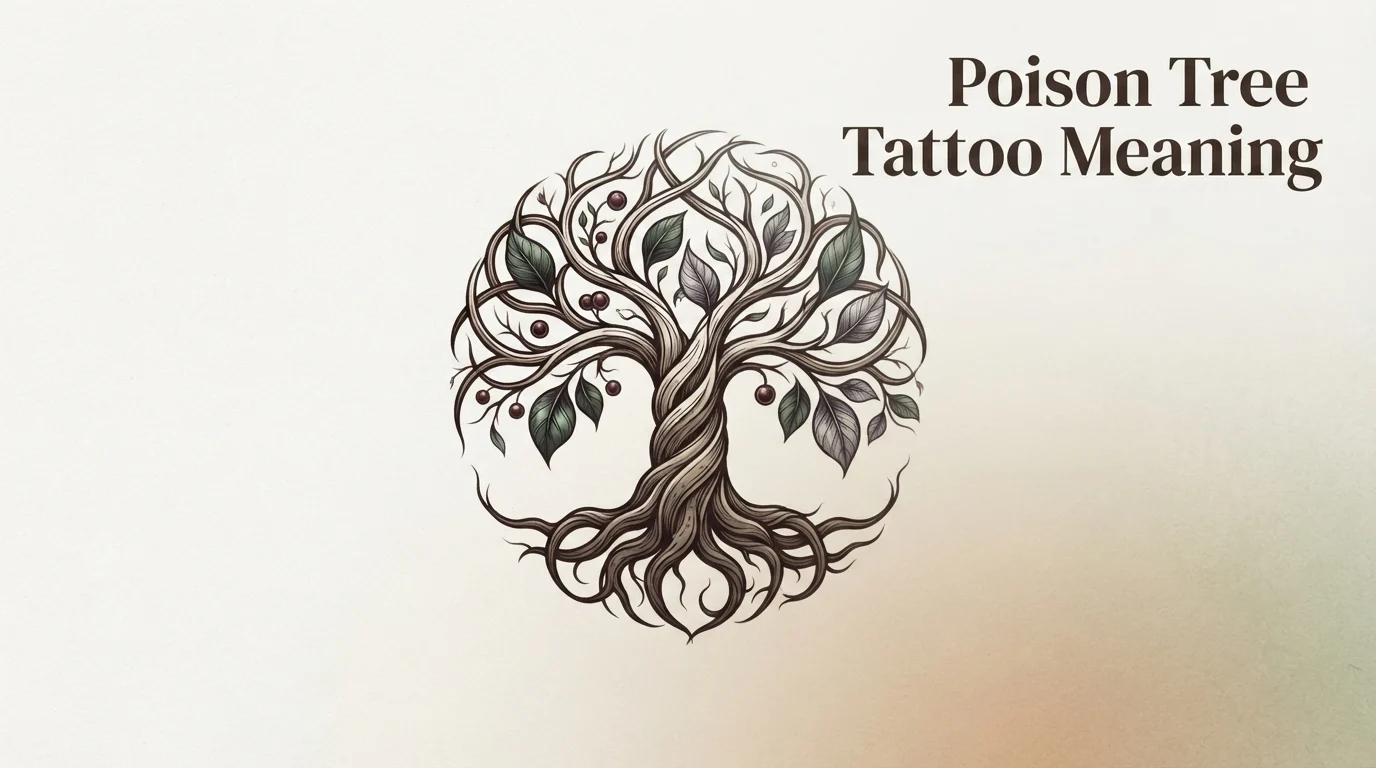
A poison tree tattoo can carry a powerful message about anger, hidden resentment, temptation, consequences, and spiritual growth. For Christians, however, it is important to understand that the “poison tree” is not a biblical symbol with one official meaning. The modern design is strongly associated with William Blake’s poem A Poison Tree, where suppressed anger grows like a tree and eventually produces destructive fruit.
From a biblical perspective, the image can still become a meaningful reminder: what we secretly nurture in the heart can eventually produce destructive fruit, while forgiveness, truth, repentance, and love lead us toward life.
Quick Answer:

A poison tree tattoo commonly represents hidden anger, resentment, revenge, temptation, or the consequences of nurturing negative emotions. Its strongest literary connection comes from William Blake’s 1794 poem A Poison Tree.
For Christians, the image can also serve as a reminder to guard the heart, forgive others, reject bitterness, and produce godly fruit instead of destructive fruit.
Key Takeaways
- A poison tree is not a specific biblical symbol.
- Its most famous meaning comes from William Blake’s A Poison Tree.
- Blake uses the tree as a metaphor for anger that is secretly cultivated.
- The apple represents the destructive result of that hidden anger.
- The image can remind Christians about the dangers of bitterness and unforgiveness.
- Scripture repeatedly teaches believers to deal with anger rather than allow it to control them.
- Genesis does not identify the forbidden fruit as an apple.
- A poison tree tattoo does not automatically have a Christian meaning; the wearer’s intention matters.
- Christians should consider the message, motive, conscience, and spiritual witness behind any tattoo.
What Is the Origin of the Poison Tree Symbol?
The most recognizable source is William Blake’s poem “A Poison Tree.”
Blake published the poem in Songs of Experience in 1794. The poem contrasts two responses to anger. When the speaker tells a friend about his anger, it ends. When he hides his anger toward an enemy, the anger grows.
The poem then turns anger into a growing tree.
The speaker describes feeding the tree with fear and tears while covering his true feelings with smiles and deceit. Eventually, the tree produces an attractive apple, and the speaker’s enemy dies beneath it.
That makes the central idea remarkably simple:
Unresolved anger can grow into something destructive.
This is why a poison tree tattoo is often chosen by people who want to represent a difficult emotional experience, betrayal, resentment, revenge, or the decision to leave bitterness behind.
What Does a Poison Tree Mean Biblically?
The Bible does not contain a symbol specifically called “the poison tree.”
That distinction matters.
A Christian interpretation should not claim that Scripture directly teaches, “A poison tree means this.” It does not.
Instead, Christians can compare the image with biblical teachings about the heart, anger, bitterness, temptation, sin, and fruit.
Jesus frequently used the imagery of trees and fruit to explain spiritual character.
In Matthew 7:16–20, Jesus teaches that a tree is recognized by its fruit. The broader biblical principle is that what exists within eventually becomes visible through what a person produces.
That makes a poison tree a useful illustration, even though it is not itself a biblical symbol.
Biblical Symbolism vs. Tattoo Interpretation
| Symbol | Biblical connection | Possible tattoo meaning |
|---|---|---|
| Tree | Trees are used throughout Scripture as spiritual imagery | Growth, life, character |
| Fruit | Jesus uses fruit to describe visible character | Results of choices |
| Poison | Scripture uses poison-like imagery for destructive speech and evil | Harm, corruption |
| Root | Biblical writers use roots to describe what is established within | Deep beliefs or emotions |
| Garden | Gardens appear in important biblical narratives | Life, temptation, beginning |
| Apple | Not specifically identified as the forbidden fruit | Temptation or consequence |
| Poison tree | Not a biblical symbol | Anger, resentment, destructive consequences |
What Does the Poison Tree Represent Spiritually?
For a Christian, the tattoo can represent several different spiritual ideas.
1. Hidden Anger
This is perhaps the strongest connection.
In Blake’s poem, anger becomes dangerous because it is secretly cultivated. The speaker does not simply experience anger; he feeds it.
That idea has a clear biblical parallel.
Paul writes:
“Be angry and do not sin.”
—Ephesians 4:26
The verse does not pretend that anger never exists. Instead, it warns believers not to allow anger to become a doorway to further sin.
A poison tree can therefore symbolize the difference between experiencing anger and nurturing anger.
Feeling hurt is not the same as choosing bitterness.
2. Bitterness
Bitterness is another powerful Christian interpretation.
Hebrews 12:15 warns believers to make sure that no “root of bitterness” grows up and causes trouble.
That language is especially relevant to a tree tattoo.
A root begins underground. You may not see it immediately, but it can continue growing.
Bitterness can work the same way.
A person may smile, go to church, work, study, and live normally while secretly carrying an old wound. If that wound is continually fed by resentment, revenge fantasies, or hatred, it can affect relationships and spiritual life.
A poison tree can therefore represent:
“I will not allow bitterness to take root in me.”
3. The Consequences of Unforgiveness
Forgiveness does not mean pretending that wrongdoing never happened.
It means refusing to let another person’s wrongdoing permanently control your heart.
Ephesians 4:31–32 gives a strong contrast. Paul tells Christians to put away bitterness, wrath, anger, and malice and instead practice kindness, compassion, and forgiveness.
A poison tree tattoo can therefore become a personal reminder:
“I have seen what bitterness can grow into, and I choose a different path.”
4. Temptation
The fruit in Blake’s poem has an attractive appearance even though it is deadly.
That creates an important spiritual lesson.
Not everything attractive is good.
Genesis 3 describes the serpent’s temptation and the woman seeing that the tree’s fruit was desirable. However, Scripture does not say that the forbidden fruit was an apple.
The apple became connected with the Eden story through later artistic and cultural tradition, not because Genesis explicitly names it.
This distinction is important when interpreting a poison tree tattoo from a biblical perspective.
5. The Consequences of Sin
The Bible repeatedly presents sin as something that produces consequences.
James 1:14–15 describes a progression in which desire gives birth to sin, and sin eventually produces death.
That progression can be compared metaphorically with a tree:
desire → choice → habit → fruit → consequence
The poison tree can therefore symbolize the danger of allowing a sinful desire to become established.
Is the Poison Tree in the Bible?
No.
There is no biblical passage describing a “poison tree” as a specific spiritual symbol.
The phrase is most strongly associated with William Blake’s poem.
However, the Bible contains many important tree and fruit images, including:
- The Tree of Life
- The tree of the knowledge of good and evil
- Trees representing people
- Fruit representing results or character
- The cross described metaphorically as a tree in some New Testament passages
Therefore, it is better to say that a poison tree tattoo has biblical parallels, rather than claiming that it has a biblical definition.
That distinction makes the interpretation more honest.
What Does a Poison Tree Tattoo Mean in Christianity?
For a Christian, the meaning depends heavily on the intention behind the design.
It could represent something negative:
- Hatred
- Revenge
- Resentment
- Hidden anger
- Temptation
- Destructive behavior
- The consequences of sin
But it could also represent a positive spiritual lesson:
- Leaving bitterness behind
- Learning from past mistakes
- Forgiving someone
- Recognizing destructive emotions
- Rejecting revenge
- Growing spiritually
- Remembering God’s grace
- Choosing good fruit over destructive fruit
The same image can therefore communicate very different messages.
A Negative Christian Interpretation
Someone might use the design to glorify:
“I hold grudges, and I enjoy revenge.”
That would obviously conflict with biblical teaching about forgiveness, love, and overcoming evil with good.
A Positive Christian Interpretation
Another person might use the exact same design to say:
“I know what bitterness can produce, so I choose forgiveness.”
That communicates a very different message.
The artwork does not tell the entire story.
The heart behind the artwork matters.
What Does the Tree Mean in the Bible?
Trees have many meanings in Scripture, so Christians should avoid assigning one universal meaning to every tree image.
Trees Can Represent Life
Psalm 1 compares the righteous person to a tree planted by streams of water.
That is a picture of stability, nourishment, fruitfulness, and spiritual health.
Trees Can Represent People
Jesus uses trees and fruit to illustrate the relationship between a person’s character and actions.
Matthew 7:17 says that a good tree produces good fruit, while a bad tree produces bad fruit.
Trees Can Represent Consequences
Biblical tree imagery can also communicate the results of choices.
This is especially helpful when thinking about a poison tree.
A tree does not suddenly appear fully grown.
It begins with a root.
Likewise, destructive behavior often begins with something small that is repeatedly tolerated or nurtured.
What Does the Fruit Mean in a Poison Tree Tattoo?
Fruit is one of the most important parts of the design.
In Blake’s poem, the tree eventually produces an apple. The attractive fruit becomes connected to the destructive ending of the poem.
For Christians, fruit can represent the visible outcome of something happening internally.
That connects naturally with Galatians 5.
Paul describes the fruit of the Spirit as:
- Love
- Joy
- Peace
- Patience
- Kindness
- Goodness
- Faithfulness
- Gentleness
- Self-control
This creates an interesting Christian contrast.
Poisonous Fruit vs. Spiritual Fruit
| Poison Tree | Biblical Fruit of the Spirit |
|---|---|
| Bitterness | Love |
| Revenge | Kindness |
| Anger | Self-control |
| Deceit | Faithfulness |
| Hatred | Goodness |
| Resentment | Peace |
| Destruction | Patience |
| Hidden hostility | Gentleness |
A Christian could use this contrast as the deeper meaning of the tattoo:
“What I cultivate determines what I eventually produce.”
Does a Poison Tree Tattoo Mean Evil?
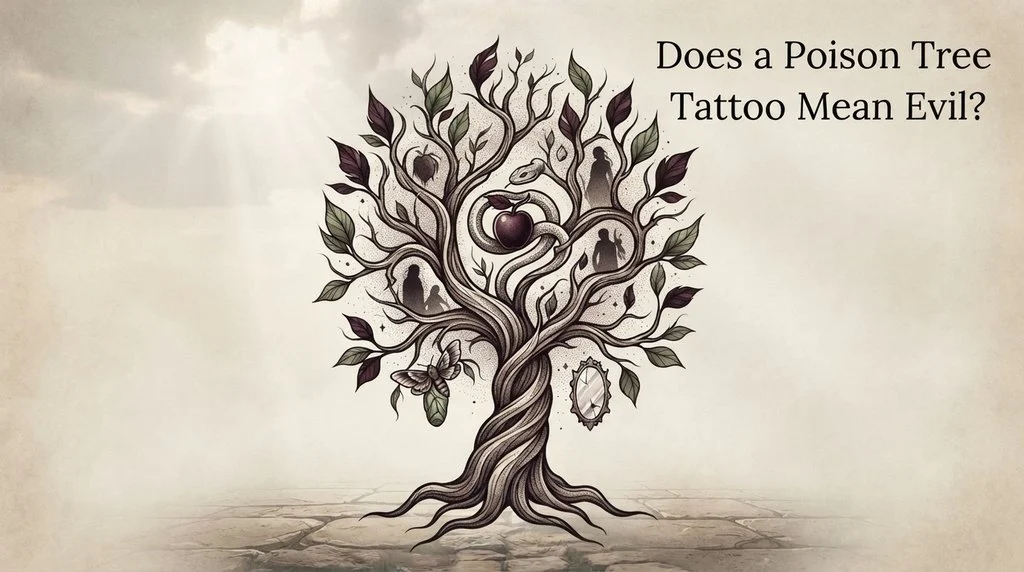
Not necessarily.
A dark tree tattoo may look sinister, but appearance alone does not establish its meaning.
Someone may choose a poison tree because they love gothic artwork. Another person may connect it to Blake’s poem. Someone else may use it as a symbol of overcoming trauma, anger, or resentment.
Christians should therefore avoid declaring that every poison tree tattoo represents evil.
At the same time, if a design is intentionally being used to celebrate hatred, occultism, revenge, or evil, a Christian should seriously consider whether that message reflects their faith.
Is a Poison Tree Tattoo a Christian Tattoo?
Usually, not by default.
A cross, fish symbol, or Scripture reference has a more direct Christian association.
A poison tree is primarily a literary and symbolic image.
Its Christian meaning comes from how someone interprets and uses it.
This is an important distinction for anyone considering the tattoo.
If you want the design to communicate a clearly Christian message, you might combine the tree with:
- A cross
- A Bible verse reference
- Green leaves representing new life
- New fruit
- Light breaking through the branches
- A broken chain representing freedom
- Roots shaped like a cross
- A phrase about forgiveness
- A reference to Galatians 5:22–23
That can shift the design from simply “dark symbolism” toward a story of redemption and spiritual transformation.
What Does a Poison Tree Tattoo Say About Anger?
It can say:
“Anger becomes dangerous when I continually feed it.”
James 1:19–20 gives Christians practical wisdom:
Be quick to listen, slow to speak, and slow to become angry.
The point is not that Christians will never feel angry.
The issue is what happens next.
Do you surrender the anger to God?
*Do you address the problem honestly?
Do you seek reconciliation when appropriate?
*Do you establish healthy boundaries?
Or do you secretly replay the offense until resentment becomes part of your identity?
That is where the poison-tree image becomes especially powerful.
What Does a Poison Tree Tattoo Mean After Betrayal?
After betrayal, the tree can represent the wound that remained after the event.
For example, imagine someone was betrayed by a close friend.
The original event was painful.
But afterward, the person repeatedly thinks:
- “I’ll never trust anyone again.”
- “They need to pay.”
- “Everyone eventually betrays you.”
- “I want them to suffer.”
The original wound becomes a root.
Repeated resentment becomes water.
Anger becomes sunlight.
Eventually, the person may produce poisonous fruit.
The tattoo could instead become a reminder:
“The betrayal happened. But I will not let it determine who I become.”
That is a much healthier Christian interpretation.
What Does a Poison Tree Tattoo Mean After Personal Growth?
A poison tree does not have to symbolize the worst thing that happened to you.
It can symbolize the lesson you learned from it.
Perhaps you once struggled with:
- Anger
- Revenge
- Jealousy
- Resentment
- Unforgiveness
- Pride
- Deception
But you changed.
The tree can represent your former life, while new growth represents God’s work in you.
That makes the design less about glorifying darkness and more about remembering transformation.
What Does the Bible Say About Holding Anger?
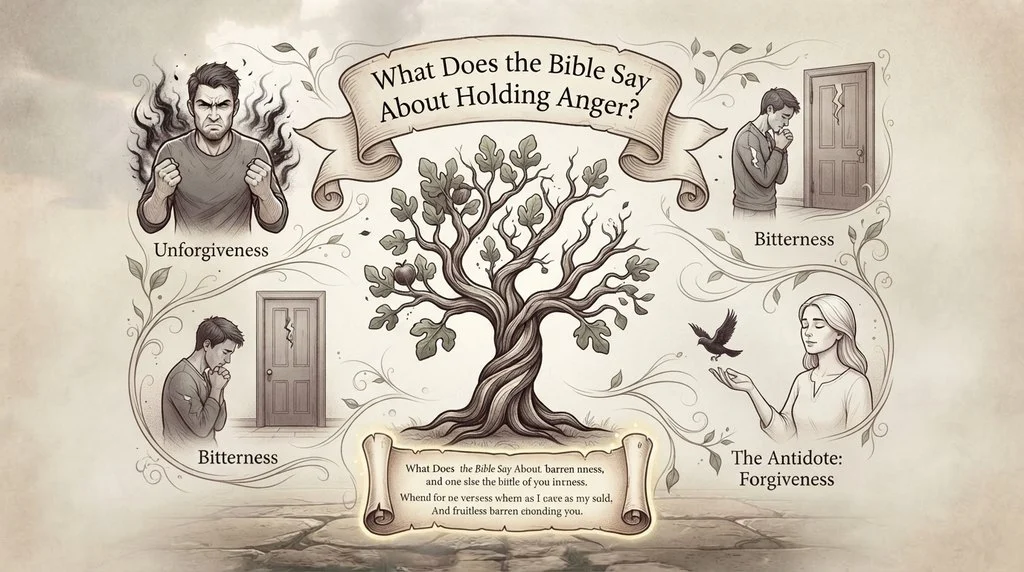
Scripture consistently warns against allowing anger to become destructive.
Ephesians 4:26–27
Paul tells believers not to let anger become an open door for the devil.
The practical message is clear:
Deal with anger before it gains control.
Proverbs 14:29
Best Proverbs praises the person who is slow to anger and contrasts that with someone who quickly loses their temper.
Proverbs 15:1
A gentle answer can turn away wrath.
This shows that our response can change the direction of a conflict.
Colossians 3:8
Paul tells Christians to put away anger, wrath, malice, slander, and abusive speech.
Ephesians 4:31–32
Paul then gives the positive alternative:
- Kindness
- Compassion
- Forgiveness
Together, these passages provide a strong biblical framework for interpreting the poison tree.
What Is the Christian Lesson Behind a Poison Tree?
The deepest Christian lesson is not simply “anger is bad.”
It is more specific:
What you repeatedly cultivate in your heart eventually influences what you produce with your life.
If you cultivate resentment, resentment can shape your behavior.
you cultivate revenge, revenge can shape your decisions.
If you cultivate God’s Word, prayer, love, forgiveness, and self-control, those things can shape your character.
The tattoo can therefore become a visual question:
What am I growing?
That is a far more useful question than simply asking whether the tree looks dark or beautiful.
What the Bible Does NOT Say About Poison Trees
Several claims should be avoided.
The Bible Does Not Say a Poison Tree Is Satan’s Symbol
There is no verse making that connection.
The Bible Does Not Call the Eden Tree a Poison Tree
Genesis does not use that phrase.
The Bible Does Not Say the Forbidden Fruit Was an Apple
Genesis identifies it only as fruit.
The Bible Does Not Give a Standard Meaning for Poison Tree Tattoos
Modern tattoo symbolism is different from biblical symbolism.
The Bible Does Not Teach That Every Dark Tattoo Is Evil
Christian discernment requires more than judging an image by appearance.
Is Getting a Poison Tree Tattoo a Sin?
There is no verse that specifically says, “Do not get a poison tree tattoo.”
The main biblical passage discussed in Christian tattoo debates is Leviticus 19:28, which prohibits cutting the body for the dead and making tattoo marks.
Christians disagree about how that command applies today.
Some Christians believe the prohibition remains morally relevant. Others understand the passage within its ancient Israelite and religious context and do not consider it a universal prohibition against modern tattoos. BibleProject, for example, emphasizes the surrounding context of ancient mourning and religious practices, while other Christian teachers argue that Christians should still apply wisdom and caution to tattoo decisions.
Therefore, it would be irresponsible to give every Christian a simplistic yes-or-no answer.
A better approach is to consider:
- What does the tattoo communicate?
- Why do I want it?
- Does it celebrate something sinful?
- Can I honestly thank God for this decision?
- Would I be comfortable explaining its meaning to another Christian?
- Does my conscience have peace?
- Could the design damage my Christian witness?
- Am I choosing it from wisdom or from anger and rebellion?
How Should Christians Think About Leviticus 19:28?
Leviticus 19:28 should not be ignored, but it should also not be pulled out of its context.
The verse explicitly mentions cutting the body for the dead and tattoo marks in the same command. Some biblical scholars and Christian teachers understand this as connected with ancient mourning and religious practices rather than a blanket statement about every modern tattoo.
Other Christians maintain a stricter position and choose to avoid tattoos altogether.
That difference exists within Christianity.
If you are considering a poison tree tattoo, study the passage carefully, pray about the decision, and consider the teaching of your own church tradition.
Poison Tree Tattoo: Biblical Meaning vs. Blake’s Meaning
| Question | Blake’s poem | Christian reflection |
|---|---|---|
| What grows? | Hidden anger | What the heart continually nurtures |
| What feeds it? | Fear, tears, deceit | Bitterness, resentment, sinful desires |
| What does it produce? | A destructive apple | Consequences of cultivated attitudes |
| What happens to the enemy? | He dies | Sin can damage relationships and people |
| Main warning | Do not nurture anger | Guard your heart |
| Better response | Open expression rather than deceit | Truth, forgiveness, wisdom, self-control |
| Overall message | Destructive anger | Choose what produces godly fruit |
Could a Poison Tree Tattoo Have a Positive Meaning?
Absolutely.
A positive Christian interpretation could be:
“I refuse to grow what once destroyed me.”
That could represent:
- Forgiveness after betrayal
- Recovery from anger
- Freedom from resentment
- Spiritual maturity
- Learning from past mistakes
- Choosing peace
- Breaking destructive family patterns
- Leaving revenge behind
- God’s ability to transform a wounded heart
The tree remains dark, but the meaning becomes hopeful.
For example, a tattoo could show a dead or poisonous tree with new green branches growing from its roots.
That would communicate:
Death is not the end of the story. God can bring new life.
Poison Tree Tattoo Ideas With Christian Meanings
If the goal is to give the tattoo a distinctly Christian message, symbolism can make a major difference.
Poison Tree With a Cross
The tree represents sin, anger, and brokenness.
The cross represents Christ’s redemption.
Meaning: Christ can redeem what was once destructive.
Poison Tree With New Growth
A dead branch transitions into green leaves.
Meaning: spiritual renewal and transformation.
Poison Apple Falling Away
The poisonous fruit lies on the ground while healthy fruit grows elsewhere.
Meaning: rejecting temptation and choosing a better path.
Tree With Scripture Reference
A small reference such as Ephesians 4:31–32 can make the message much clearer.
Meaning: putting away bitterness and choosing forgiveness.
Roots Turning Into a Cross
The roots form the shape of a cross.
Meaning: Christ is the foundation of transformation.
What Is the Most Positive Christian Meaning?
If you want the tattoo to have a hopeful Christian message, I would interpret it as:
A reminder that hidden anger and bitterness can produce destructive fruit, but through forgiveness, repentance, God’s grace, and spiritual growth, a person can choose a different harvest.
That interpretation respects the original symbolism without pretending that the Bible directly defines the poison tree.
How to Turn the Symbol Into a Spiritual Reminder
A tattoo can become more than artwork when it points you toward a biblical truth.
When you see the tree, ask:
What am I feeding?
Are you feeding:
- Love?
- Faith?
- Anger?
- Fear?
- Bitterness?
- Pride?
- Peace?
What fruit am I producing?
Are your choices producing:
- Peace or conflict?
- Forgiveness or revenge?
- Kindness or cruelty?
- Patience or impatience?
- Self-control or impulsiveness?
What needs to be removed?
Sometimes spiritual growth requires more than adding good habits.
You may need to surrender:
- An old grudge
- A desire for revenge
- A harmful relationship
- A sinful habit
- A false belief
- A painful memory you keep using as fuel for resentment
A Simple Christian Action Plan
| Step | Question | Biblical direction |
|---|---|---|
| 1 | What hurt me? | Be honest |
| 2 | What am I feeling? | Bring it to God |
| 3 | Am I feeding resentment? | Stop nurturing bitterness |
| 4 | What response honors Christ? | Choose wisdom |
| 5 | Do I need to forgive? | Practice forgiveness |
| 6 | Do I need boundaries? | Seek wise action |
| 7 | What fruit should grow instead? | Pursue godly character |
Forgiveness does not mean allowing continued abuse or pretending that wrongdoing is acceptable.
Sometimes wisdom requires distance, boundaries, accountability, or professional help.
Christian forgiveness and healthy boundaries can exist together.
Prayer Inspired by the Poison Tree
A Prayer for a Heart Free From Bitterness
Lord Jesus,
You know every hurt I carry, including the ones I have never spoken aloud. You know the anger, disappointment, fear, and resentment that can quietly grow inside my heart.
Help me not to nourish bitterness.
Give me the courage to face painful emotions honestly and the wisdom to respond without revenge. Teach me to forgive as You have forgiven me, while also giving me discernment to establish healthy boundaries where they are needed.
Remove anything in my heart that produces destructive fruit. Replace anger with self-control, hatred with love, fear with faith, and bitterness with peace.
Help me cultivate the kind of heart that produces fruit that honors You.
May my past teach me without controlling me. May my wounds become places where Your grace is visible.
In Jesus’ name, Amen.
Reflection: What Are You Growing?
The poison tree provides a simple but uncomfortable question:
What are you growing in secret?
Every person carries emotions that others cannot see.
A hurt can become resentment.
Resentment can become bitterness.
Bitterness can influence decisions.
And repeated decisions can shape character.
But the opposite is also true.
A small act of forgiveness can begin a different pattern.
A prayer can redirect your thoughts.
A truthful conversation can prevent resentment from growing.
A decision to love someone who hurt you can become an important step toward healing.
The Christian life is not about pretending that pain does not exist.
It is about bringing that pain to God instead of allowing it to become your master.
Common Mistakes When Interpreting a Poison Tree Tattoo
Mistake 1: Calling It a Biblical Symbol
It is not.
It is primarily a literary symbol associated with William Blake.
Mistake 2: Saying the Eden Fruit Was an Apple
Genesis does not identify the fruit as an apple.
Mistake 3: Assuming Every Poison Tree Represents Satan
There is no biblical basis for that claim.
Mistake 4: Saying Every Tattoo Is Automatically Sinful
Christian views on modern tattoos differ, particularly in how Leviticus 19:28 applies under the new covenant.
Mistake 5: Ignoring the Meaning Behind the Tattoo
A design should be evaluated not only by appearance but also by its purpose and message.
Mistake 6: Confusing Forgiveness With Permission
Forgiving someone does not require remaining in an unsafe or abusive situation.
FAQs:
What does a poison tree tattoo symbolize?
A poison tree tattoo commonly symbolizes suppressed anger, resentment, revenge, temptation, or the destructive consequences of nurturing negative emotions. Its strongest cultural connection is William Blake’s poem A Poison Tree, published in 1794.
Is the poison tree a biblical symbol?
No. The Bible does not define a symbol called the “poison tree.” The concept mainly comes from William Blake’s poem. Christians can draw biblical parallels involving trees, fruit, anger, bitterness, and spiritual character, but those parallels should not be presented as direct biblical definitions.
Is a poison tree tattoo evil?
Not automatically. Its meaning depends on the design and the intention of the person wearing it. It can represent revenge and hatred, but it can also symbolize overcoming anger, rejecting bitterness, forgiveness, or learning from a painful experience.
What does the poison tree mean in Christianity?
For Christians, it can symbolize the danger of nurturing anger and bitterness. It can also become a reminder to guard the heart and pursue forgiveness, self-control, love, and spiritual fruit.
Is the poison tree related to the Tree of Knowledge?
There can be a literary connection because Blake’s “apple bright” can evoke the biblical story of Eden, and some literary analysis identifies the apple as an allusion to the Genesis story. However, Blake’s poison tree is not the biblical Tree of the Knowledge of Good and Evil.
Was the forbidden fruit in Genesis an apple?
The Bible does not say that it was an apple. Genesis describes it as fruit from the tree of the knowledge of good and evil. The identification with an apple comes from later cultural and artistic tradition, not from the biblical text itself.
Does the Bible say Christians cannot get tattoos?
Leviticus 19:28 contains a prohibition against tattoo marks and cutting the body for the dead. Christians differ on how this Old Testament command applies today. Some see it as continuing moral guidance, while others understand it within its ancient covenant and religious context.
Can a poison tree tattoo have a Christian meaning?
Yes. A Christian could use it as a reminder of the danger of bitterness and the importance of forgiveness. Adding a cross, Scripture reference, new growth, or healthy fruit can make a redemption-focused meaning clearer.
What Bible verse fits a poison tree tattoo?
Several verses can fit, but Ephesians 4:31–32 is especially relevant because it contrasts bitterness, anger, and malice with kindness, compassion, and forgiveness. Galatians 5:22–23 also works well if the tattoo focuses on replacing destructive fruit with the fruit of the Spirit.
What is the deeper lesson of a poison tree?
The deeper lesson is that what we repeatedly nurture eventually influences what we produce. A Christian can use the image as a reminder to examine the heart, surrender bitterness to God, practice forgiveness, and cultivate spiritual fruit.
Final Thoughts:
The Poison Tree Tattoo Meaning is much richer than simply “a dark tree.”
Its most famous origin is William Blake’s A Poison Tree, where hidden anger is metaphorically watered and cultivated until it produces destructive fruit.
The Bible does not give the poison tree a formal meaning. Yet its imagery can provide a powerful Christian reflection on anger, bitterness, temptation, sin, consequences, forgiveness, and spiritual fruit.
For a Christian, perhaps the most meaningful interpretation is this:
What you cultivate in your heart will eventually influence the fruit of your life.
So the question behind the tattoo is not simply, “Why is the tree poisonous?”
It is:
“What am I choosing to grow?”
That question points beyond the tattoo itself—to the daily Christian call to put away bitterness, practice forgiveness, guard the heart, and grow in the character of Christ.

I’m Chris Robert, a writer at NameFluxo who explores the deeper meanings behind biblical names, words, dreams, and spiritual symbols. I enjoy turning Bible-based insights into clear, simple, and meaningful articles that help readers understand their faith and Scripture better.