
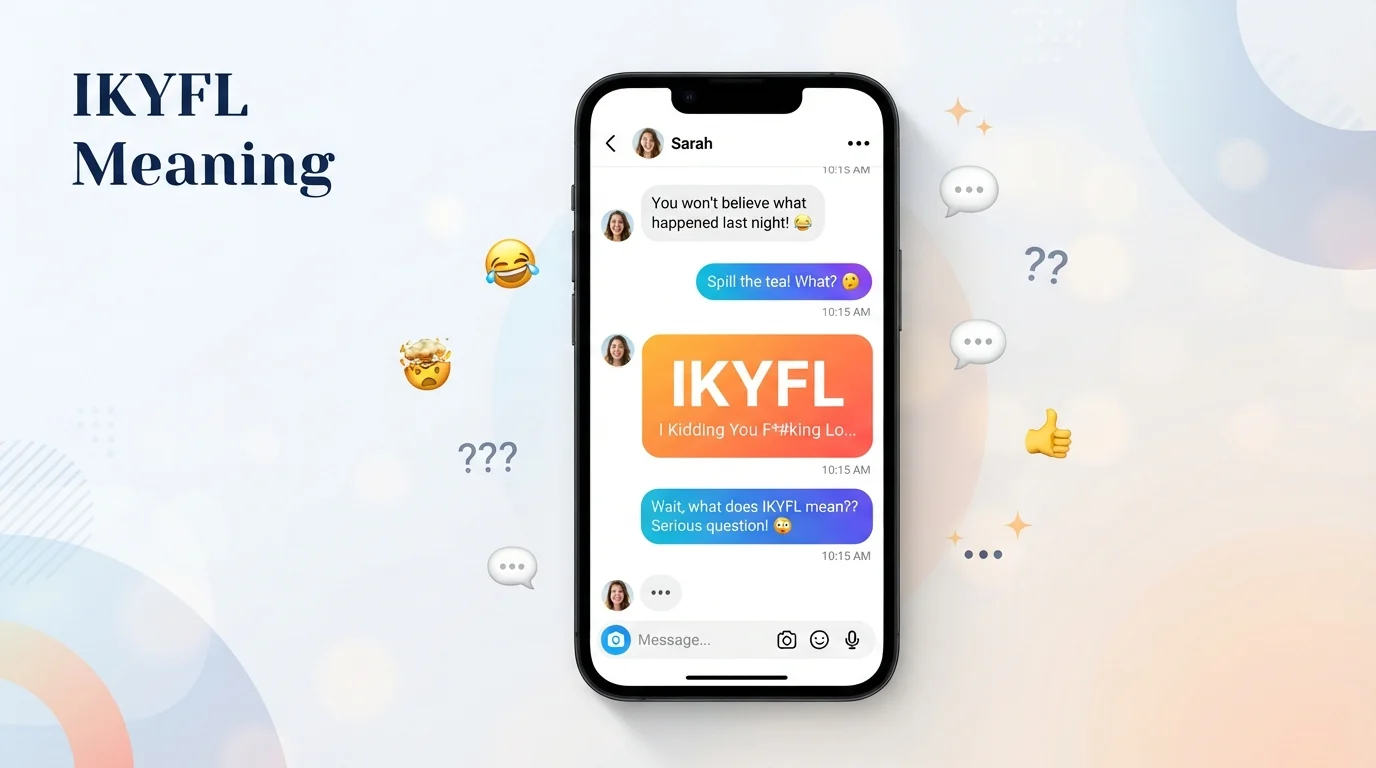
If you have seen IKYFL in a text, TikTok comment, Instagram post, or group chat, you may have wondered what those four letters mean.
IKYFL is not a biblical abbreviation, Hebrew word, Greek word, or Christian phrase. It is modern internet slang. The most common meaning is a profanity-containing version of “I know you’re fing lying”** or “I know you fing lying.”** It is normally used to express strong disbelief or accuse someone of not telling the truth.
Because this article is written from a Christian perspective, there is an important second question: What does the Bible teach about lying, truth, anger, and the way we speak to other people?
The Bible does not define IKYFL itself because the expression is modern. However, Scripture gives Christians clear principles for dealing with dishonesty without allowing anger, insults, or harsh speech to control the conversation.
Quick Answer:

IKYFL usually means “I know you’re f*ing lying.”** It is an informal internet acronym used when someone strongly believes another person is lying, exaggerating, or saying something unbelievable.
Depending on the situation, it can be serious, sarcastic, humorous, or confrontational. It is not a biblical term and contains profanity, so Christians may prefer more respectful alternatives.
Key Takeaways
- IKYFL is internet slang, not a biblical expression.
- Its most common meaning involves accusing someone of lying.
- The tone can range from playful disbelief to serious confrontation.
- Context matters when interpreting the acronym.
- The Bible strongly emphasizes truthfulness.
- Scripture also teaches believers to control angry and harmful speech.
- Christians can confront dishonesty without using profanity or insults.
- Not every accusation of lying is automatically correct.
- Wisdom requires listening, checking facts, and seeking peace.
What Does IKYFL Stand For?
The Common Meaning
The most widely documented meaning of IKYFL is a shortened form of “I know you’re fing lying.”** Some sources phrase it as “I know you fing lying.”** Both communicate essentially the same idea: I strongly believe you are not telling the truth.
The acronym compresses a strong emotional reaction into four letters.
For example:
Person A: “I didn’t eat the last piece of cake.”
Person B: “IKYFL 😂”
Here, the sender may not be making a serious accusation. They could simply be joking because they know the other person probably ate it.
Why the Meaning Can Change With Context
Online slang often depends heavily on tone.
Someone might use IKYFL because they are:
- Seriously accusing someone of lying
- Shocked by a statement
- Playfully teasing a friend
- Reacting to an unbelievable story
- Expressing sarcasm
- Calling out an obvious exaggeration
So the letters themselves do not tell you the entire emotional meaning.
A laughing emoji can make the expression playful. A period or angry message can make it feel much more confrontational.
Is IKYFL a Biblical Word?
No, IKYFL Is Not Found in the Bible
There is no biblical meaning of IKYFL itself.
It does not appear as a word in Scripture, and it is not a Hebrew or Greek biblical term. It developed as internet and texting slang rather than from biblical language.
Therefore, Christians should be careful about claims that IKYFL contains a hidden spiritual or biblical meaning.
There is no sound biblical basis for saying that the acronym itself represents a prophecy, spiritual sign, divine message, or special Christian symbol.
What the Bible Does Say About Its Main Idea
Although Scripture does not discuss the acronym, it discusses the central issue behind it: truth and lying.
The Bible repeatedly calls God’s people to speak truthfully.
Ephesians 4:25 teaches believers to put away falsehood and speak truthfully to one another.
That principle is far more important for a Christian than understanding any particular internet acronym.
What Does the Bible Say About Lying?
God Values Truth
Truth is central to Christian character.
Jesus said:
“I am the way, and the truth, and the life.”
— John 14:6, ESV
Truth is not merely a communication preference in Christianity. It is closely connected with God’s character.
Proverbs 12:22 says that lying lips are an abomination to the LORD, while those who act faithfully are pleasing to Him.
This gives Christians a clear reason to take dishonesty seriously.
Lying Damages Relationships
A lie may appear small at first.
But repeated dishonesty can destroy trust between:
- Friends
- Married couples
- Family members
- Church members
- Coworkers
- Leaders and followers
Once trust is damaged, restoring it may take much longer than telling the truth would have taken.
Christian wisdom therefore does not treat truthfulness as a minor issue.
Christians Are Called to Speak Truthfully
Colossians 3:9 tells believers not to lie to one another.
The Christian goal is not simply to avoid getting caught in a lie. It is to develop a life characterized by honesty.
That means telling the truth even when the truth is uncomfortable.
Does Using IKYFL Conflict With Christian Teaching?
The Acronym Is Not the Main Issue
Simply seeing or understanding IKYFL is not the same as committing the behavior it describes.
The more important question is how a Christian uses language.
If someone uses IKYFL to playfully express surprise among close friends, the context is different from using it to humiliate, curse at, or aggressively attack another person.
Christians should examine both their words and their intentions.
The Profanity Matters
The phrase behind IKYFL contains profanity.
The Bible gives believers principles for avoiding speech that is corrupting, abusive, or inappropriate.
Ephesians 4:29 teaches Christians to use words that build others up rather than tear them down.
That does not mean Christians must avoid every difficult conversation.
It means truth should be communicated in a way that honors God and treats people with dignity.
IKYFL vs. Biblical Communication
| Situation | IKYFL-style response | More Christian response |
|---|---|---|
| Someone appears dishonest | “IKYFL.” | “I don’t think that’s true. Can we talk about it?” |
| A friend makes an unbelievable claim | “IKYFL 😂” | “Wait, seriously?” |
| Someone hurts you with dishonesty | Angry accusation | Calmly explain what you observed |
| You are unsure about the facts | Immediate accusation | Ask questions first |
| A serious conflict occurs | Profanity and insults | Truth, grace, and self-control |
The Christian alternative is not silence.
It is truthful communication without unnecessary hostility.
What Should a Christian Do When Someone Is Lying?
1. Make Sure You Know the Facts
Before accusing someone of lying, slow down.
You may have misunderstood the situation.
Proverbs 18:13 warns against answering a matter before hearing it fully.
This is especially important online, where short messages can easily be misunderstood.
2. Ask Questions
Instead of immediately saying, “You’re lying,” consider asking:
- “Can you explain what happened?”
- “Help me understand this.”
- “I remember it differently. Can we talk about it?”
- “Are you sure that’s what happened?”
- “Can you clarify what you meant?”
Questions can uncover the truth without unnecessarily escalating conflict.
3. Speak the Truth Clearly
Christian kindness does not require pretending that falsehood is acceptable.
Jesus taught His followers to deal honestly with one another.
You can say:
“I care about you, but I don’t believe that explanation is accurate.”
That statement is firm without being abusive.
4. Control Your Anger
Ephesians 4:26 says:
“Be angry and do not sin.”
Being upset about dishonesty does not automatically make you sinful.
The danger comes when anger controls your actions.
A person can be correct about the lie and still respond wrongly.
5. Seek Restoration When Possible
If someone has lied to you, ask what outcome you want.
Do you want revenge?
Or do you want truth, accountability, forgiveness, and restoration?
Christian wisdom points toward the second path whenever restoration is possible and safe.
Is It Wrong to Call Someone a Liar?
It Depends on the Situation
The Bible clearly condemns lying, but Christians should not casually label people without sufficient evidence.
There is an important difference between:
“That statement appears to be false.”
and
“You are a liar.”
The first addresses a specific claim.
The second makes a broader judgment about a person’s character.
Wisdom considers evidence, circumstances, motives, and the possibility of misunderstanding.
Jesus Took Truth Seriously
Jesus did not ignore hypocrisy or dishonesty.
At the same time, Christians are instructed to examine themselves rather than becoming obsessed with the faults of others.
Matthew 7:3–5 teaches this through the memorable picture of the speck and the log.
The lesson is not that Christians should never confront wrongdoing.
It is that confrontation should begin with humility.
What Does IKYFL Mean in Texting?
In texting, IKYFL usually communicates something like:
“I don’t believe you.”
The profanity adds emotional force.
For example:
“You seriously finished the entire pizza?”
Someone might respond:
“IKYFL 😂”
Here, the expression could simply mean:
“I can’t believe you actually did that!”
The context makes it less like a serious accusation and more like playful disbelief.
What Does IKYFL Mean on TikTok and Instagram?
On TikTok
IKYFL can appear in comments, captions, or conversations as a reaction to surprising or unbelievable content.
The meaning remains closely connected to disbelief.
On Instagram
People may use it under posts, reels, or in direct messages.
Again, it can be serious or humorous depending on the surrounding conversation.
On Other Social Platforms
The acronym can function as a quick reaction.
Because written communication does not include facial expressions or voice tone, emojis and surrounding words often help reveal whether the sender is joking or genuinely angry.
Are There Other Meanings of IKYFL?
Less Common Interpretations Exist
Some acronym databases list alternative expansions, including meanings unrelated to lying. One documented alternative is “I know you feel like.”
However, these meanings are considerably less common.
If you encounter IKYFL, context should determine the interpretation rather than assuming every possible expansion applies.
The Safest Interpretation
In ordinary social-media and texting contexts, the lying-related meaning is the one most commonly documented.
If the conversation does not make sense under that interpretation, ask the sender what they meant.
Biblical Lessons Behind the Conversation

Truth Matters
The first lesson is simple:
God cares about truth.
Christians should not become comfortable with deception simply because dishonesty is common in modern culture.
Words Matter
The Bible treats speech as morally significant.
Proverbs repeatedly connects wise speech with righteousness and foolish speech with destruction.
Our words can heal or wound.
Motives Matter
Two people can use similar words with completely different hearts.
One may be joking.
Another may be trying to humiliate someone.
Christian maturity means examining not only what we say but also why we say it.
Self-Control Matters
Galatians 5:22–23 lists self-control among the fruit associated with the Holy Spirit.
A Christian response to dishonesty should not be driven entirely by emotional impulse.
Sometimes the strongest response is a calm one.
What the Bible Does NOT Say About IKYFL
It is important not to put words into Scripture.
The Bible does not say:
- IKYFL has a secret biblical code.
- IKYFL is a prophetic sign.
- IKYFL is a Hebrew biblical acronym.
- Seeing IKYFL means God is sending you a message.
- Every use of IKYFL is spiritually significant.
- Christians must interpret internet slang as divine revelation.
These claims would go beyond what Scripture actually teaches.
The wise approach is to distinguish what the Bible says from modern interpretations people may attach to ordinary slang.
Christian Alternatives to IKYFL
If you want to express disbelief without profanity, try:
- “I don’t believe you.”
- “Are you serious?”
- “Really?”
- “That doesn’t sound right.”
- “I think something is missing from that story.”
- “Can you explain?”
- “I’m having trouble believing that.”
- “Let’s talk about what actually happened.”
- “I don’t think that’s accurate.”
- “Please be honest with me.”
These expressions allow you to communicate skepticism while keeping the conversation more respectful.
A Simple Christian Response to Dishonesty
When you believe someone has lied, remember this four-step pattern:
| Step | Christian Principle | Practical Action |
| 1 | Pause | Do not react immediately |
| 2 | Verify | Make sure you understand the facts |
| 3 | Speak | Address the problem truthfully |
| 4 | Restore | Seek peace and accountability when possible |
This approach protects you from two opposite mistakes: ignoring dishonesty and responding to dishonesty with sinful anger.
A Short Prayer for Wisdom and Truth
Prayer
Heavenly Father,
Help me love truth and reject dishonesty. Give me wisdom when I am unsure whether someone is being truthful. Help me control my anger and choose words that honor You.
When I need to confront something wrong, give me courage to speak honestly and grace to speak with love. Keep me from making unfair accusations, and help me forgive when forgiveness is appropriate.
Teach me to let my words reflect the character of Christ.
In Jesus’ name, amen.
FAQs:
What does IKYFL mean?
IKYFL most commonly means “I know you’re f*ing lying”** or a closely related wording. It is internet slang used to express disbelief or accuse someone of lying.
Is IKYFL a Christian word?
No. IKYFL is not a Christian or biblical term. It is modern internet slang.
Is IKYFL found in the Bible?
No. The acronym does not appear in the Bible and has no established Hebrew or Greek biblical meaning.
What does IKYFL mean in texting?
In texting, IKYFL usually communicates strong disbelief, often meaning that the sender thinks the other person is lying or exaggerating.
Is IKYFL always serious?
No. It can be serious, sarcastic, humorous, or playful. Context, relationship, punctuation, and emojis can affect its tone.
Should Christians use IKYFL?
Christians should consider whether the language and attitude behind the expression reflect biblical principles of wholesome, gracious, and self-controlled speech. Because the phrase contains profanity and can sound accusatory, a respectful alternative may be wiser.
What does the Bible say about lying?
The Bible consistently teaches that God’s people should reject falsehood and speak truthfully. Proverbs 12:22, Ephesians 4:25, and Colossians 3:9 are relevant passages.
What should I say instead of IKYFL?
You could say, “I don’t believe you,” “Can you explain?” or “That doesn’t sound right.” These communicate doubt without profanity.
Can Christians confront people who lie?
Yes. Christianity does not require believers to ignore dishonesty. However, confrontation should be truthful, wise, self-controlled, and aimed at a good outcome rather than revenge.
Does seeing IKYFL have a spiritual meaning?
Not by itself. There is no biblical basis for treating this internet acronym as a supernatural sign or divine message.
Conclusion:
IKYFL usually means “I know you’re f*ing lying.”** It is a modern internet expression used to communicate disbelief, skepticism, or an accusation that someone is not telling the truth.
For Christians, however, the more meaningful question is not simply what the acronym means.
It is how we respond when we believe someone is being dishonest.
Scripture calls believers to truth, wisdom, self-control, grace, and words that build others up. You do not have to ignore dishonesty, but you also do not have to answer dishonesty with profanity or uncontrolled anger.
When truth is needed, speak truth.
*When clarification is needed, ask questions.
When correction is necessary, be courageous.
And when emotions rise, remember that a Christian response should reflect Christ—not merely the intensity of the moment.
Truth and grace can belong in the same conversation.

I’m Chris Robert, a writer at NameFluxo who explores the deeper meanings behind biblical names, words, dreams, and spiritual symbols. I enjoy turning Bible-based insights into clear, simple, and meaningful articles that help readers understand their faith and Scripture better.